The Enigmatic Depiction of Everyday Moments
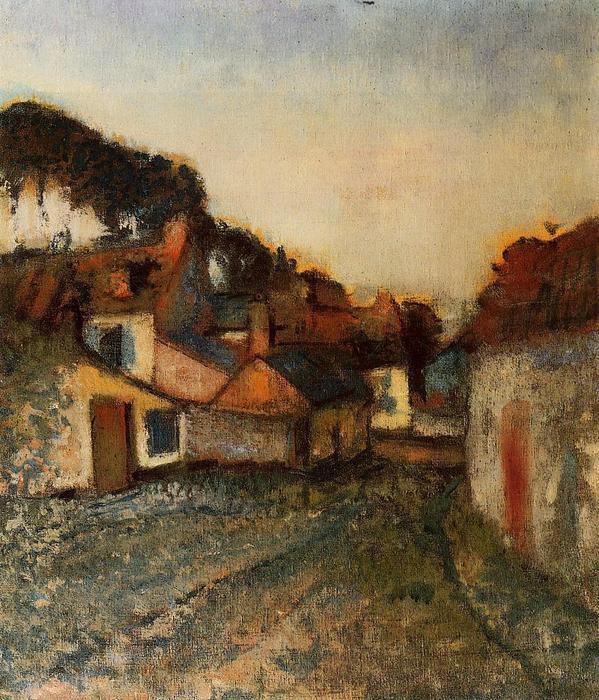
Edgar Degas’s Village Street (circa 1896-1898) isn't merely a landscape; it’s a carefully constructed tableau vivant, a fleeting moment captured with the artist’s signature blend of realism and Impressionistic brushwork. This oil on canvas transports us to a quiet corner of rural France, a scene brimming with understated beauty and a poignant sense of timelessness. Degas, often categorized as a Realist despite his close association with the Impressionists, masterfully avoids grand gestures or dramatic narratives, instead focusing on the subtle details that define everyday life – the worn dirt road, the modest houses, the purposeful strides of the villagers. The painting’s power lies not in its overt subject matter but in its ability to evoke a feeling of serenity and invite the viewer into this intimate world.
Degas's choice of composition is deliberate. He employs a slightly elevated perspective, as if observing the scene from a nearby bench or doorway, creating a sense of intimacy and drawing us directly into the heart of the village. The diagonal lines of the road and the buildings guide our eye through the scene, while the figures – walking men, women carrying baskets, and the horses tethered near the center – are rendered with remarkable sensitivity to movement and gesture. Notice how Degas doesn’t attempt to capture a single, static image; instead, he conveys the impression of a continuous flow, suggesting that this is just one moment in an ongoing rhythm of village life.
Impressionism Meets Realist Observation
Village Street exemplifies Degas's unique artistic approach – a synthesis of Impressionistic techniques and a deeply rooted commitment to realism. While he embraced the Impressionists’ focus on capturing fleeting light and atmosphere, he retained a meticulous attention to detail and a rigorous study of anatomy and perspective, hallmarks of his Realist training. The loose, broken brushstrokes characteristic of Impressionism are evident in the depiction of the sky, the buildings, and even the figures, creating a shimmering effect that suggests movement and luminosity. Yet, these strokes are grounded in a solid understanding of form and structure, ensuring that the scene remains visually coherent and believable.
Degas’s use of color is equally nuanced. He employs a muted palette dominated by earthy tones – browns, ochres, greens, and blues – to create a sense of warmth and tranquility. The subtle variations in hue and tone suggest the play of light on different surfaces, adding depth and realism to the scene. The artist’s masterful control over color allows him to evoke not just the appearance of the village but also its atmosphere—a feeling of quiet contentment and connection to the land.
A Window into Degas's World & Legacy
Born in Paris in 1834, Edgar Degas’s artistic journey was shaped by a complex interplay of influences. Initially drawn to history painting under the guidance of Ingres, he eventually embraced Impressionism while retaining his rigorous training and observational skills. His work reflects a fascination with modern life, particularly the world of ballet dancers, which he captured with unparalleled insight and dynamism. Village Street offers a glimpse into another facet of Degas’s artistic vision – his interest in depicting the everyday lives of ordinary people.
Degas's paintings are celebrated in prestigious museums worldwide, including the Metropolitan Museum of Art in New York City and the Art Gallery of Ontario in Toronto. His legacy extends far beyond the Impressionist movement; he is recognized as one of the most innovative and influential artists of the 19th century. For those seeking to delve deeper into Degas’s oeuvre or explore the broader context of Impressionism, resources like Wikipedia (Wikipedia's page on Edgar Degas) and online art databases offer invaluable insights.
ArtsDot offers exquisite hand-painted reproductions of Village Street, allowing you to bring this captivating artwork into your home or office. Each reproduction is created by skilled artists using the same techniques and materials as the original, ensuring that you receive a faithful representation of Degas’s masterpiece.
Explore more of Degas's works on ArtsDot.com and discover the beauty and depth of this timeless painting.