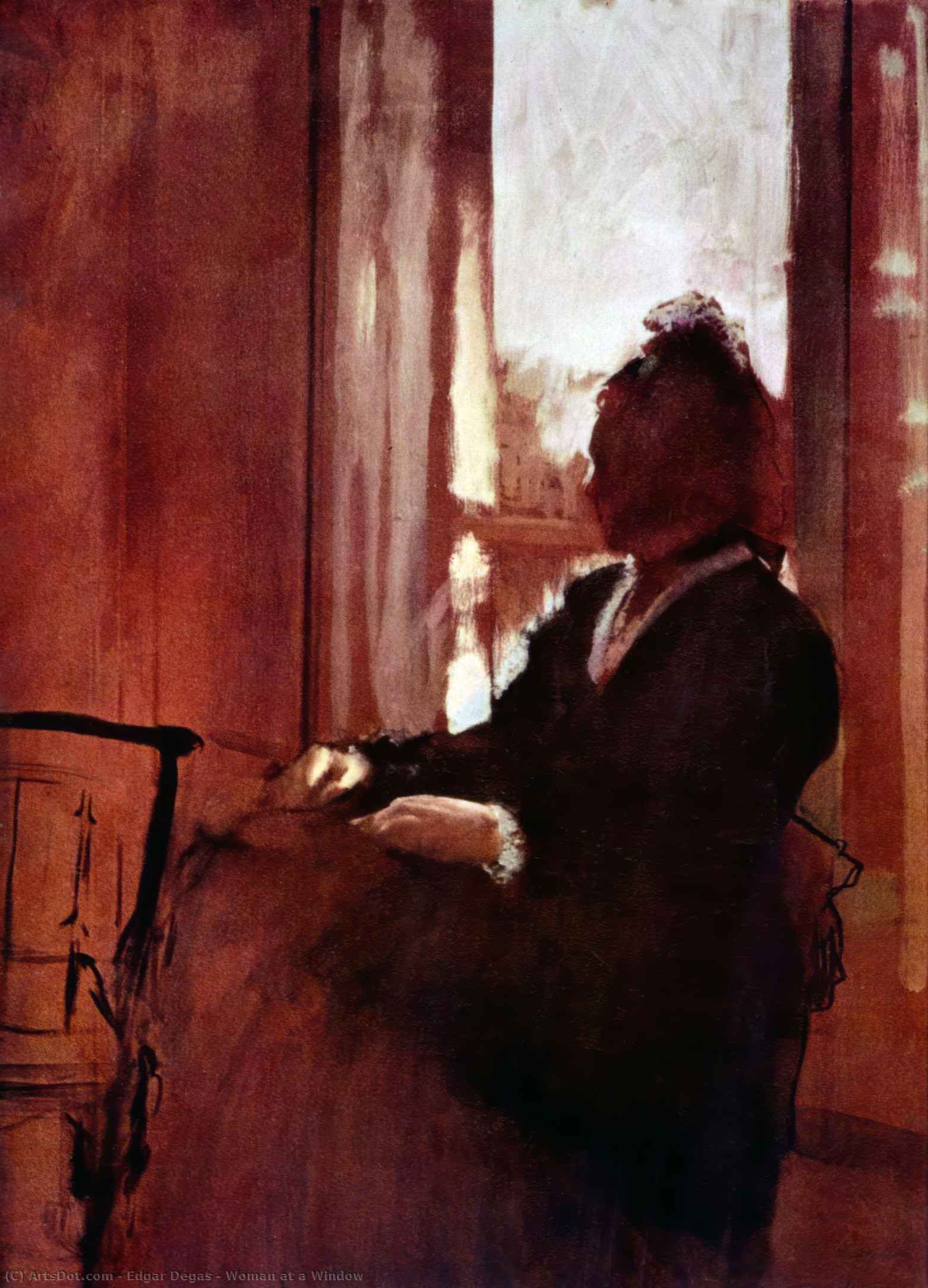
The Enigmatic Gaze: Unpacking Degas’s ‘Woman at a Window’
Edgar Degas's “Woman at a Window,” painted in 1872, is more than just a depiction of a figure observing the world outside; it’s a masterful exploration of light, reflection, and the quiet contemplation of the human spirit. This oil on cardboard artwork, measuring 61 x 45 cm, exemplifies Degas's signature Impressionist style – a deliberate rejection of academic formality in favor of capturing fleeting moments and subjective experiences. The painting immediately draws the viewer into a scene of serene yet subtly unsettling intimacy, inviting us to consider what lies beyond that windowpane.
At first glance, the composition appears deceptively simple: a woman, partially obscured by her back, sits bathed in the diffused light streaming through a large window. The room behind her is sparsely furnished – two chairs and a bench suggesting a private space, yet retaining an air of understated elegance. However, Degas’s genius lies not in literal representation but in his manipulation of atmosphere and visual cues. The central placement of the window isn't merely decorative; it acts as a portal, both physically and emotionally, connecting the interior world with the vibrant activity outside.
Light, Shadow, and the Dance of Reflection
Degas’s command of light is nothing short of extraordinary. The bright, natural light flooding through the window creates a dramatic contrast with the darker interior, lending depth and dimensionality to the scene. This interplay of light and shadow isn't simply about illumination; it’s a key element in establishing mood and directing the viewer’s eye. Crucially, Degas utilizes the reflective surface of the glass to create an almost mirrored image of the woman herself, subtly blurring the boundaries between observer and observed. This technique, characteristic of Impressionism, emphasizes the ephemeral nature of perception – how our own reflections shape our understanding of reality.
The brushwork further enhances this effect. Degas employs short, broken strokes—a hallmark of his style—to suggest texture and movement without resorting to detailed rendering. Notice how he uses these tiny brushstrokes to capture the delicate folds of the woman’s dress and the subtle variations in color across the windowpane. This technique creates a sense of immediacy and vitality, as if we are witnessing the painting's creation unfold before our eyes.
A Glimpse into Degas’s World: Context and Symbolism
“Woman at a Window” was painted during a tumultuous period in French history – the siege of Paris by Prussian forces. While this historical context adds another layer of interpretation, it's important to note that Degas himself resisted categorization as an “Impressionist,” preferring to describe his work as “realist.” Walter Sickert, a fellow artist and friend who owned the painting, recounted a rather intriguing anecdote: the model was paid with a hunk of raw meat, which she devoured immediately. This detail offers a glimpse into the realities of life in 19th-century Paris and subtly underscores the painting’s themes of hunger, isolation, and perhaps even vulnerability.
Beyond its historical context, “Woman at a Window” can be interpreted as a meditation on introspection and the human condition. The woman's posture – her back turned to the viewer – invites us to project our own thoughts and feelings onto her figure. Is she lost in thought? Yearning for something beyond her immediate surroundings? The painting’s ambiguity is precisely what makes it so compelling, prompting viewers to engage with it on a deeply personal level.
Bringing Degas Home: A High-Quality Reproduction
ArtsDot offers meticulously crafted hand-painted reproductions of “Woman at a Window,” allowing you to bring this iconic masterpiece into your own space. Our skilled artists replicate Degas’s delicate brushwork, vibrant colors, and atmospheric effects with exceptional precision. Whether you're an art collector, interior designer, or simply someone who appreciates the beauty of Impressionism, our reproduction provides a stunning and authentic representation of this timeless work. Explore our collection today and discover the perfect way to experience the enigmatic gaze of “Woman at a Window.”