A Portrait of Domestic Labor: Exploring Edgar Degas’s Woman Ironing
Edgar Degas stands as a cornerstone of Impressionism, yet his artistic vision extended far beyond merely capturing fleeting moments of light. He possessed an unwavering fascination with the everyday realities of human existence—particularly the lives of women engaged in domestic tasks—and Woman Ironing embodies this dedication to portraying life with remarkable precision and empathy.
Painted in 1869, this oil on canvas masterpiece—measuring 80 x 63 cm—holds a prominent place within the Neue Pinakothek in Munich, Germany—one of the oldest galleries globally—and houses a significant collection of European paintings from the 18th to the 19th century. Its presence there underscores its enduring importance within art history.
The Scene: Capturing Routine and Emotion
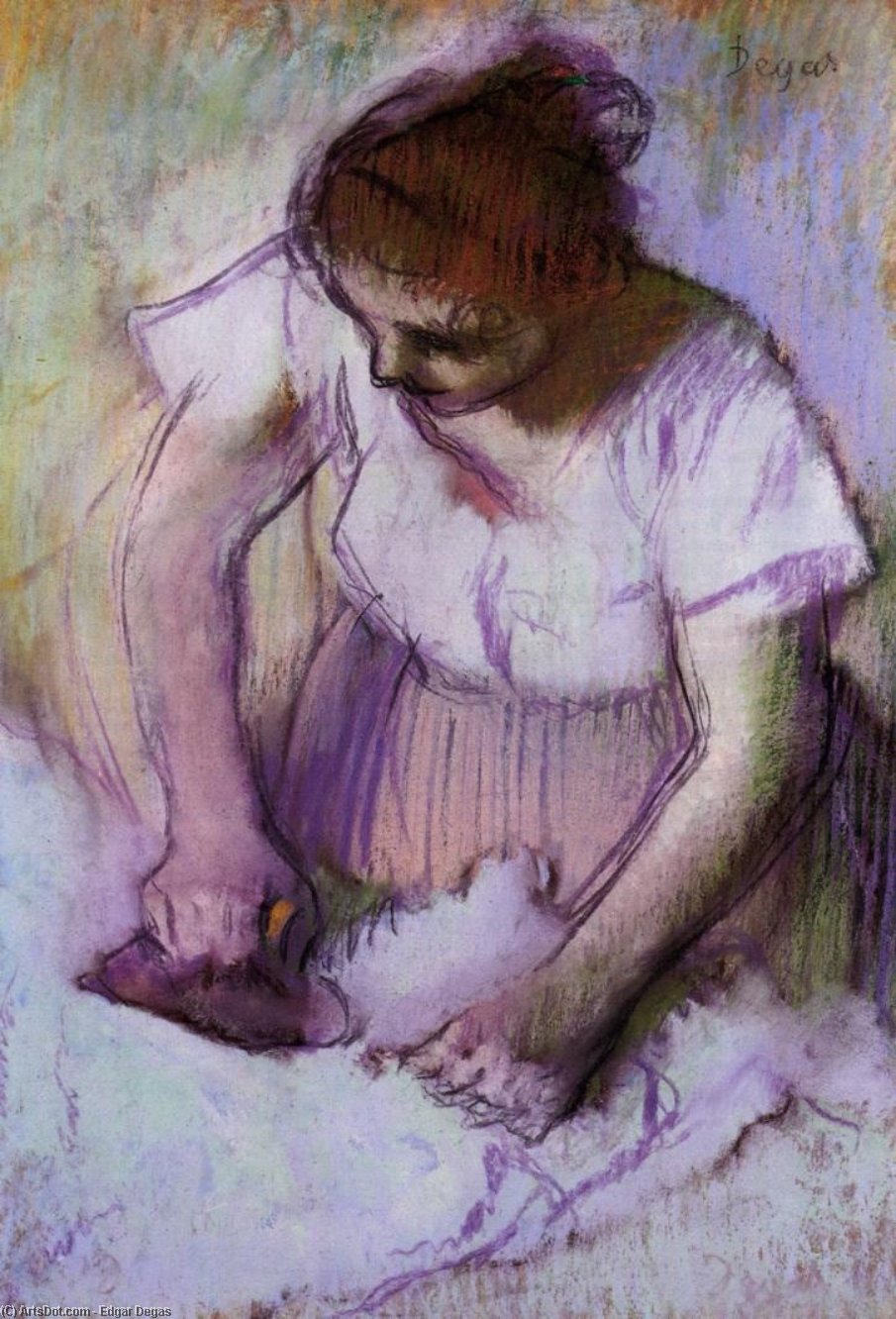
Degas’s Woman Ironing depicts a solitary woman absorbed in her chore—pressing clothes with focused determination. The composition is deliberately understated, eschewing grand gestures or dramatic lighting to convey the quiet dignity of domestic life. She wears a simple white dress, reflecting the muted palette characteristic of Impressionism and emphasizing the subject's vulnerability.
Around her are scattered garments—a shirt and trousers—suggesting the cyclical nature of daily tasks. A chair positioned nearby reinforces this sense of stillness and routine, inviting contemplation on the commonplace moments that constitute human experience. The artist’s meticulous attention to detail—the folds of fabric, the posture of the woman, the subtle nuances of light—elevates a seemingly mundane activity into an artistic statement.
Artistic Style: Impressionist Technique
Degas's approach aligns perfectly with Impressionism’s core principles. Like Monet and Renoir, he prioritized capturing the effects of light and color on canvas using oil paint—a medium that allowed for rich textures and vibrant hues. The brushstrokes are loose and visible, eschewing academic smoothness in favor of conveying immediacy and spontaneity.
Furthermore, Degas skillfully utilizes chiaroscuro—the interplay between light and shadow—to sculpt the woman’s form and imbue the scene with emotional depth. This technique enhances realism while simultaneously hinting at the psychological state of the subject—her concentration, her weariness, and perhaps even a hint of melancholy.
Historical Context: Domestic Life in Victorian France
Woman Ironing emerged during a pivotal period in French history—the Victorian era—characterized by strict social conventions and evolving perceptions of femininity. Degas’s depiction reflects the realities faced by women at the time, who bore the brunt of household responsibilities while striving for independence.
The painting's inclusion within the Neue Pinakothek underscores its significance as a document of its era—a testament to Degas’s ability to transform ordinary life into enduring art.
Related Works and Artistic Legacy
Degas's fascination with women engaged in domestic activities extended beyond Woman Ironing. He created several other paintings exploring similar themes, including Woman Ironing and Laundresses Carrying Linen in Town—each offering a nuanced portrayal of female experience.
His influence on subsequent artists is undeniable, shaping movements like Neoimpressionism and paving the way for explorations of realism and psychological depth. Woman Ironing remains an iconic image—a poignant reminder of Degas’s unwavering commitment to capturing the beauty and complexity of everyday life.