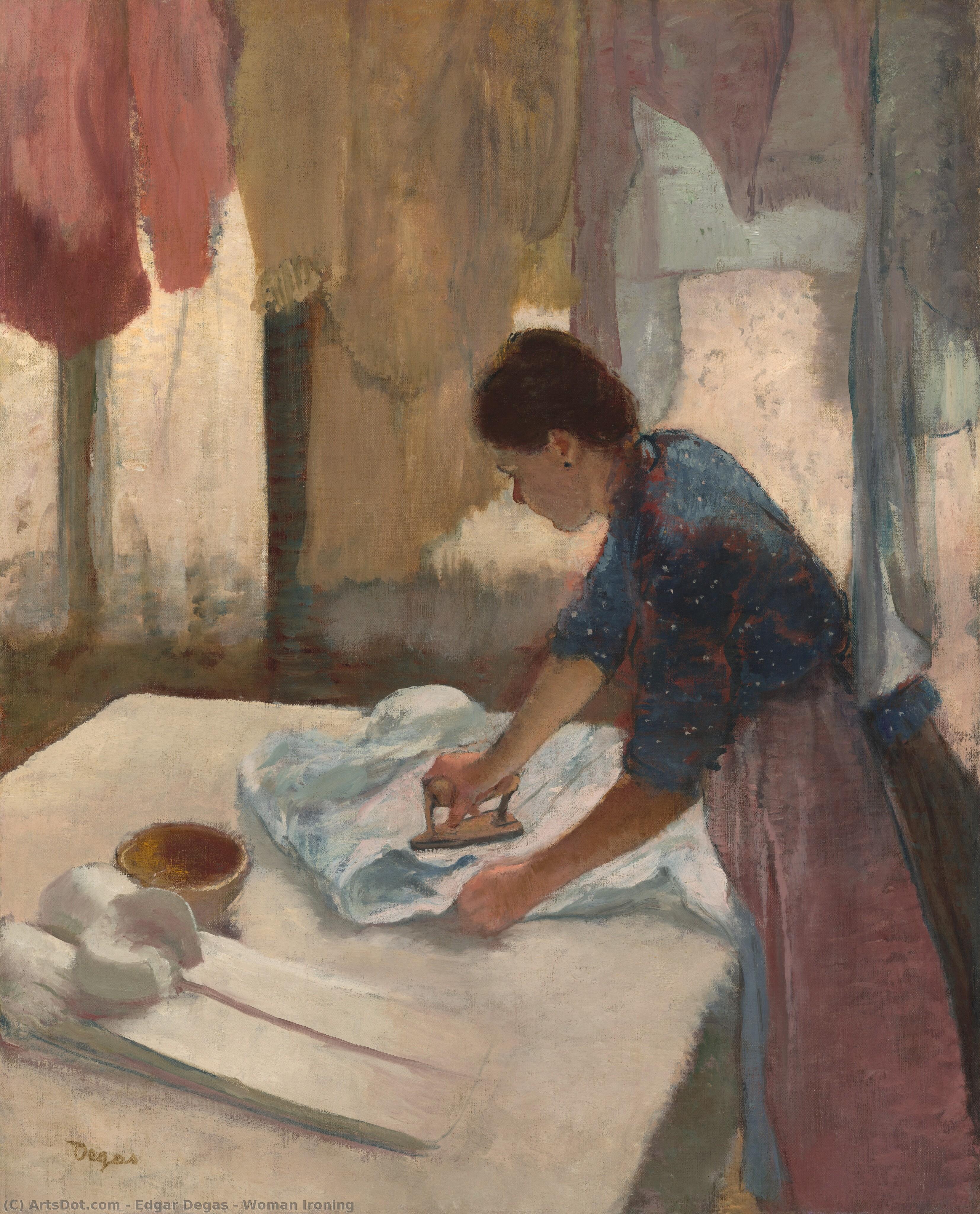
A Moment Frozen in Domestic Tranquility: Examining Degas’s “Woman Ironing”
The painting "Woman Ironing" by Edgar Degas, completed in 1887, transcends mere depiction; it captures a fleeting glimpse into the everyday life of Parisian women during Impressionism's golden age. More than just an observation of domestic labor—though undeniably significant—the artwork speaks to themes of quiet dignity, meticulous detail, and the subtle beauty found within seemingly mundane activities. Degas’s refusal to categorize himself as an Impressionist is telling, highlighting his dedication to realism while simultaneously employing techniques that elevate the scene beyond a simple snapshot. He wasn't interested in capturing fleeting impressions of light; instead, he sought to convey a palpable sense of presence and emotion through careful brushwork and compositional choices.
- Subject Matter: The painting portrays Madame Léopoldine Bouvier, a dressmaker who posed for Degas repeatedly during his ballet studies. This wasn’t simply a commission; it was an exploration of the female figure—particularly women engaged in work—a subject that resonated deeply with Degas's artistic sensibilities.
- Style & Technique: Degas’s style is characterized by loose, broken brushstrokes – a hallmark of Impressionism – yet he avoids the hazy diffusion favored by Monet and Renoir. Instead, he employs a technique that emphasizes texture and form, meticulously rendering the folds of fabric and the contours of Madame Bouvier's body with remarkable precision.
Historical Context: The Ballet Dancer’s Studio and Beyond
Degas’s fascination with ballet stemmed from his belief in its transformative power—both physically and aesthetically. He spent years documenting the rehearsals and performances of dancers at the Paris Opera Ballet, capturing not just their movements but also the atmosphere of the studio itself. “Woman Ironing” reflects this preoccupation with observation and documentation, mirroring the broader artistic impulse to portray life as it truly is, rather than idealizing it. The painting emerged during a period of significant social change in France, where women were increasingly entering the workforce and challenging traditional gender roles. Degas’s depiction of Madame Bouvier subtly acknowledges these shifts while simultaneously celebrating the quiet resilience and dignity of women performing essential tasks.
Symbolism & Composition: Light, Texture, and Gesture
The painting's composition is deliberately understated yet powerfully evocative. The vertical arrangement emphasizes Madame Bouvier’s stature and reinforces the sense of stillness within the room. The diffused light filtering through the windows contributes to a hazy atmosphere—a technique Degas adopted to heighten emotional impact—but it also serves to soften the harshness of reality, creating an illusion of tranquility. Notice the careful placement of objects – the bowl and shirt – which are rendered with meticulous detail, mirroring Degas’s obsession with capturing texture and form. The woman's posture conveys a sense of focused concentration, highlighting her inner life amidst the outward activity of ironing.
Emotional Impact: Quiet Beauty and Human Connection
Ultimately, “Woman Ironing” succeeds in conveying a profound emotional resonance. It’s not a grand narrative or dramatic gesture; rather, it's an intimate portrait that invites contemplation on themes of labor, domesticity, and the beauty found within everyday life. Degas captures a moment frozen in time—a woman performing a simple task with grace and determination—and transforms it into something extraordinary. The painting speaks to our shared humanity, reminding us that even the most ordinary activities can hold moments of profound significance.