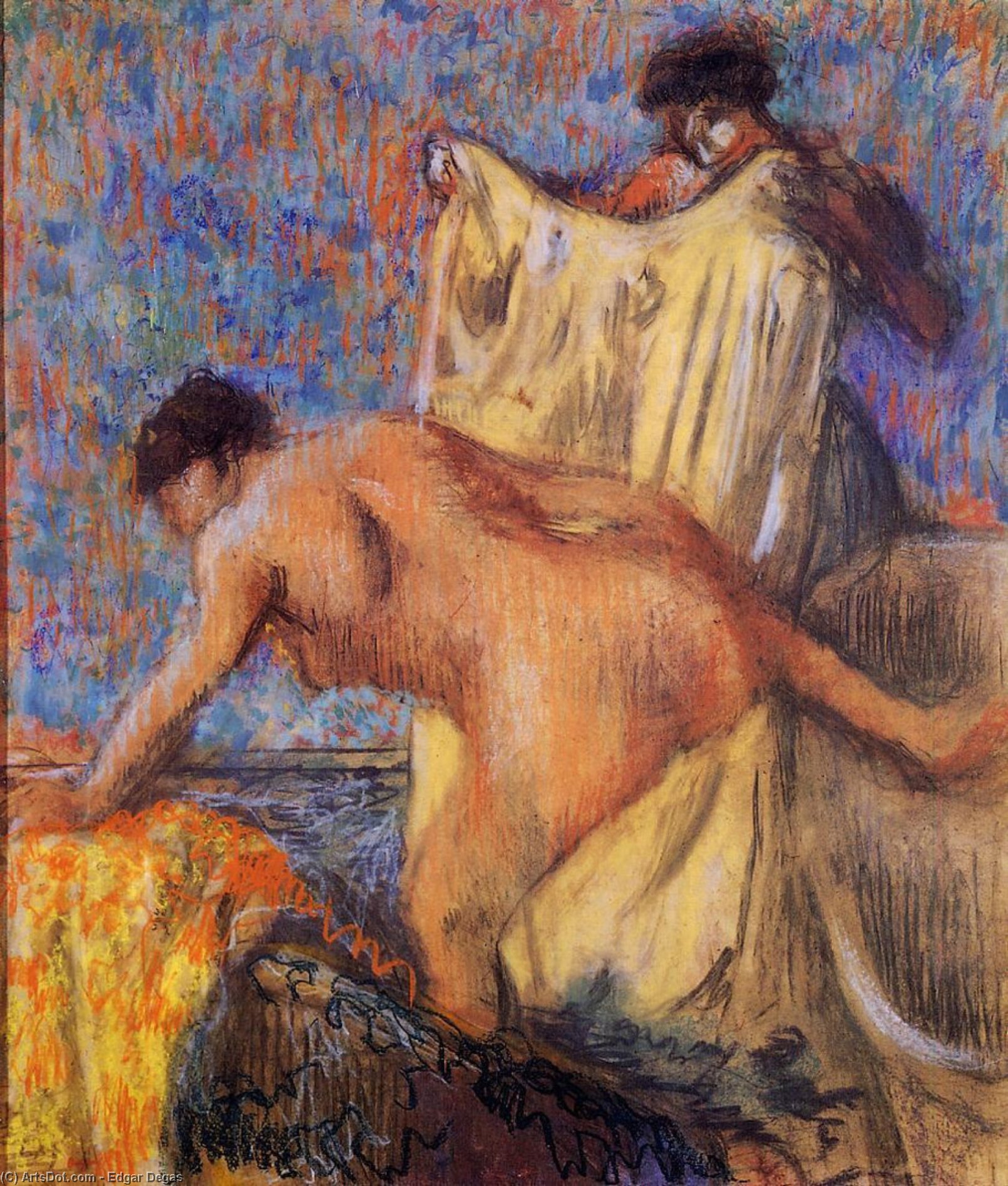
Captured in vibrant pastel hues by Edgar Degas during Impressionism’s golden age, ‘Woman Leaving Her Bath’ portrays two women with remarkable realism and dynamism—a captivating glimpse into everyday life that invites you to explore this iconic masterpiece.
Edgar Degas: A revolutionary French artist known for his captivating ballet dancers, Parisian scenes, and innovative techniques—a true master of modern art.
A Moment Frozen in Pastel Light – Edgar Degas’s Woman Leaving Her Bath
The pastel drawing “Woman Leaving Her Bath,” completed by Edgar Degas in 1877, stands as a testament to the artist's singular vision—a blend of Impressionistic observation and Realist precision that captures not just an image but also a palpable sense of atmosphere. More than simply depicting a scene from daily life, Degas’s work delves into themes of vulnerability, movement, and the quiet dignity of human experience.
The Scene Unfolds: Composition and Observation
Measuring 23 x 31 cm, this artwork showcases Degas's masterful ability to distill complex realities onto a relatively small canvas. Two women dominate the foreground; one nude, bathed in soft pastel hues, embodies an arresting stillness amidst the bustle of activity. Beside her stands another woman, dressed modestly and clutching a towel, preparing to depart – a gesture laden with unspoken emotion. The background is populated by figures engaged in various tasks—preparing towels, observing the scene—creating a dynamic tableau that reflects the vibrant energy of a Parisian bathhouse. Degas’s meticulous attention to detail isn't merely decorative; it underscores his belief that art should strive for an honest representation of the world as he perceived it.
Impressionism Revisited: Style and Technique
Degas famously resisted categorization, rejecting the “Impressionist” label championed by his peers. However, his artistic sensibilities undeniably align with the movement’s core principles—namely, capturing fleeting impressions of light and color. Unlike traditional oil paintings that aim for photorealistic accuracy, pastel allows Degas to achieve a luminous quality unattainable through other mediums. He skillfully employs hatching and blending techniques to build up tonal variations, creating textures that mimic the softness of skin and fabric. The subtle shifts in hue contribute significantly to the painting’s overall mood—a serene contemplation juxtaposed with the anticipation of departure.
Echoes of Daumier: Influences Beyond Impressionism
Degas's artistic trajectory was profoundly shaped by influences outside the Impressionist circle, notably Honoré Daumier, a fellow Parisian artist known for his satirical caricatures. Like Daumier, Degas sought to portray contemporary life with unflinching honesty and social commentary. This commitment is evident in the painting’s depiction of ordinary women—a deliberate departure from idealized representations prevalent in academic art. The artist's fascination with ballet dancers – exemplified by “Dancers in the Old Opera House” – further demonstrates his preoccupation with movement and performance, mirroring Daumier’s exploration of social dynamics through visual satire.
Symbolism Beneath Surface Calm
Beyond its immediate visual appeal lies a deeper symbolic resonance. The nude woman represents vulnerability and exposure—a poignant reminder of human fragility within the larger context of society. Simultaneously, her posture conveys resilience and grace as she prepares to leave – suggesting an acceptance of life’s inevitable transitions. The pastel medium itself contributes to this emotional impact; its delicate texture evokes feelings of tenderness and intimacy, mirroring the quiet contemplation inherent in the scene.
A Legacy of Quiet Observation
“Woman Leaving Her Bath” remains a captivating masterpiece because it embodies Degas's unwavering dedication to capturing the essence of human experience with remarkable sensitivity. It’s a painting that invites viewers to linger on its surface beauty while pondering the profound themes it conveys—a testament to the enduring power of observation and artistic expression.