A Vision of Antiquity: The Allure of Hubert Robert’s Architectural Reverie
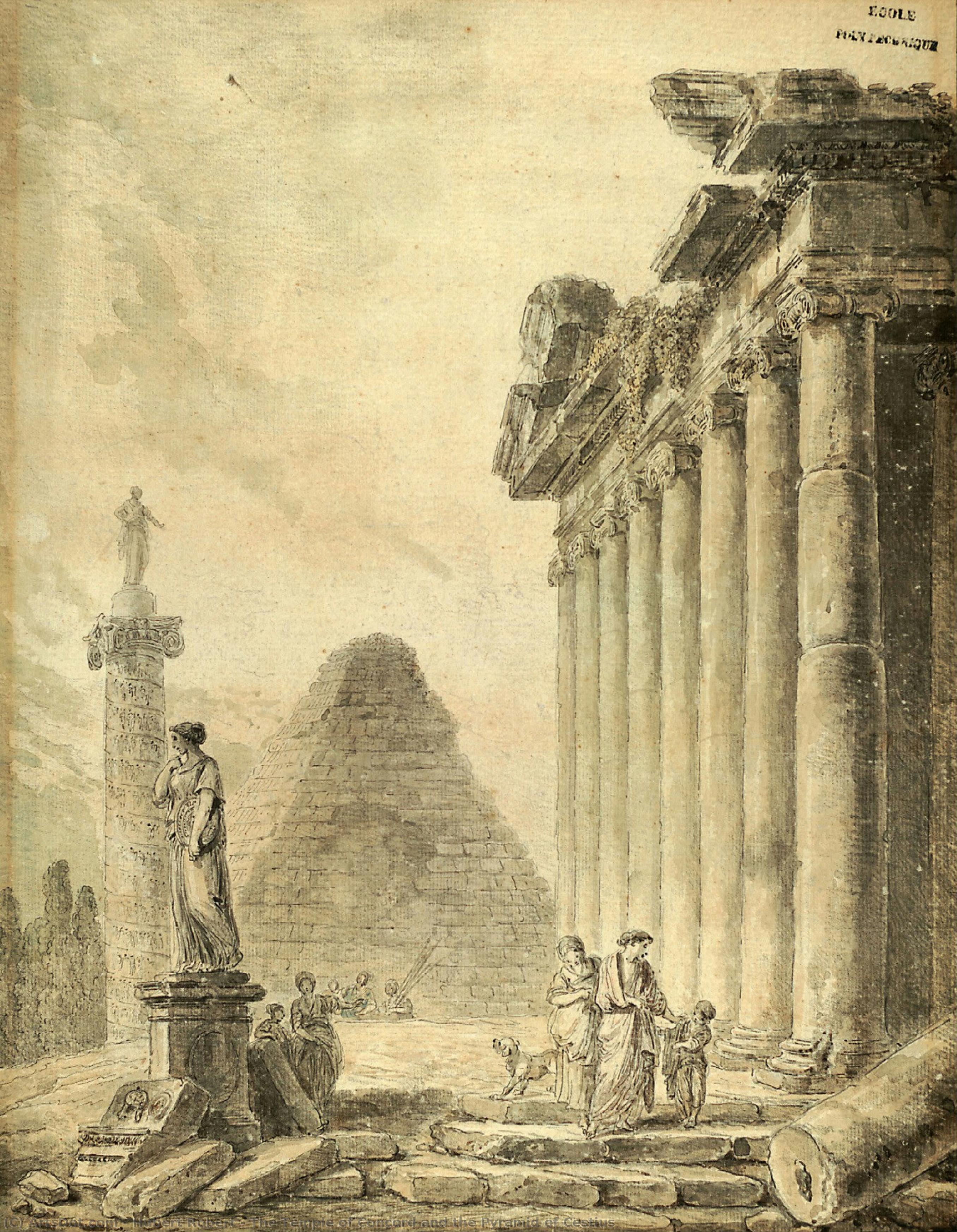
In this evocative 1774 drawing, the master of ruins, Hubert Robert, invites us into a world where the grandeur of ancient Rome meets the quiet intimacy of a fleeting moment. The Temple of Concord and the Pyramid of Cestius is not merely a topographical record but a profound meditation on the passage of time and the enduring spirit of classical architecture. Through his delicate hand, the artist captures the monumental scale of Roman structures, juxtaposing the heavy, weathered stone of the temple and the stark geometry of the pyramid against the fragile, transient presence of living beings. The composition breathes with an atmospheric stillness, drawing the viewer into a space where history feels both immense and intimately accessible.
The technical mastery displayed in this work lies in its subtle use of light and shadow, even within the monochromatic constraints of a drawing. Robert employs a sophisticated interplay of tones to define the textures of crumbling masonry and the soft silhouettes of figures scattered throughout the scene. The presence of small, seemingly incidental details—a dog resting near a traveler, birds drifting through the sky, and a solitary bench—serves to ground the monumental architecture in a sense of lived reality. These elements act as memento mori, reminding us that while empires fall and monuments decay, the simple rhythms of life continue to unfold amidst the wreckage of greatness.
For the discerning collector or interior designer, this piece offers a sophisticated focal point that embodies the essence of Neoclassical elegance. The artwork’s ability to evoke nostalgia and wonder makes it an ideal addition to spaces designed for contemplation, such as a private library, a formal study, or a grand hallway. Its monochromatic palette provides a timeless versatility, allowing it to integrate seamlessly into both traditional and contemporary settings. A high-quality reproduction of this work does more than decorate a wall; it introduces a narrative of historical depth and intellectual curiosity, transforming a room into a sanctuary of classical thought and romantic beauty.
To possess such a work is to hold a fragment of the 18th-century imagination. Robert’s unique ability to blend capriccio—the whimsical invention of imaginary landscapes—with historical accuracy creates an emotional resonance that transcends time. This drawing serves as a window into a period when the ruins of the past were viewed not as mere debris, but as poetic reminders of human ambition and the inevitable cycle of nature. It is a piece that invites endless scrutiny, rewarding the eye with new layers of detail and emotion upon every viewing.