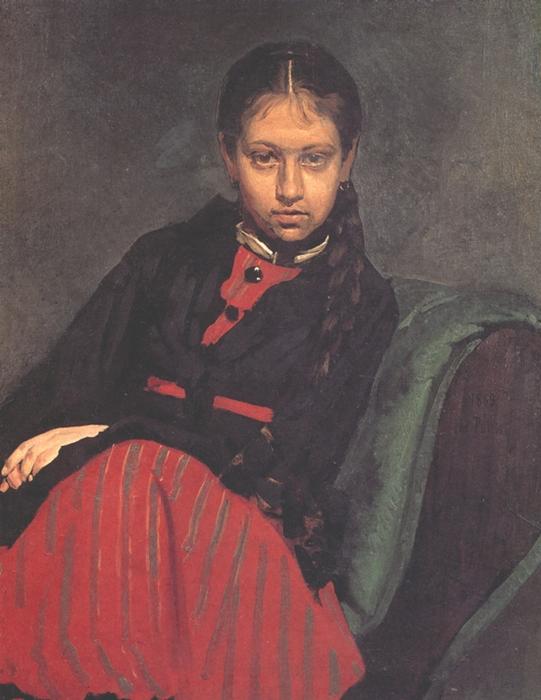
The
Portrait of Vera Shevtsova is a stunning oil on canvas painting created by the renowned Russian artist
Ilya Yefimovich Repin in 1869. This beautiful piece measures 83 x 67 cm and is a prime example of
Realism, a style that Repin was known to excel in. The painting is available for viewing at the
Vladikavkaz Art Museum, Russia, which is located in the capital city of North Ossetia-Alania, Russia.
The Painting's Composition and Style
The
Portrait of Vera Shevtsova is a captivating portrait of a woman with long hair, wearing a black dress and red scarf. She appears to be sitting on a chair, possibly in a relaxed or contemplative pose. The woman's expression seems somewhat serious as she looks directly at the viewer. In addition to the main subject, there are two other people visible in the painting - one person is located near the top left corner and another person can be seen on the right side of the image. These individuals appear to be in the background or periphery of the scene.
Realism is a key element in Repin's work, and the
Portrait of Vera Shevtsova is no exception. The painting's attention to detail and use of color create a sense of depth and dimensionality, drawing the viewer into the scene. For more information on Repin's style and other works, visit
Ilya Yefimovich Repin at ArtsDot.com.
Some of Repin's notable works include
Job and His Friends,
Send off of recruit, and
Ivan the Terrible and His Son Ivan on November 16, 1581. These paintings showcase Repin's skill in capturing historical scenes and his ability to convey emotion through his subjects. For more information on these paintings, visit
Job and His Friends,
Send off of recruit, and
Ivan the Terrible and His Son Ivan on November 16, 1581 at ArtsDot.com.
- The Vladikavkaz Art Museum, Russia is home to a diverse collection of Russian art, including works by Repin.
- Repin's use of Realism in his paintings creates a sense of authenticity and draws the viewer into the scene.
- The Portrait of Vera Shevtsova is a beautiful example of Repin's skill in capturing the human form and conveying emotion through his subjects.