Ishibashi Kazunori’s Preparatory Sketch: A Bridge Between Worlds
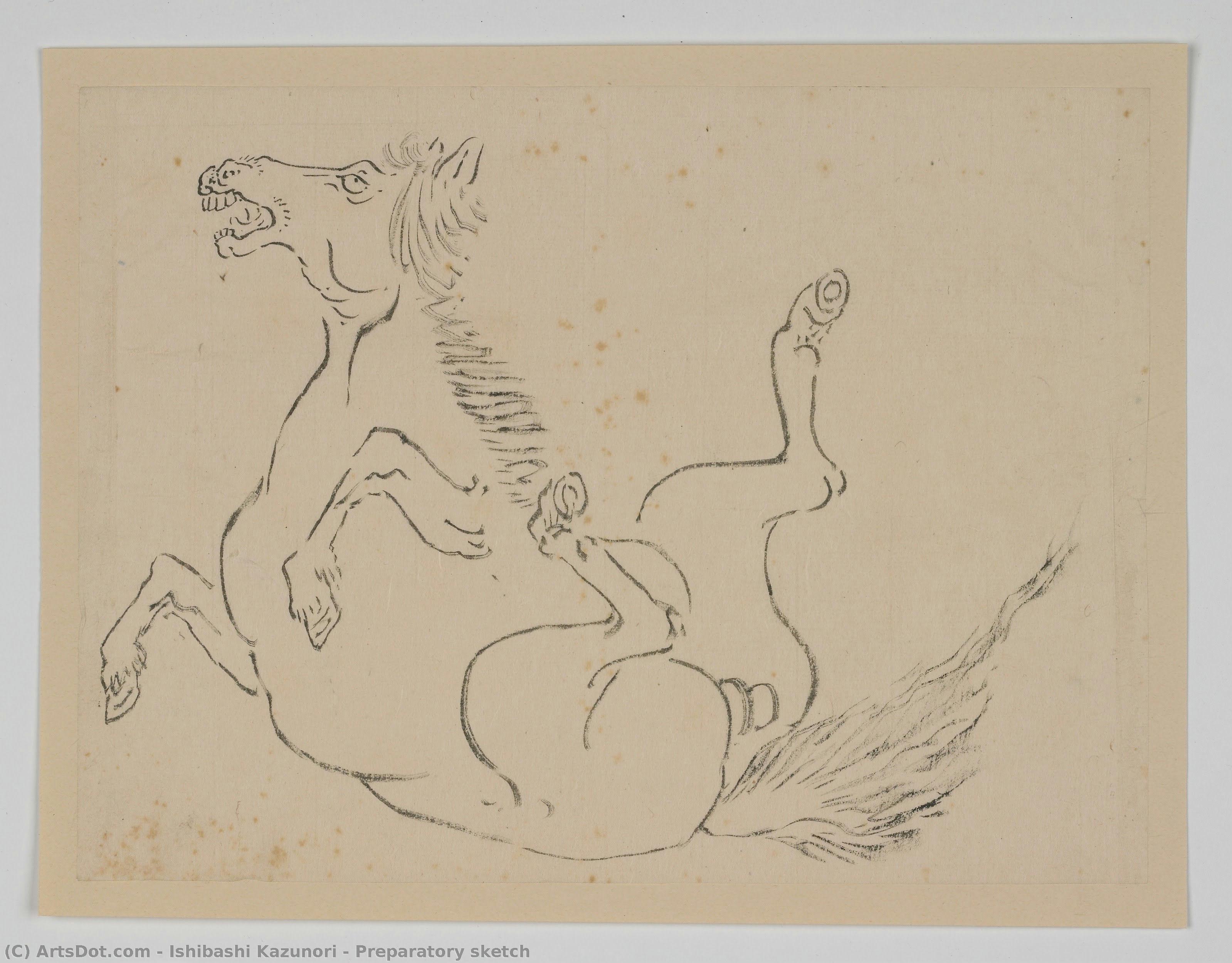
The image before you isn't merely a drawing; it’s a window into the mind of Ishibashi Kazunori, a pivotal figure bridging the vibrant currents of late 19th and early 20th-century Japanese art. This preparatory sketch, rendered in delicate black ink on aged paper, offers a glimpse behind the scenes of a master's creative process – a study brimming with potential, hinting at a larger, more fully realized work. It’s a testament to Ishibashi’s unique vision: a synthesis of traditional Japanese aesthetics and the burgeoning influence of Western painting techniques, a harmonious blend that defined his distinctive style.
Born in 1876 and tragically passing away in 1928, Ishibashi's journey was one of constant exploration. Initially immersed in the rigorous traditions of Nihonga – Japanese-style painting – he soon found himself captivated by Yōga, or Western art. This pivotal shift led him to England, where he studied at the Royal Academy Schools and absorbed the techniques of European masters. Yet, he never abandoned his roots; instead, he skillfully wove elements of both styles into a profoundly personal artistic language. The sketch itself embodies this duality – the loose, expressive lines reminiscent of Nihonga’s emphasis on gesture and atmosphere, juxtaposed with a careful observation of form and composition characteristic of Yōga.
A Study in Horses: Form and Movement
The primary subject of this sketch is undeniably horses. Two magnificent animals dominate the composition, rendered with remarkable sensitivity and an acute understanding of anatomy. The central horse, its mouth open in a gesture that could be interpreted as surprise, relaxation, or even vulnerability, commands immediate attention. Its form is captured with confident, yet fluid lines – a testament to Ishibashi’s ability to convey both power and grace. The smaller horses flanking it suggest a larger scene, perhaps a pasture or a stable, inviting the viewer's imagination to complete the narrative.
Notice the deliberate looseness of the linework. This isn’t a finished product; rather, it’s a preliminary study, brimming with potential energy. The lines aren’t meticulously defined but instead suggest movement and dynamism. Ishibashi wasn’t striving for photographic realism; he was capturing the *essence* of the horses – their spirit, their posture, their relationship to one another. The subtle shading, achieved through varying line weights and tonal values, adds depth and volume without resorting to precise rendering.
Color, Light, and Composition: A Monochromatic Symphony
The monochrome palette—a range of grays against a light beige or cream-colored paper—is crucial to the sketch’s impact. By eschewing color, Ishibashi forces us to focus on form, line, and composition. The absence of vibrant hues amplifies the sense of atmosphere and creates a mood of quiet contemplation. The lighting is flat and even, suggesting an ambient light source – perhaps natural daylight diffused through a window.
Compositionally, the sketch is remarkably balanced. The horses are arranged in a way that draws the eye across the page, creating a sense of visual rhythm. The human figure, positioned near the center-left, provides context and anchors the scene within a narrative framework. The use of overlapping forms – the larger horse partially obscuring the smaller ones – adds depth and spatial complexity to the composition.
Symbolism and Emotional Resonance
While the sketch itself doesn’t overtly convey symbolic meaning, the open-mouthed horse evokes a powerful emotional response. It could be interpreted as an expression of surprise, curiosity, or even vulnerability. The overall impression is one of observation and exploration – a moment captured in time before being transformed into a more fully realized work. Ishibashi wasn’t simply depicting horses; he was capturing their essence, their spirit, and the quiet beauty of the natural world.
Further Exploration & Reproduction
This preparatory sketch offers a fascinating glimpse into the creative process of Ishibashi Kazunori, a truly remarkable artist. Resources like the British Museum’s collection (link provided) and online databases offer further insights into his life and work. Consider commissioning a high-quality hand-painted reproduction to bring this evocative image into your home or office – a beautiful reminder of the power of art to transport us to another time and place.