The Serene Descent: Jacopo Bellini’s Dormition of the Virgin
Within the hushed reverence of the Louvre’s galleries resides a masterpiece that transcends mere representation – Jacopo Bellini’s “Dormition of the Virgin,” painted circa 1450. More than simply a depiction of Mary's passing, it is a profound meditation on faith, loss, and the enduring power of divine grace, rendered with an astonishingly modern sensibility for its time. Bellini, a pivotal figure in bridging the gap between Byzantine tradition and the burgeoning Renaissance style of Venice, doesn’t offer a dramatic, overtly emotional scene; instead, he presents a quietly dignified tableau that invites contemplation and imbues the viewer with a sense of profound peace.
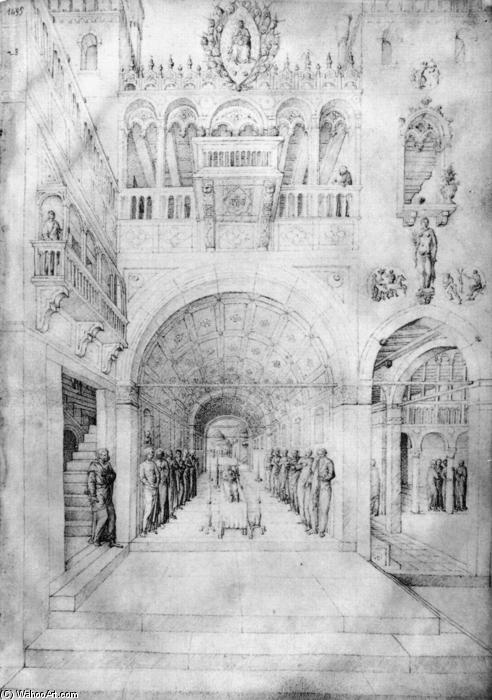
Bellini's genius lay not just in his technical skill – evidenced by the meticulous detail of the architectural setting and the subtly rendered drapery – but also in his innovative approach to perspective. He was one of the first Venetian artists to truly embrace linear perspective, a technique previously largely absent from their vibrant, decorative style. This is particularly evident in the receding arches and columns of the vast interior, creating an illusion of depth that draws the eye into the heart of the composition: the central archway leading to another chamber, hinting at an infinite expanse beyond the visible space. The use of hatching and cross-hatching skillfully builds volume and texture, transforming the smooth surfaces of stone and fabric into tangible forms.
A Renaissance Vision in Byzantine Echoes
The painting’s setting is a masterful synthesis of influences. While firmly rooted in the conventions of Byzantine iconography – particularly the depiction of Mary as a serene, almost ethereal figure – Bellini incorporates elements characteristic of the early Renaissance. The architectural details, reminiscent of Venetian palazzi and churches, are rendered with a precision that reflects the humanist interest in classical forms and spatial reasoning. The figures themselves, though modeled after Byzantine prototypes, possess a greater sense of naturalism and volume than their predecessors. This careful balance between tradition and innovation is what makes Bellini’s work so compelling – it feels both familiar and strikingly new.
Bellini's training likely involved studying the works of Gentile da Fabriano, whose influence can be seen in the richness of color and decorative elements. However, he quickly surpassed his teacher, developing a more independent style characterized by a profound understanding of light, shadow, and spatial relationships. The subdued palette – dominated by shades of gray and brown – contributes to the painting’s atmosphere of solemnity and reverence. The lighting is diffused, casting gentle shadows that define forms without creating harsh contrasts, further enhancing the sense of tranquility.
Symbolism and Spiritual Resonance
Beyond its technical brilliance, “Dormition of the Virgin” is rich in symbolic meaning. The central archway can be interpreted as a metaphor for the passage from earthly life to heavenly realms, while the figures clustered around Mary’s body represent the grieving apostles and disciples. The statue on the right side of the composition – a stylized representation of the Virgin herself – serves as a focal point, anchoring the scene and emphasizing her role as the Mother of God. The overall effect is one of profound spiritual resonance, inviting viewers to contemplate the mysteries of faith and mortality.
Bellini’s sketchbooks, now housed in the British Museum and Louvre, offer invaluable insight into his artistic process and reveal a deep fascination with landscape vistas and architectural designs. These drawings foreshadowed many of the stylistic developments that would characterize the Renaissance, solidifying Bellini's place as one of its foundational innovators. His legacy endures not only through his paintings but also through these meticulously rendered studies, which continue to inspire artists and art lovers alike.
A Timeless Masterpiece for Reflection and Display
“Dormition of the Virgin” is more than just a beautiful painting; it’s a testament to the enduring power of art to evoke emotion, stimulate contemplation, and connect us to something larger than ourselves. Whether displayed in a private collection or a public gallery, this remarkable work offers a profound experience for all who encounter it. Its serene composition, masterful technique, and rich symbolism make it an ideal choice for those seeking a piece that is both visually stunning and intellectually stimulating – a timeless masterpiece worthy of admiration and reverence.