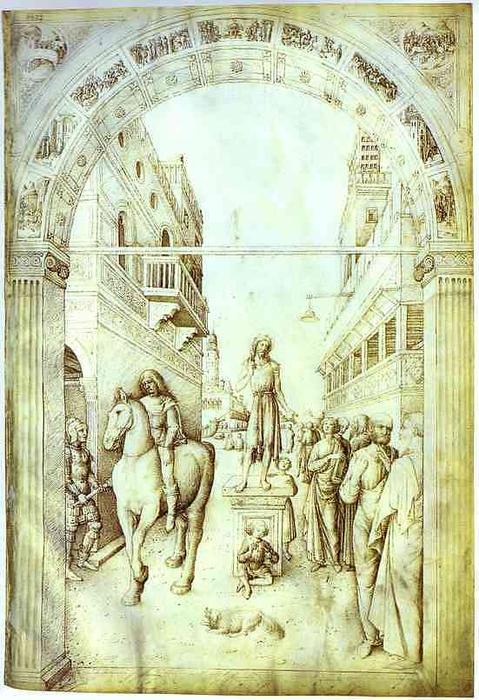
The Echoes of Prophecy: St. John the Baptist Preaching
To gaze upon this depiction of St. John the Baptist preaching is to step directly into the vibrant, yet muted, atmosphere of the early Renaissance city square. The scene arrests the viewer with its profound sense of narrative weight; here stands the prophet, a beacon of truth amidst the bustle of human activity. The composition masterfully draws the eye toward the central figure, elevated upon his pedestal as if by divine decree. One can almost hear the resonance of his voice echoing off the surrounding stone arches and through the throng of onlookers. It is a moment suspended in time—a pivotal sermon that speaks not only to faith but to the enduring human need for guidance.
A Study in Line and Perspective
Technically, this work is a breathtaking testament to meticulous draftsmanship. Executed with what appears to be pen and ink upon aged paper, the artist has employed an astonishing array of fine lines, cross-hatching, and delicate hatching techniques. These linear applications are not mere decoration; they are the very sinews that give form and volume to the scene. Observe how the architectonic elements—the receding buildings framed by the grand archway—are rendered with such acute attention to linear perspective. This masterful illusion of depth pulls the viewer deep into the canvas, suggesting a vast, lived-in urban space. The overall effect is one of scholarly precision, characteristic of the period's burgeoning interest in scientific observation married to divine subject matter.
Historical Resonance and Artistic Lineage
The style whispers of the early Renaissance masters, particularly evoking the spirit of artists like Jacopo Bellini, whose genius lay in pioneering perspective within Venetian art. While the specific hand that created this drawing remains a point of scholarly fascination, its aesthetic DNA is undeniably rooted in that period's quest for naturalism and spatial accuracy. The limited palette—dominated by sepia tones, creams, and browns—lends an air of antiquity, as if the very paper has absorbed centuries of devotion. This monochromatic restraint forces the viewer to concentrate solely on the interplay of light, shadow, and line, elevating the drawing from a mere depiction to a profound study in tonal contrast.
Symbolism and Emotional Depth for the Modern Collector
Beyond its technical brilliance, this piece resonates with deep symbolic power. St. John’s commanding presence symbolizes unwavering moral clarity, while the surrounding crowd represents humanity at various stages of contemplation—some attentive, some merely passing by. For the collector or designer seeking an object imbued with history and gravitas, this reproduction offers more than just decoration; it offers a focal point for reflection. Imagine this piece gracing a library, a study, or a grand hall—its solemnity and intellectual depth provide an immediate sense of cultured contemplation, transforming any space into one worthy of profound thought.