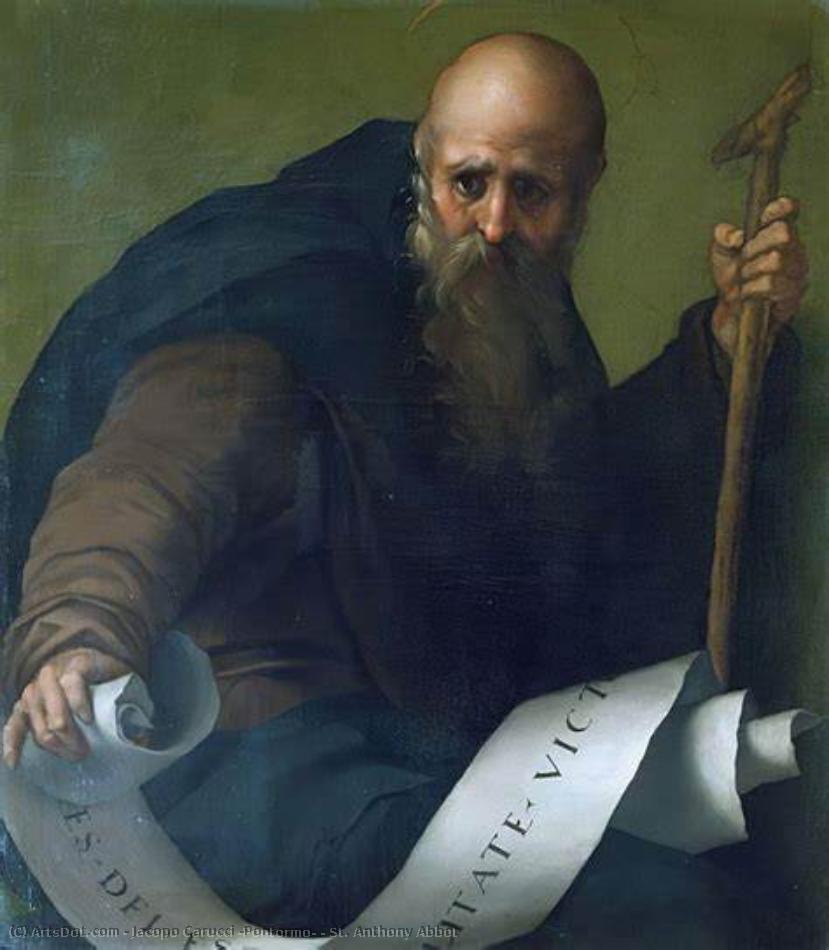
Explore Jacopo Pontormo’s masterpiece – St. Anthony Abbot – a Renaissance portrait imbued with spiritual depth and masterful technique. Discover stunning reproductions at ArtsDot.com.
Discover Jacopo Pontormo (1494-1557), a pivotal Italian Mannerist painter. Explore his emotive figures, vibrant colors, and innovative compositions—a bridge between Renaissance & Baroque art. View reproductions at ArtsDot.
Step into the Renaissance heart of Florence at the Uffizi Gallery! Explore masterpieces by Botticelli, Leonardo da Vinci & Michelangelo – an unforgettable art experience.
A Renaissance Reverie: Jacopo Pontormo’s St. Anthony Abbot
Jacopo Pontormo (1494 – 1557/7), a Florentine maestro, stands as an unforgettable voice within the burgeoning Mannerist movement—a painter who dared to transcend conventional artistic boundaries and forged his own distinctive vision of beauty. Unlike many contemporaries consumed by replicating classical ideals of harmony and proportion, Pontormo embraced emotional intensity and psychological depth, establishing him as a pivotal conduit between the serene grandeur of the High Renaissance and the dramatic dynamism that would soon characterize the Baroque era. His life unfolded amidst both prodigious talent and profound personal sorrow—a poignant duality reflected in his oeuvre, which serves as an enduring testament to artistic conviction tempered by human experience.
Pontormo’s formative years were steeped in the influence of titans like Domenico del Pollaiuolo and Michelangelo Buonarroti—artists whose mastery of anatomical realism and sculptural form irrevocably shaped his stylistic trajectory. These masters instilled within him a meticulous attention to detail, mirroring their unwavering commitment to capturing the essence of human form with unparalleled accuracy. This dedication would become a cornerstone of Pontormo’s artistic philosophy, informing his approach to portraying figures imbued with palpable emotion and psychological complexity—a departure from the idealized representations prevalent during his time.
The Painting Itself: Jacopo Pontormo's depiction of St. Anthony Abbot is a masterful exemplar of Mannerist artistry. Executed in oil on wood around 1519, the canvas exudes an aura of contemplative solemnity, achieved through a deliberate orchestration of color and light. The muted greenish-yellow hue of the background serves as a subtle counterpoint to the luminous figure of St. Anthony Abbot, directing the viewer’s gaze towards his serene countenance. Pontormo skillfully employs chiaroscuro—the dramatic interplay between light and shadow—to sculpt the Abbot's form, creating an illusion of three dimensionality that transcends the limitations of planar representation. The artist’s meticulous rendering of drapery imbues the robe with a tactile quality, conveying both texture and movement, hinting at the Abbot’s ascetic lifestyle.
Symbolism Embedded in Detail: Beyond its aesthetic beauty, Pontormo's painting resonates with profound theological significance. St. Anthony Abbot, revered as the patron saint of penitence and solitude, embodies Christian virtues of humility and devotion. The scroll held aloft by St. Anthony—bearing Latin text proclaiming “EGO SUM LUX MUNDI” (“I am the light of the world”)—references Jesus Christ’s Gospel proclamation and underscores the saint's spiritual mission. This emblem serves as a powerful reminder of divine illumination and moral righteousness, encapsulating the core tenets of Christian faith. Pontormo’s deliberate inclusion of this symbolic element elevates the artwork beyond mere portraiture, transforming it into an evocative meditation on spirituality and enlightenment.
Concluding Reflection: Jacopo Pontormo's St. Anthony Abbot transcends stylistic conventions to deliver a deeply emotive experience for the viewer. It stands as a poignant distillation of Renaissance artistic ideals—characterized by intellectual curiosity, psychological insight, and masterful technique—while simultaneously foreshadowing the expressive fervor that would define the Baroque period. The painting’s enduring appeal lies in its ability to capture not only the physical likeness of St. Anthony Abbot but also his inner essence—a testament to Pontormo's unparalleled artistic vision and a timeless celebration of faith and contemplation.