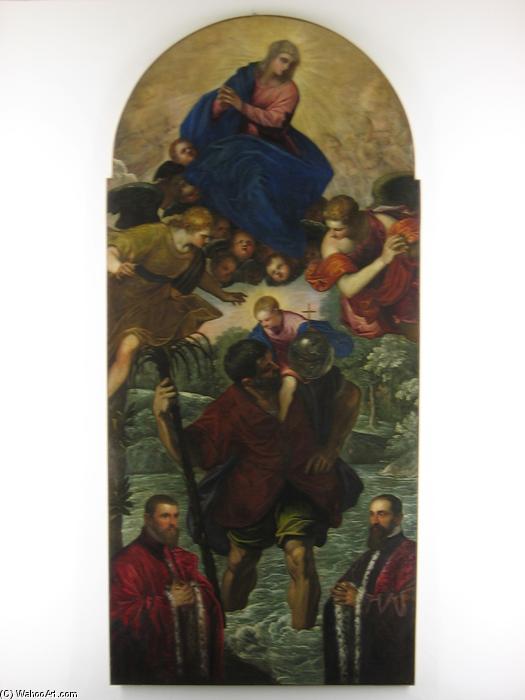
Explore Tintoretto’s ‘St. Christopher,’ a dramatic Baroque masterpiece featuring Christ & angels. Discover rich colors, dynamic lines & spiritual depth in this Venetian icon.
Discover Tintoretto (Jacopo Comin), a Venetian Renaissance master renowned for his dramatic compositions, bold brushwork ('Il Furioso'), and innovative use of light & perspective. Explore iconic works & his lasting legacy!
A Vision of Divine Ascent: Exploring Tintoretto’s “St. Christopher”
This captivating oil painting by Jacopo Robusti, better known as Tintoretto, offers a dramatic glimpse into the Venetian Renaissance's artistic fervor. While the exact date and size remain unknown, the artwork powerfully conveys a sense of spiritual transcendence through its complex composition and masterful technique. The scene centers not on St. Christopher’s famed river crossing, but rather an *Ascension* narrative – likely Christ’s – surrounded by celestial and earthly witnesses.
Style & Historical Context
Tintoretto (1518-1594) was a pivotal figure in the Venetian School of Italian painting, renowned for his dynamic compositions and bold brushwork that earned him the nickname “Il Furioso” (“the Furious”). This piece exemplifies the hallmarks of his style – dramatic lighting, rich color palettes, and an energetic rendering of figures. The work falls within the late Renaissance/Mannerist period, a time when artists began to move away from the strict classical ideals of harmony and proportion towards more expressive and emotionally charged depictions. Venice itself was a unique artistic hub, fostering a style characterized by vibrant colors and a theatrical flair, distinct from the more restrained approaches of Florence or Rome.
Technique & Composition
Tintoretto’s technique is immediately apparent in the visible brushstrokes that lend texture and realism to the canvas. He masterfully employs oil paints to create rich layers of color and depth. The composition, while complex, isn't defined by strict linear perspective; instead, a sense of spatial relationships and layering creates an immersive experience for the viewer. Figures are dynamically arranged – angelic beings ascend towards Christ, while figures resembling St. Peter and St. Paul observe from below, grounding the scene in earthly witness. The use of strong highlights and deep shadows further enhances the dramatic effect, drawing the eye to key focal points within the composition.
Symbolism & Iconography
The painting is replete with symbolic elements common to religious art of the period. Haloes denote divine presence, while palm branches signify victory over death and martyrdom. The ascending figures represent spiritual elevation and the promise of salvation. The very act of depicting Christ’s ascension speaks to themes of faith, hope, and the power of divine grace. While not explicitly depicted, the implied narrative invites contemplation on the mysteries of faith and the relationship between heaven and earth.
Emotional Impact & Interpretation
“St. Christopher” evokes a sense of awe and reverence. The dramatic lighting and dynamic composition create an atmosphere of intense spiritual energy. The painting isn’t merely a depiction of a religious event; it's an invitation to participate in that event, to feel the weight of faith and the promise of redemption. It is a work designed to inspire contemplation and evoke a profound emotional response.
For Collectors & Designers
This artwork – or a high-quality reproduction – would be a stunning addition to any collection, particularly those focused on Renaissance art, religious iconography, or Venetian masters. Its rich colors and dramatic composition make it suitable for a variety of interior design schemes, adding a touch of historical grandeur and spiritual depth to living rooms, libraries, or contemplative spaces. The painting’s scale (though unknown) suggests it was intended for prominent display, making it a statement piece capable of commanding attention and sparking conversation.