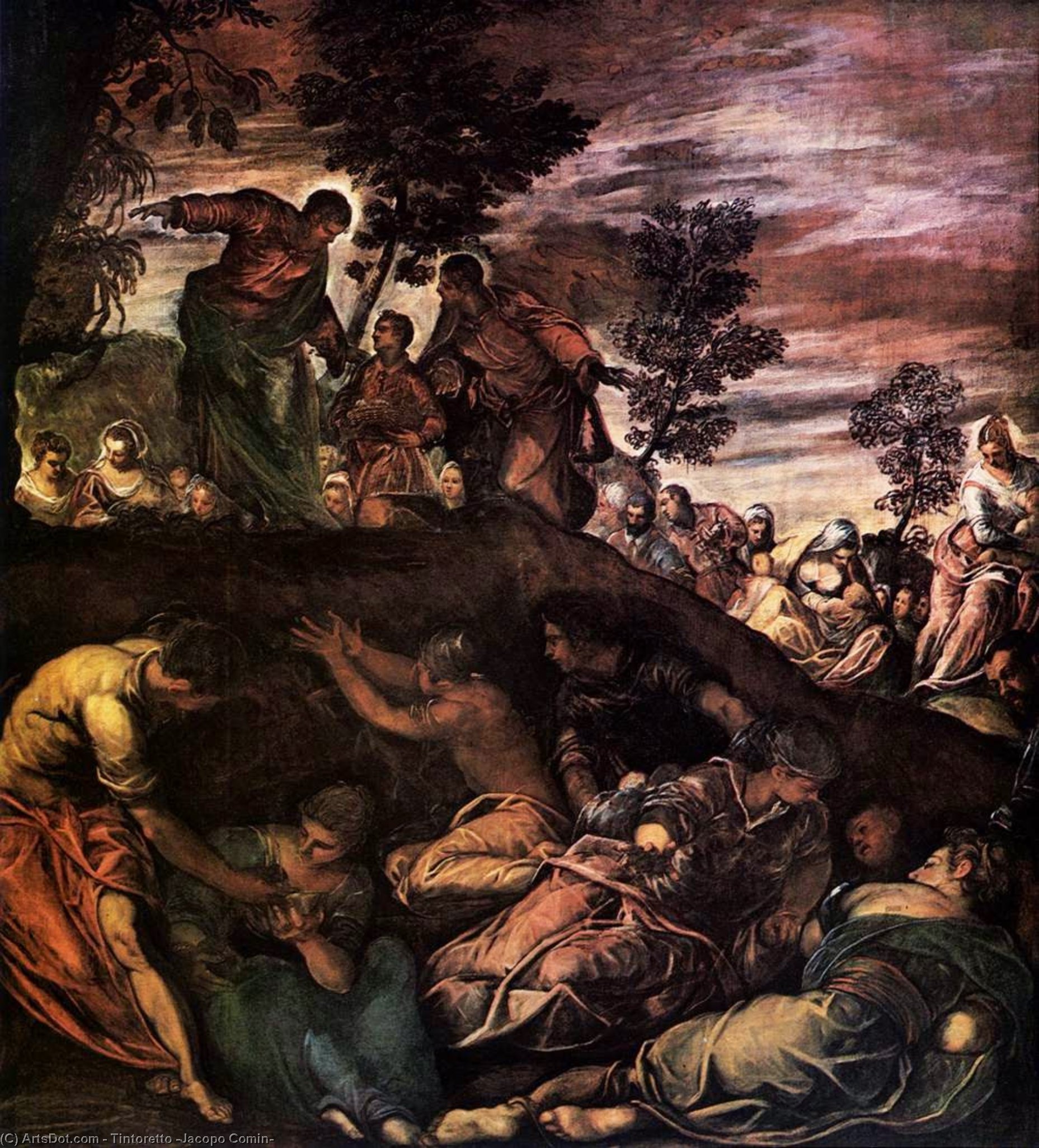
A visceral explosion of color and movement defines Tintoretto's Mannerist masterpiece The Miracle of the Loaves and Fishes, capturing divine intervention with dramatic Venetian energy that you can bring to your collection.
Discover Tintoretto (Jacopo Comin), a Venetian Renaissance master renowned for his dramatic compositions, bold brushwork ('Il Furioso'), and innovative use of light & perspective. Explore iconic works & his lasting legacy!
Discover Tintoretto's breathtaking masterpieces at the Scuola Grande di San Rocco in Venice! Explore dramatic biblical scenes & Venetian art within a stunning historic setting.
A Dramatic Encounter with Faith: Tintoretto’s “The Miracle of the Loaves and Fishes”
Jacopo Tintoretto, born Jacopo Robusti in Venice around 1518, stands as a titan amongst Venetian Renaissance artists—a figure whose restless spirit propelled him beyond stylistic conventions to forge an unparalleled artistic vision. Unlike many contemporaries who honed their craft under established masters like Titian, Tintoretto pursued his artistic education largely independently, driven by an unwavering fascination for observation and experimentation. While accounts suggest a brief but contentious apprenticeship with Titian, the acknowledged luminary of Venetian colorism—a relationship marked by disagreement over stylistic priorities—Tintoretto swiftly distanced himself from this tutelage, embarking on a path defined by audacious innovation and a strikingly dynamic artistic style. He immersed himself in meticulous anatomical studies, meticulously dissecting human form to achieve breathtaking realism within his compositions. This dedication to scientific accuracy wasn’t merely academic; it served as the bedrock for Tintoretto's revolutionary approach to portraying movement and emotion—a cornerstone of his distinctive oeuvre.
The Compositional Genius: Capturing Divine Intervention
Tintoretto’s “The Miracle of the Loaves and Fishes,” housed at the Scuola Grande di San Rocco in Venice, exemplifies this masterful command of visual storytelling. Measuring an impressive 523 x 460 cm, the canvas depicts a pivotal episode from Christian scripture—Jesus miraculously multiplying five loaves of bread and two fish to feed thousands of hungry disciples. The artist’s genius lies not simply in depicting the event itself but in orchestrating its narrative impact with masterful precision. At the heart of the scene stands Jesus Christ, positioned prominently on a hillside, surrounded by his disciples – figures rendered with palpable energy and dynamism. Scattered throughout the composition are individuals kneeling or seated, conveying a profound sense of communal devotion and awe. The backdrop is dominated by stylized trees—a deliberate choice that imbues the painting with naturalistic depth while simultaneously reinforcing its spiritual significance. Tintoretto’s masterful use of chiaroscuro – dramatic contrasts between light and shadow – draws the viewer's gaze directly to Jesus, elevating him as the focal point of divine grace.
A Revolutionary Style: Bold Brushwork and Energetic Light
Tintoretto’s artistic style was characterized by a breathtaking speed—he famously proclaimed “I paint like thunder,” reflecting his ability to execute complex compositions with astonishing rapidity. This remarkable efficiency wasn't achieved through mere haste; it stemmed from an internalized rhythm of thought and action, honed over decades of relentless practice. His contemporaries recognized and debated the merits of Tintoretto’s audacious technique, labeling him "Il Furioso" ("The Furious") – a moniker that accurately captured his rebellious spirit and unwavering commitment to artistic innovation. Unlike many artists who adhered rigidly to established stylistic conventions, Tintoretto deliberately challenged accepted norms, prioritizing expressive force over meticulous detail. His brushstrokes are bold, energetic, and often impasto—thickly applied paint creating textural surfaces that pulsate with vitality. This technique allowed him to convey movement and emotion with unparalleled intensity, capturing the palpable drama of biblical narratives.
Symbolism Rooted in Faith and Hope
Beyond its visual splendor, “The Miracle of the Loaves and Fishes” resonates deeply with theological symbolism. The loaves and fish represent not merely sustenance but also spiritual nourishment—a metaphor for Jesus’s divine provision and his ability to transform ordinary circumstances into extraordinary expressions of faith. The hillside symbolizes ascension – a reference to Christ's triumph over death and eternal life, while the multitude embodies humanity united in devotion and trust. Tintoretto skillfully employs these symbols to communicate profound truths about God’s compassion and benevolence—a message that continues to inspire viewers centuries after its creation.
A Legacy Enduring Through Reproduction
Today, reproductions of Tintoretto's “The Miracle of the Loaves and Fishes” grace homes and galleries worldwide, offering a glimpse into the artistic brilliance of Venice’s Golden Age. ArtsDot.com presents exceptionally detailed prints that faithfully capture the painting’s luminous palette and dramatic composition—allowing art enthusiasts to experience Tintoretto’s visionary style firsthand. Explore this iconic masterpiece and discover its enduring power to evoke contemplation and wonder.