Jacques Stella (1596-1657) was a French classicist painter known for his elegant compositions, religious scenes like the childhood of Christ, and portraits. Influenced by Florentine & Roman art, he served as 'Peintre du Roi' to Louis XIII.
Explore the Louvre Museum in Paris! Home to iconic masterpieces like the Mona Lisa & Venus de Milo, journey through art history from ancient Egypt to Renaissance icons. Plan your visit today!
Clelie Passant Le Tibre: A Florentine Echo in Parisian Elegance
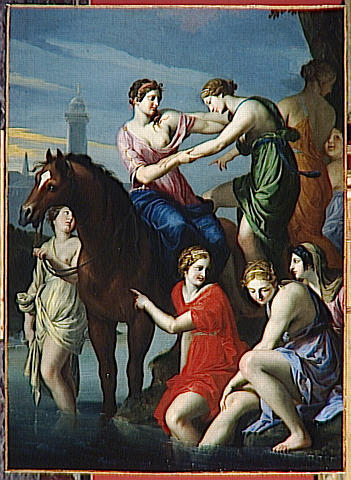
Jacques de Stella’s “Clelie Passant Le Tibre” transcends mere visual representation; it embodies the spirit of Renaissance Florence transplanted into the burgeoning artistic landscape of Paris. Painted circa 1630, this monumental canvas captures a scene brimming with classical allusion and imbued with an understated grandeur that speaks volumes about its creator's mastery. The artwork depicts Clelie Passant Le Tibre – a figure from Virgil’s Aeneid – traversing a riverbank adorned with lush foliage and populated by elegantly draped nude figures engaged in contemplative repose. This juxtaposition of mythological narrative and humanist observation exemplifies Stella’s signature style, blending the meticulous precision of Florentine disegno with the expressive warmth characteristic of Roman maniera vera.
- Composition & Perspective: The painting employs a pyramidal structure, anchoring the central group of nude figures—Clelie herself and several companions—atop a subtly receding landscape. Linear perspective skillfully establishes depth, guiding the viewer’s gaze towards the distant cityscape, mirroring the architectural grandeur favored by Renaissance artists.
- Color Palette & Lighting: Stella utilizes a harmonious color palette dominated by warm hues – ochres, reds, golds – reflecting the influence of Venetian painting while maintaining a Florentine restraint. Soft, diffused lighting illuminates the figures and foliage, creating an atmosphere of serene beauty and enhancing the sculptural quality of the composition.
- Technique & Texture: Executed in oil paint on canvas, Stella’s technique demonstrates remarkable finesse. Brushstrokes are carefully blended to achieve smooth skin tones and subtle gradations of color, conveying a palpable sense of texture—particularly evident in the drapery folds and the horse’s coat—adding depth and realism to the scene.
- Symbolism & Narrative: Clelie Passant Le Tibre draws upon Virgil's epic poem, symbolizing purity and grace amidst the complexities of human experience. The nude figures represent idealized beauty and contemplation, reflecting humanist ideals prevalent during Stella’s time. Their serene poses invite reflection on themes of virtue and harmony.
- Emotional Impact: Beyond its formal elements, the artwork possesses a profound emotional resonance. Stella's masterful depiction evokes feelings of tranquility, admiration for classical art, and an appreciation for the sublime beauty of nature—a testament to his ability to capture the essence of human emotion through visual form.
Jacques de Stella: Bridging Artistic Traditions
Born in Lyon in 1596, Jacques de Stella’s artistic lineage traced back to François Stella, a painter and merchant of Flemish origin who instilled in his son a passion for art and scholarship. Despite lacking formal training due to his father's untimely demise, Stella benefited from the encouragement of his siblings—sculptor Madeleine and artist François the Younger—who fostered an environment conducive to artistic exploration. This familial influence propelled him towards a distinguished career marked by collaborations with prominent patrons and institutions, including Louis XIII and Cardinal Richelieu.
Stella’s formative years in Florence between 1615 and 1620 proved pivotal in shaping his artistic vision. Immersed in the vibrant intellectual and artistic milieu of the Florentine Renaissance—where Michelangelo Buonarroti, Raffaello Sanzio, and Leonardo da Vinci exerted considerable influence—Stella absorbed the precepts of disegno, prioritizing anatomical accuracy and compositional balance. This Florentine grounding would subsequently inform his stylistic choices throughout his life’s work.
Further Exploration: Artistic Influences & Historical Context
Stella's artistic output reflects a broader trend toward reconciling classical ideals with emerging Baroque sensibilities. While retaining the elegance of disegno, he embraced expressive brushwork and dramatic lighting—characteristics emblematic of Roman maniera vera—demonstrating an adaptability that cemented his reputation as one of the foremost painters of his era. His depictions of religious subjects—particularly the childhood of Christ—were celebrated for their meticulous detail and emotional intensity, securing him a place among the artistic luminaries of Louis XIII’s court.
Recommended Resources