Jacques Stella (1596-1657) was a French classicist painter known for his elegant compositions, religious scenes like the childhood of Christ, and portraits. Influenced by Florentine & Roman art, he served as 'Peintre du Roi' to Louis XIII.
Jacques Stella (1596-1657) was a French classicist painter known for his elegant compositions, religious scenes like the childhood of Christ, and portraits. Influenced by Florentine & Roman art, he served as 'Peintre du Roi' to Louis XIII.
Explore the Louvre Museum in Paris! Home to iconic masterpieces like the Mona Lisa & Venus de Milo, journey through art history from ancient Egypt to Renaissance icons. Plan your visit today!
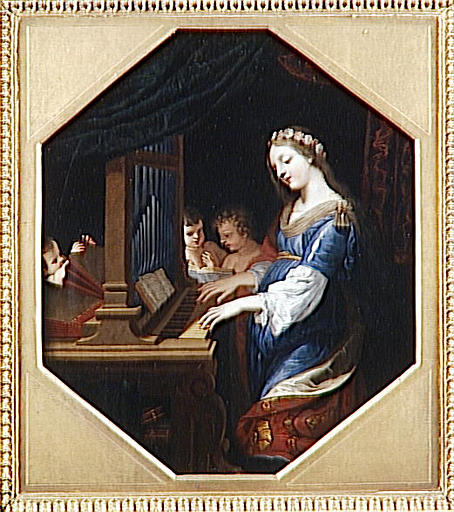
SAINTE CECILE JOUANT DE L'ORGUE: A Baroque Symphony of Faith and Light
Jacques Stella’s Sainte Cécile jouant de l'orgue stands as a testament to the grandeur and spiritual fervor of the Baroque period, capturing a pivotal moment in artistic history—the intersection of Florentine classicism and Roman dynamism. Executed around 1640, this monumental oil painting on copper transcends mere depiction; it’s an immersive experience designed to evoke contemplation and reverence. The artwork resides within the Musée du Louvre, where its meticulous detail continues to inspire awe among visitors.
- Composition & Framing: Stella masterfully employs a tightly framed octagonal border—a stylistic choice characteristic of the era—to draw the viewer’s gaze directly to Saint Cecilia, positioned slightly off-center yet commanding attention. Two cherubic figures flank the organ, acting as silent observers and reinforcing the painting's solemn atmosphere. The careful arrangement contributes to a sense of theatrical grandeur, mirroring the Baroque penchant for dramatic presentation.
- Color Palette & Light: Dominating the canvas is a rich tapestry of blues—deep indigoes and ceruleans—contrasted by opulent golds adorning the organ pipes and Cecilia’s crown. Accents of crimson and brown provide grounding tones, enhancing depth and creating visual harmony. Stella's masterful use of chiaroscuro – dramatic contrasts between light and shadow – illuminates Cecilia’s face and hands, casting much of the background in velvety darkness. This technique amplifies the painting’s emotional impact, conveying a profound sense of spirituality.
- Technique & Material: Painted on copper—a favored medium for artists of Stella's time—the artwork showcases exceptional craftsmanship. The meticulous layering of paint reveals an astonishing level of realism and textural detail. Stella skillfully captures the sheen of polished metal and the subtle nuances of fabric folds, demonstrating a profound understanding of artistic principles honed through years of study and practice.
- Symbolism & Context: Saint Cecilia’s depiction embodies the veneration for music as divine inspiration—a central theme within Baroque art. Playing the organ symbolizes harmony and spiritual communion, reflecting the period's preoccupation with religious contemplation. The cherubic figures represent angelic guardianship, reinforcing the painting’s moral message. Stella’s work aligns perfectly with the broader artistic currents of his time, mirroring the influence of Nicolas Poussin and celebrating the humanist ideals championed by Renaissance thinkers.
- Historical Significance: Sainte Cécile jouant de l'orgue exemplifies the Baroque style's commitment to conveying emotion and grandeur. Its meticulous execution and evocative lighting underscore the period’s fascination with theatrical illusionism—a technique perfected by Stella alongside fellow artist Simon Vouet. The painting’s enduring appeal testifies to its ability to transcend time, continuing to captivate audiences with its beauty and spiritual depth.
Provenance: Quentin Crawford; seized during the French Revolution, 1797 (cf. Prigot, 2007); at Maison d’éducation de la Légion d’honneur until April 1863. Currently housed in the Musée du Louvre.