A Poignant Moment Frozen in Time
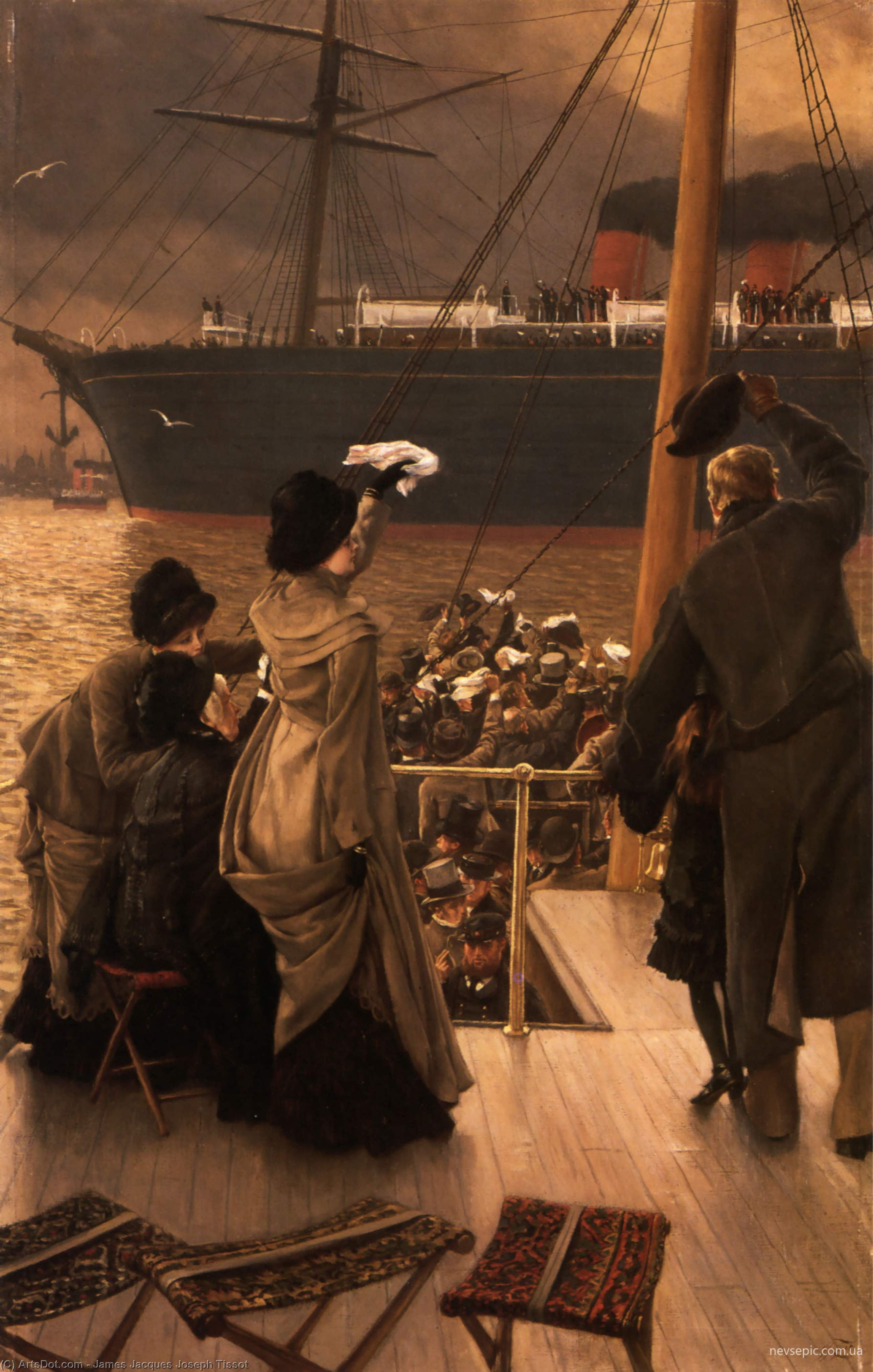
In the evocative monochrome of "Goodbye, on the Mersey," we are transported back to 1881, witnessing a fleeting moment of human connection set against the industrial grandeur of the maritime era. Jacques Joseph Tissot, a master of capturing the nuances of social interaction and atmosphere, presents us with a scene that is as much about the weight of departure as it is about the spectacle of travel. The composition centers on a small vessel navigating the waters, its deck populated by figures caught in various states of observation and emotion. A woman, positioned with striking clarity, waves toward a massive ship looming in the background—a gesture that serves as the emotional heartbeat of the piece. This single movement encapsulates the bittersweet essence of the Belle Époque: the excitement of new journeys clashing with the profound ache of separation.
The artistry of Tissot shines through his meticulous attention to detail and his ability to manipulate light and shadow within a limited tonal range. Though rendered in black and white, the painting possesses a remarkable depth that suggests a rich, textured world. The way the light catches the ripples of the water and the silhouettes of the passengers creates a sense of movement, making the viewer feel as though they are drifting alongside the boat. A solitary bird, perched near the upper periphery, adds a touch of natural grace to the industrial setting, perhaps symbolizing the freedom of flight in contrast to the heavy, anchored reality of the departing vessel. For the discerning collector or interior designer, this piece offers a sophisticated layer of narrative depth, perfect for spaces that value historical elegance and contemplative moods.
The Mastery of Tissot’s Realism
To understand the allure of this work, one must consider the lineage of its creator. Trained under the legendary Ingres at the École des Beaux-Arts, Tissot possessed an unparalleled ability to blend classical precision with a burgeoning Impressionistic sensibility. In "Goodbye, on the Mersey," we see this technical prowess manifested in the way he handles texture—from the heavy, imposing hull of the distant ship to the delicate, ephemeral nature of the waves. His background in observing the high fashion of Parisian society allowed him to imbue even a maritime scene with a sense of dignity and sartorial grace, making every figure on that deck feel like a character in a much larger, unfolding drama.
For those looking to integrate this reproduction into a curated collection, it serves as an exquisite focal point that bridges the gap between historical documentation and fine art. The monochromatic palette makes it an incredibly versatile choice for modern interiors, allowing it to harmonize with both minimalist contemporary decor and more traditional, opulent settings. It is not merely a depiction of a river scene; it is an invitation to reflect on the transient nature of time and the enduring strength of human bonds. Owning such a piece is an opportunity to possess a fragment of history, rendered with the soul and sophistication that only a master like Tissot could provide.