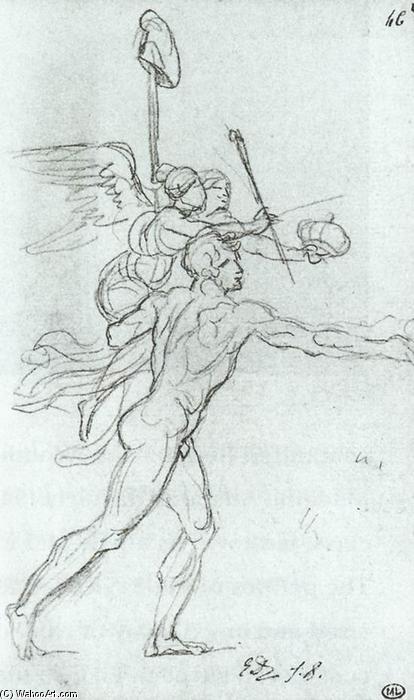
A Vision of Virtue Amidst Revolution
In the heart of 1792, as the streets of Paris echoed with the transformative cries of the French Revolution, Jacques-Louis David captured a moment of profound political and spiritual tension. His work, Allegory of the French People Offering the Crown and Sceptre to the King, is far more than a mere historical record; it is a breathtaking window into an era where the very foundations of authority were being renegotiated. Through his masterful hand, David transcends the chaos of the Reign of Louis XVI to present a scene of celestial struggle, where the fate of a nation is decided not by men alone, but by the divine interplay of opposing forces. This piece serves as a monumental bridge between the fading opulence of the Rococo era and the stern, moral clarity of Neoclassicism, offering a visual narrative that remains as gripping today as it was two centuries ago.
The composition is a masterclass in dramatic tension and symbolic depth. At its core, the artwork depicts a celestial battle—angels engaged in a fierce struggle over the symbols of monarchical power: the crown and the sceptre. This imagery serves as a powerful metaphor for the ideological warfare defining France at the time. The figures are not merely mythological entities; they represent the competing visions of governance, justice, and divine right that tore through the social fabric of the Ancien Régime. David utilizes a striking monochrome palette to heighten this sense of gravity, stripping away unnecessary ornamentation to focus the viewer's eye on the raw, muscular energy of the combatants. The interplay of light and shadow—a technique reminiscent of the great masters of history painting—creates a sculptural quality that lends an air of permanence and monumental importance to the fleeting moment of conflict.
The Neoclassical Soul and Artistic Mastery
To behold this work is to witness the pinnacle of Neoclassical technique. David, having refined his craft under the influence of Joseph-Marie Vien, moved away from the frivolous, swirling aesthetics of his predecessors toward a style defined by austere lines, idealized forms, and meticulous detail. Every stroke in this composition is deliberate, designed to evoke a sense of Roman virtue and civic duty. The artist’s deep study of classical sculpture, particularly the emotional weight found in Michelangelo's works, is evident in the anatomical precision and the palpable emotional depth of the figures. For the discerning collector or interior designer, this piece offers an unparalleled sense of intellectual prestige and historical weight.
Beyond its technical brilliance, the painting possesses a unique emotional resonance that makes it a captivating centerpiece for any sophisticated space. It evokes a sense of drama, resilience, and the eternal struggle between order and upheaval. Whether placed in a grand library, a formal study, or a contemporary gallery setting, a high-quality reproduction of this masterpiece invites contemplation on the nature of power and the enduring human spirit. It is an investment in art that does not merely decorate a wall but tells a story of courage, transformation, and the relentless pursuit of a new moral horizon.