A Brushstroke Across Revolution: The Life and Art of Jacques-Louis David
Jacques-Louis David, born in Paris in 1748, wasn’t merely a painter; he was a visual recorder of an era convulsed by transformation – from the opulent decadence of Rococo to the austere precision of Neoclassicism and ultimately, through the turbulent crucible of the French Revolution and Napoleon's ascendancy. His personal journey mirrored this dramatic shift in artistic sensibilities, marked by early hardship and physical challenges that honed his observational acuity and fueled an unwavering dedication to mastering his craft.
Initially apprenticed to François Boucher, David swiftly gravitated towards Joseph-Marie Vien’s more morally resonant approach to history painting and classical subjects. Vien's emphasis on idealized form and rational composition instilled in David a profound belief in art as a vehicle for moral instruction and civic virtue – principles that would permeate his oeuvre throughout his career.
- Early Influences: Boucher’s Rococo style initially shaped David’s artistic vision, prioritizing decorative elegance and sensual beauty. However, Vien’s didactic fervor quickly captivated him, propelling him toward a more intellectually stimulating aesthetic.
- The Revolution's Embrace: David’s involvement in the French Revolution solidified his commitment to portraying heroic ideals and challenging established hierarchies. He became a fervent supporter of Robespierre and championed republican values through monumental canvases like ‘Oath of the Horatii,’ demonstrating an unwavering belief in the power of art to inspire social reform.
- Napoleon's Patronage: Napoleon recognized David’s artistic genius and appointed him as his official painter, securing him a position at the apex of Napoleonic grandeur. This patronage allowed David to produce iconic works celebrating imperial authority and commemorating pivotal moments in Napoleonic history, notably ‘The Coronation of Napoleon.’
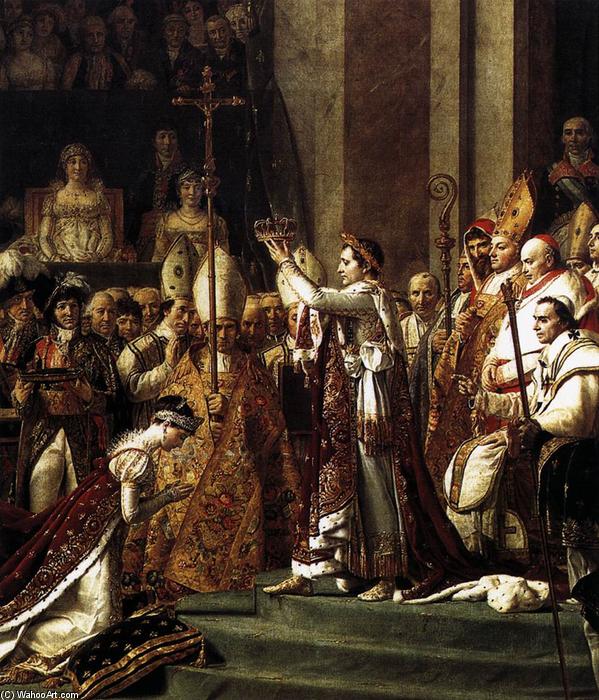
“Consecration of the Emperor Napoleon I (detail)” – A Symphony of Form and Symbol
This monumental painting captures a defining moment in European history: the coronation ceremony of Napoleon Bonaparte in 1805. Executed with meticulous precision and imbued with profound symbolic significance, David’s depiction transcends mere visual representation to convey an overarching narrative of power, piety, and imperial legitimacy.
David skillfully employs Neoclassical techniques—characterized by crisp lines, idealized proportions, and a restrained palette—to create a scene brimming with grandeur. The central figure of Napoleon dominates the composition, positioned atop a stage adorned with opulent drapery and illuminated by diffused light. His regal posture exudes confidence and authority, underscored by the placement of his crown prominently displayed on his head.
- Composition: David’s pyramidal structure directs the viewer's gaze upward toward Napoleon, emphasizing his dominance and reinforcing the hierarchical order he embodies.
- Color Palette: The muted tones of crimson, gold, and ivory contribute to a solemn atmosphere, reflecting the sacred nature of the ceremony and highlighting the emperor’s divine status.
- Symbolism: The scepter and orb held by Napoleon symbolize royal power and dominion—symbols that resonate with classical notions of imperial majesty.
Technical Mastery & Artistic Legacy
David's mastery of oil paint is evident in the painting’s remarkable detail and textural richness. He meticulously rendered fabrics, skin tones, and architectural elements with painstaking accuracy, achieving an unparalleled level of realism within the Neoclassical style.
“Consecration of the Emperor Napoleon I (detail)” stands as a testament to David's artistic vision—a powerful embodiment of Enlightenment ideals fused with classical grandeur. Its enduring influence can be seen in subsequent generations of artists who sought inspiration from its formal elegance and emotive depth, cementing David’s place among the titans of European art history.
Further Exploration
To delve deeper into Jacques-Louis David's artistic journey and explore his broader oeuvre, we encourage you to visit Portrait of Pope Pius VII and admire another remarkable masterpiece showcasing David’s stylistic prowess. You can also revisit Consecration of the Emperor Napoleon I (detail) on ArtsDot.com for a high-quality reproduction.