A Chronicle of Exile and Imperial Grandeur: Jacques-Louis David’s General Étienne-Maurice Gérard
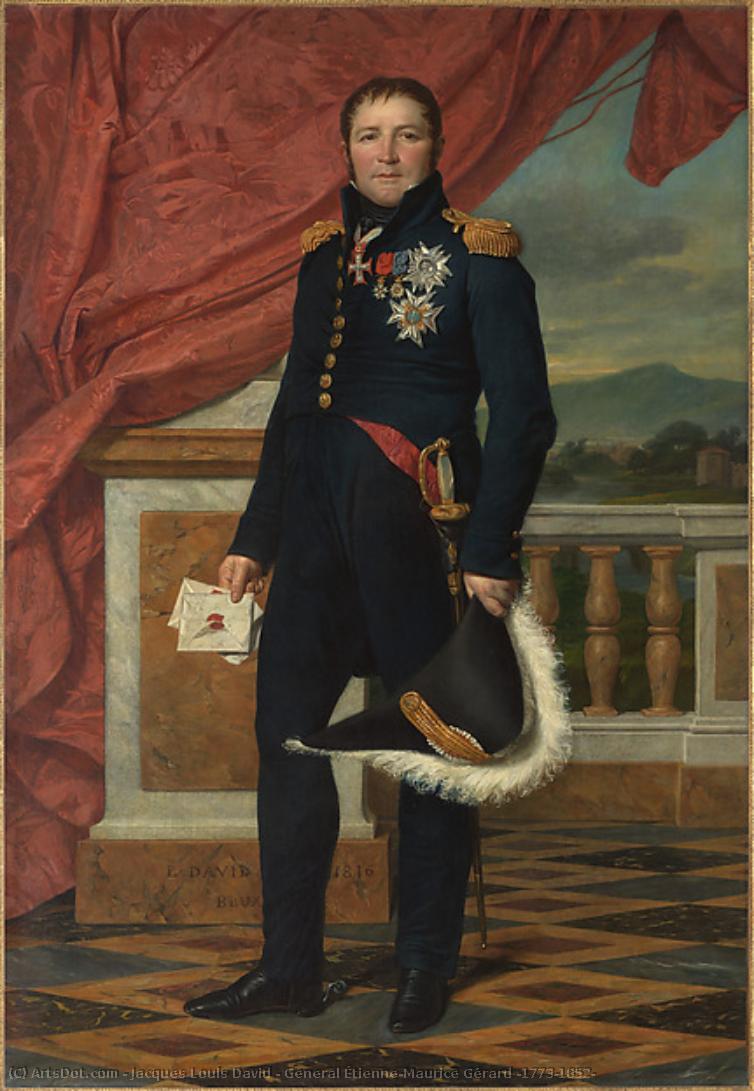
Jacques-Louis David's "General Étienne-Maurice Gérard" is more than just a portrait; it’s a meticulously crafted document of a turbulent era. Painted in 1816, shortly after Napoleon’s defeat at Waterloo and the subsequent exile of many prominent figures to Brussels, this monumental canvas captures not merely a man but the weight of history, political upheaval, and lingering imperial ambition. David, a pivotal figure in the French Revolution and later intimately linked with Napoleon's rise and fall, here presents Gérard – a highly decorated commander who embodied both the revolutionary fervor and the autocratic power that defined much of the 18th and early 19th centuries. The painting stands as a testament to David’s remarkable ability to distill complex political realities into a single, commanding image, revealing a surprising restraint in his artistic choices despite the dramatic circumstances.
The portrait immediately establishes a sense of authority through Gérard's imposing stature and deliberate pose. He is depicted on a balcony overlooking an expansive cityscape – a subtle yet potent symbol of his elevated position within the French military hierarchy. His stance, upright and resolute, conveys unwavering confidence, while the slight turn of his head draws the viewer into a direct engagement. The meticulous detail in his attire—the rich blue coat adorned with gold trim, the crisp black hat, and the vibrant red sash— speaks to the opulence associated with the Napoleonic era, yet David’s palette deliberately avoids excessive flamboyance. Instead, he employs a strikingly vibrant, almost theatrical use of color – deep blues, reds, and golds are juxtaposed against a muted background, creating a dynamic tension that reflects the instability of the time.
Neoclassical Precision and Emotional Resonance
David’s mastery of Neoclassicism is evident in every brushstroke. The composition adheres to strict geometric principles, with clear lines and balanced proportions contributing to an overall sense of order and control. However, this isn't the cold, detached formality often associated with the style. David infuses the portrait with a palpable emotional intensity through his skillful manipulation of light and shadow. Notice how the light catches Gérard’s face, highlighting his features and conveying a subtle hint of melancholy – perhaps reflecting the loss of power and the exile from his homeland. The sharp realism in the depiction of his attire and posture further enhances this sense of immediacy, making the viewer feel as though they are witnessing a genuine moment captured in time.
The inclusion of the letter in Gérard’s hand is particularly significant. It suggests a private reflection, a yearning for connection amidst isolation. The backdrop, featuring trees and glimpses of the Brussels cityscape, provides context without overwhelming the central figure. This careful orchestration of elements creates a layered narrative – one that speaks to both the man's military achievements and his personal circumstances. The painting’s scale—measuring 197 x 136 cm—further emphasizes Gérard’s importance and the grandeur associated with his position, reinforcing David’s intention to portray him as a commanding presence.
Historical Context and Artistic Intent
Understanding the historical context is crucial to appreciating the nuances of this portrait. Following Napoleon's defeat, many former imperial figures sought refuge in Brussels, forming a vibrant émigré community. David, himself exiled from France, was commissioned to paint portraits of these prominent individuals – a project that offered him a degree of artistic freedom and a chance to document a significant chapter in European history. This particular portrait stands out for its relative restraint compared to some of David’s earlier works celebrating Napoleon; it lacks the overt glorification and propagandistic elements characteristic of his imperial commissions.
David seems to deliberately avoid succumbing to the prevailing political climate, opting instead for a dignified portrayal that emphasizes Gérard's character rather than overtly aligning himself with any particular regime. This subtle defiance is a testament to David’s artistic integrity and his ability to navigate the complex political landscape of post-revolutionary France. The painting serves as a poignant reminder of the personal sacrifices made by individuals caught in the crosscurrents of war and revolution, offering a glimpse into the lives and anxieties of those who once held immense power.
A Reproduction for Collectors
ArtsDot is proud to offer meticulously hand-painted reproductions of Jacques-Louis David’s “General Étienne-Maurice Gérard.” Our skilled artisans replicate the artist's masterful technique, capturing the vibrant colors, sharp details, and emotional depth of the original with exceptional accuracy. Whether you are an art enthusiast, a collector seeking to expand your collection, or simply someone drawn to the drama and beauty of this iconic portrait, our reproduction provides a stunning and authentic representation of this significant work of art. Experience the power and artistry of David’s masterpiece in a way that honors its historical context and enduring appeal.