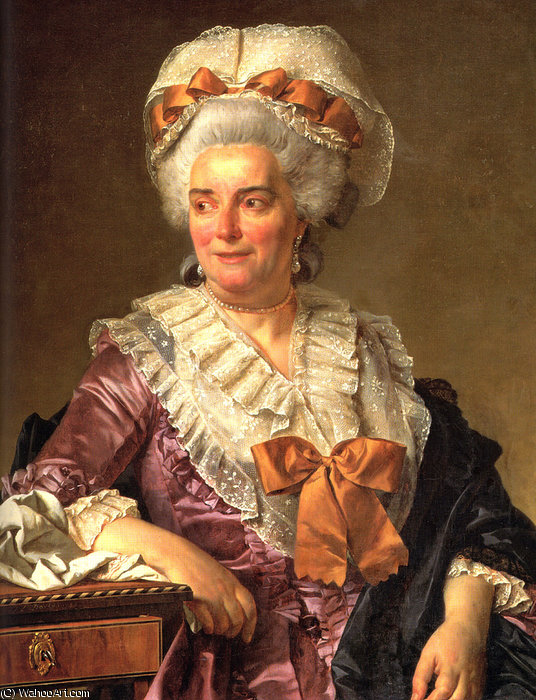
A Portrait of Grace and Quiet Power: Jacques-Louis David’s Genevieve Jacqueline Pecoul
Jacques-Louis David's "Portrait of Genevieve Jacqueline Pecoul" is more than simply a likeness; it’s a carefully constructed tableau of 18th-century elegance, imbued with the subtle tensions of a nation on the cusp of revolution. Painted in the late Rococo period and firmly rooted in the emerging Neoclassical style, this portrait offers a glimpse into the life of a woman of considerable standing – a testament to David’s ability to capture not just physical appearance but also an underlying sense of character and social bearing. The painting immediately draws the eye with its harmonious composition: Genevieve, positioned against a deliberately muted yellow wall, exudes a quiet confidence that belies the dramatic shifts occurring around her. The color palette is restrained, dominated by soft pinks, creams, and the warm ochre of the background, creating an atmosphere of refined intimacy rather than bombastic display – a hallmark of David’s evolving artistic philosophy.
Decoding the Details: Style, Technique, and Composition
David's mastery is evident in every meticulously rendered detail. The subject’s pose, with her hand resting gracefully on her corset, speaks volumes about her composure and social standing. The large bow adorning her hair isn’t merely an accessory; it’s a symbol of wealth and status, echoing the elaborate hairstyles popular during the period while simultaneously aligning with the Neoclassical preference for classical motifs. Notice the precision of the drapery – subtly sculpted to suggest form beneath the fabric, a technique borrowed from ancient sculpture. David's use of *chiaroscuro*, the dramatic interplay of light and shadow, adds depth and volume to Genevieve’s face, emphasizing her features and drawing attention to her expression. The slightly raised eyebrow, almost imperceptible, hints at a subtle wit or perhaps even a touch of irony – a captivating element that elevates the portrait beyond a simple representation.
- Neoclassical Influence: David consciously moved away from the frivolity of Rococo art towards the clarity and order of Neoclassicism.
- Precise Detail: The meticulous rendering of fabric, hair, and jewelry demonstrates David’s commitment to realism and accuracy.
- Chiaroscuro Technique: Dramatic lighting enhances the portrait's depth and creates a sense of three-dimensionality.
A Window into an Era: Historical Context and Symbolism
To fully appreciate “Portrait of Genevieve Jacqueline Pecoul,” it’s crucial to understand its historical context. Painted during a period of significant social and political upheaval in France, the portrait reflects both the lingering opulence of the aristocracy and the growing anxieties surrounding the impending revolution. Genevieve's attire – the pink dress, the corset, the elaborate hair – speaks to her privileged position within society. However, there’s an underlying sense of restraint, a subtle acknowledgement of the changing times. The yellow background, often associated with wealth and royalty, is deliberately muted, suggesting a shift in power dynamics. David's choice of subject—a woman of noble birth—could be interpreted as a deliberate attempt to capture the essence of the old order before it crumbled.
Emotional Resonance: Capturing Character and Presence
Beyond its technical brilliance, “Portrait of Genevieve Jacqueline Pecoul” possesses a remarkable emotional resonance. David masterfully captures Genevieve’s inner life through her gaze – a direct, intelligent look that seems to hold both confidence and a hint of melancholy. The subtle curve of her lips suggests a quiet dignity, while the slight tilt of her head hints at an observant nature. It's this ability to convey character—to imbue a static image with a sense of movement and feeling—that makes David’s portraits so enduringly captivating. When reproduced on high-quality canvas, as offered by ArtsDot.com, this portrait retains its power to transport the viewer back in time, offering a poignant glimpse into the world of 18th-century France.