Explore James Abbott McNeill Whistler (1834-1903): American artist of Tonalism & Aestheticism. Discover 'Whistler's Mother,' nocturnes, portraits & his 'art for art's sake' philosophy.
Annabel Lee (Also known as Niobe) - A Portrait of Serenity Amidst Symbolism
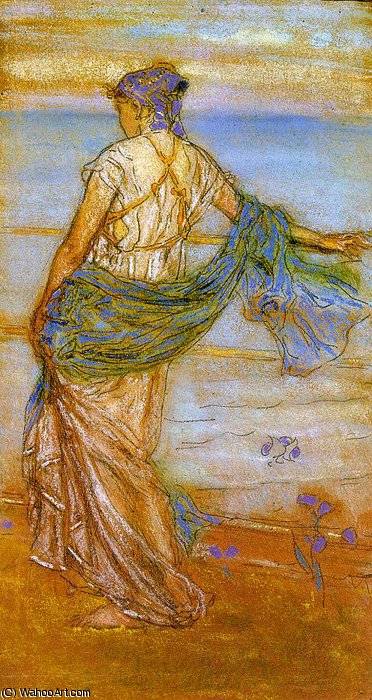
James Abbott McNeill Whistler’s “Annabel Lee,” completed in 1890, stands as a cornerstone of Aestheticism—a movement dedicated to elevating art beyond mere utilitarian concerns and embracing its intrinsic beauty. More than just a depiction of a woman, it's an exploration of memory, loss, and the enduring power of love rendered with Whistler’s signature tonalist style, offering viewers a glimpse into his profound artistic vision.
The Artist and His Unique Approach
Whistler (1834-1903), born in Lowell, Massachusetts, rejected the prevailing Victorian obsession with narrative storytelling, proclaiming “art for art’s sake.” This radical stance fueled his experimentation with color and form, resulting in canvases like “Annabel Lee” that prioritize subtle gradations of tone—the careful manipulation of light and shadow—over bold hues. Unlike Impressionists who sought to capture fleeting moments of sensory experience, Whistler aimed to distill emotion into a harmonious visual statement, prioritizing mood and atmosphere above detailed representation. His meticulous brushwork contributes to the painting’s ethereal quality, creating an illusion of depth and luminosity that draws the eye inward.
A Detailed Examination of Composition and Technique
The portrait itself presents a woman seated on a beach, bathed in soft light. Whistler skillfully employs tonalism—a technique characterized by blending colors into shades of gray—to achieve remarkable subtlety. Notice how he captures the breeze rustling through her hair, conveying movement without resorting to dramatic poses. The pale blue scarf draped around her neck serves as a focal point, introducing a delicate color accent that contrasts beautifully with the dominant tones of beige and cream. Whistler’s layering of thin glazes builds up texture and luminosity, resulting in an image that feels both luminous and contemplative. The background landscape—a tranquil expanse of water punctuated by scattered flowers—further enhances the painting's serene ambiance.
Symbolism Within Aesthetic Beauty
“Annabel Lee” transcends mere visual pleasure; it embodies the core tenets of Aestheticism. The woman’s pose suggests stillness, introspection, reflecting on cherished memories – a poignant reminder of lost love and enduring affection. The beach setting symbolizes purity and renewal, mirroring the idealized vision of beauty championed by Whistler and his contemporaries. Flowers represent remembrance and fragility—elements deliberately chosen to evoke emotion and elevate the artwork beyond the superficial.
Availability of Reproductions & Further Exploration
ArtsDot.com offers meticulously crafted oil painting reproductions of “Annabel Lee,” allowing art enthusiasts to experience Whistler’s masterpiece in their own homes. These reproductions utilize archival-quality pigments and canvases, guaranteeing exceptional color fidelity and longevity. To delve deeper into Whistler's artistic legacy, visit Wikipedia for biographical information and explore the Alte Nationalgalerie in Berlin, where several of his paintings are housed—a testament to his enduring influence on modern art history.