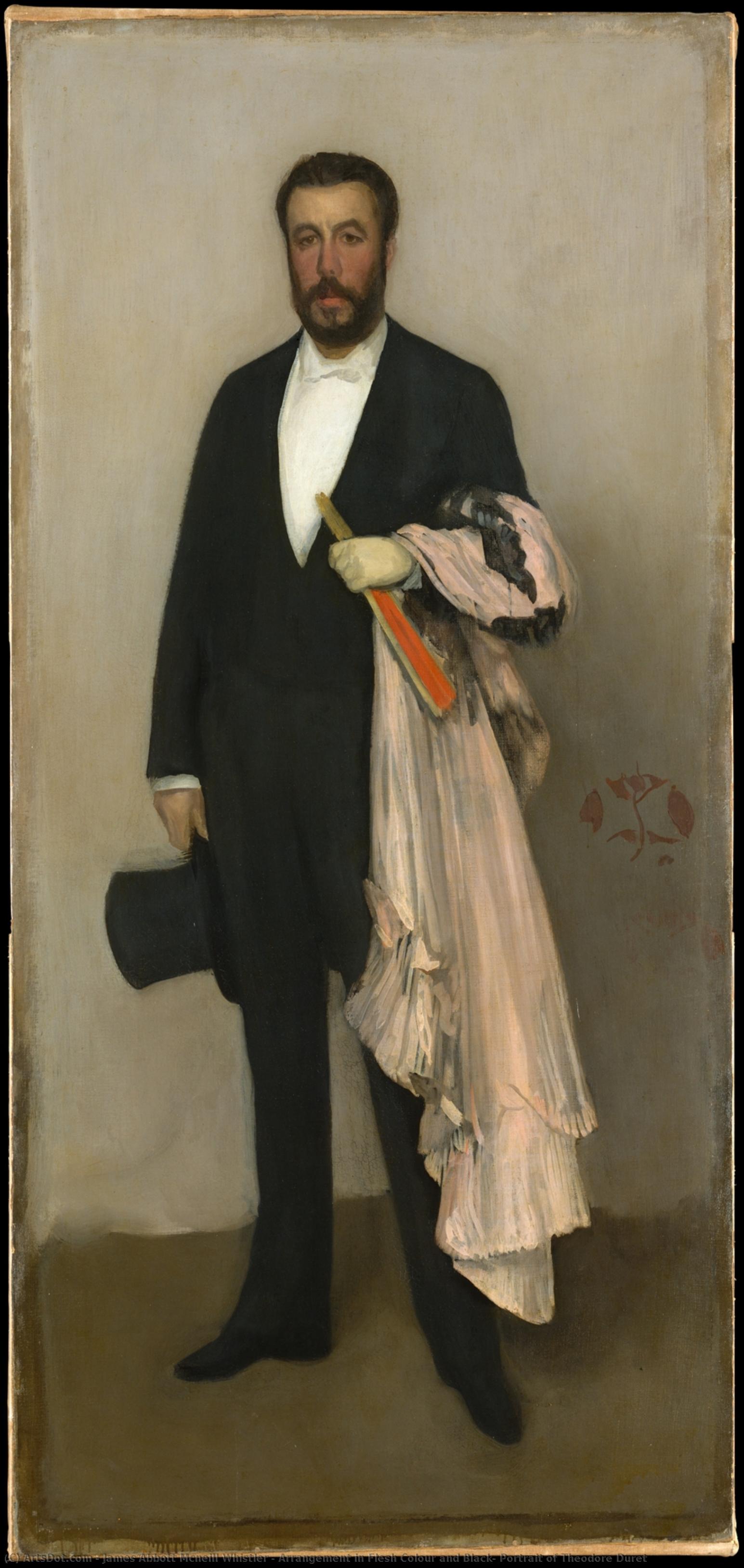
An Intimate Portrait: James Abbott McNeill Whistler’s “Arrangement in Flesh Colour and Black: Portrait of Theodore Duret”
“Art for art's sake.” This guiding principle of the Aesthetic movement, championed by James Abbott McNeill Whistler, is beautifully embodied in his 1883 portrait of Théodore Duret. More than a simple likeness, this painting is a carefully constructed *arrangement* – a harmonious blend of color, form, and mood that transcends traditional portraiture.
The Subject: A Connoisseur of Modernity
The sitter, Théodore Duret (1838-1927), was a pivotal figure in the Parisian art world. As an early advocate for Realist and Impressionist painters like Courbet and Manet, Duret possessed both discerning taste and considerable influence. His role as a collector, orientalist, and critic positioned him at the forefront of artistic innovation. Whistler’s connection to Duret came through Manet, highlighting the interconnectedness of these progressive artists.
Style & Technique: Tonalism and Aesthetic Harmony
This work exemplifies Whistler's signature style – a refined blend of Realism and Impressionism leaning heavily into *tonalism*. The muted palette—dominated by shades of brown, cream, and black—creates a somber yet dignified atmosphere. Notice how Whistler prioritizes tonal relationships over precise detail. He achieves this through loose, flowing brushstrokes that suggest form rather than rigidly defining it. While appearing quickly sketched, the portrait is actually the result of prolonged work, demonstrating Whistler’s deliberate approach to achieving visual harmony. The addition of the pink domino, at Whistler's suggestion, wasn't about accurate representation but about enhancing the *decorative arrangement* of the composition.
Historical Context: A Celebration at the Salon
“Arrangement in Flesh Colour and Black” was a critical success when exhibited at the Paris Salon of 1885. It was widely considered one of the finest portraits of Duret created by any leading artist of the period, signaling Whistler’s growing recognition on the international stage. This acclaim came during a time when traditional academic painting still held sway, making the portrait's acceptance all the more significant as it challenged conventional norms.
Symbolism and Interpretation
The subject’s formal attire – evening dress, top hat, and cane – immediately conveys status and sophistication. However, Whistler subverts expectations by focusing on the overall aesthetic effect rather than emphasizing Duret's social standing. The pink domino introduces a touch of playful contrast, disrupting the otherwise restrained color scheme. It can be interpreted as a symbol of Duret’s unconventional taste or his role as a patron of avant-garde art.
Emotional Impact & Interior Design
The portrait evokes a sense of quiet contemplation and perhaps even melancholy. The subdued colors and relaxed pose create an intimate atmosphere, inviting viewers to engage with the subject on a personal level. This artwork would be a stunning focal point in a study, library, or dining room, adding a touch of refined elegance and intellectual depth to any interior space. Its muted tones complement both traditional and contemporary décor schemes, making it a versatile choice for collectors and designers alike.
- Dimensions: 193 x 91 cm
- Date: 1883
- Artist: James Abbott McNeill Whistler (American, 1834-1903)