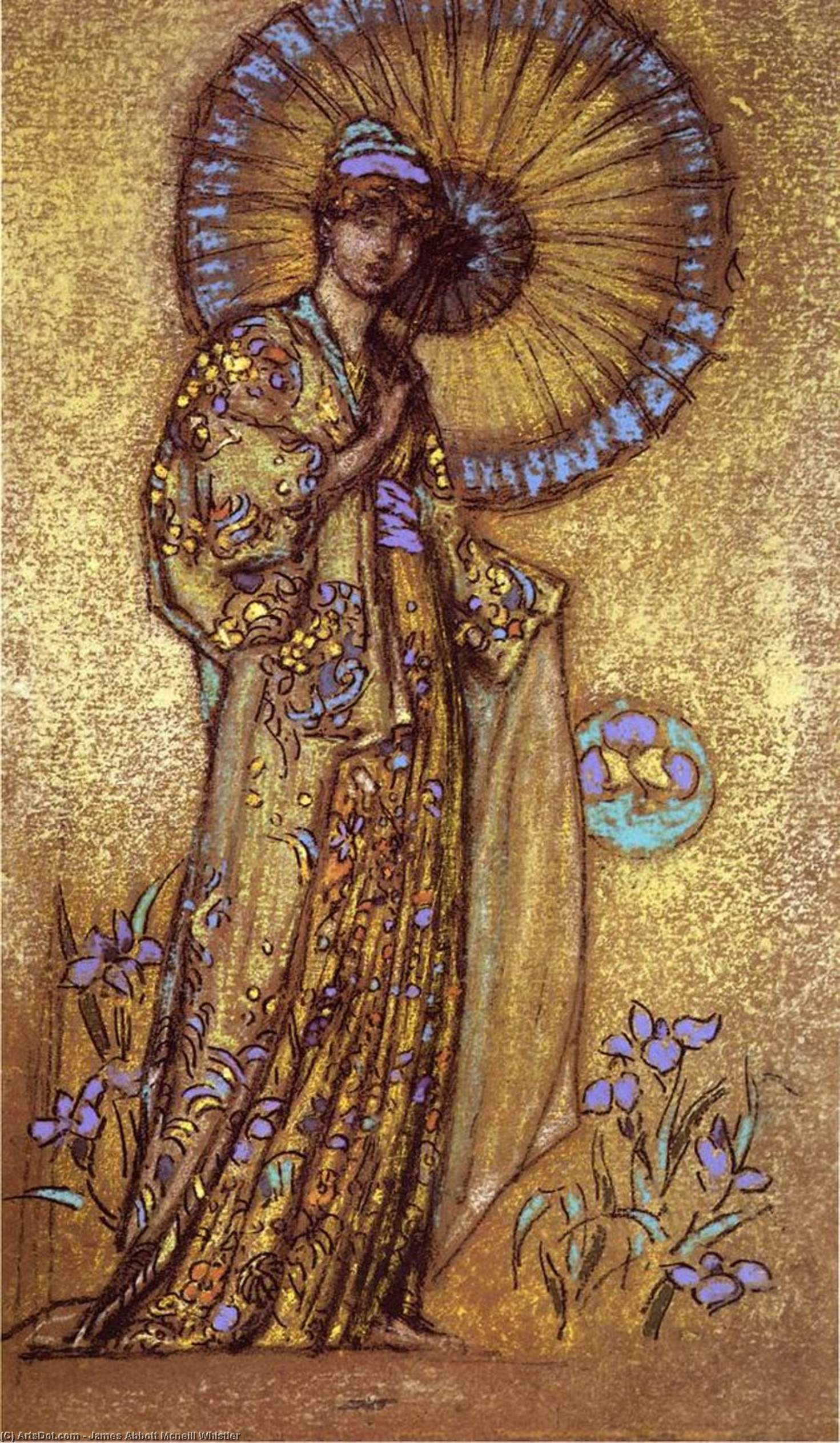
James Abbott McNeill Whistler’s serene Design for a Mosaic captures the elegance of aestheticism—a woman sheltered beneath an umbrella amidst vibrant florals and a tranquil blue sky. This evocative painting exemplifies Whistler's commitment to pure artistic expression, inviting you to experience its beauty.
A Delicate Dance Between Form and Feeling: Exploring James Abbott McNeill Whistler’s “Design for a Mosaic”
James Abbott McNeill Whistler's "Design for a Mosaic" isn’t merely a depiction of a woman sheltering beneath an umbrella; it’s a masterful distillation of Aestheticism—a movement that prioritized beauty and sensory experience above didactic storytelling. Painted circa 1867, this artwork encapsulates the spirit of its time, reflecting a profound shift away from Victorian moralizing towards a celebration of pure visual pleasure. Whistler himself famously declared “art for art’s sake,” rejecting the pressure to convey social commentary or religious allegory, and "Design for a Mosaic" embodies precisely that ethos.
- Subject Matter & Composition: The central figure—a woman—represents femininity and grace, positioned beneath an umbrella which serves as both a practical element and a visual motif. Its yellow tint subtly contrasts with the dominant blues of the sky and dress, creating a harmonious balance that prioritizes color relationships over narrative complexity.
- Style & Technique: Whistler’s signature style is characterized by tonal modulation—a technique he termed “atmospheric perspective.” Rather than striving for photographic realism, he aimed to capture the elusive quality of light and air, achieving this through careful layering of thin washes of pigment. This method lends the painting an ethereal luminescence, conveying a sense of stillness and contemplative beauty.
The historical context surrounding "Design for a Mosaic" is crucial to understanding its significance. Whistler was deeply influenced by Japanese prints—particularly Hiroshige’s landscapes—which championed simplicity and tonal harmony. This fascination with Japonisme profoundly impacted his artistic vision, prompting him to adopt compositional strategies that mirrored the flattened perspective and muted palettes of Japanese art. The deliberate omission of detail reinforces this stylistic influence, directing the viewer's gaze towards the interplay of color and texture.
- Symbolism: Beyond its aesthetic qualities, "Design for a Mosaic" carries subtle symbolic resonance. The umbrella symbolizes protection—both physical and emotional—suggesting resilience amidst vulnerability. Simultaneously, it acts as a visual anchor, grounding the composition while simultaneously emphasizing the expansive blue sky, representing freedom and transcendence.
- Emotional Impact: Whistler’s intention wasn't to provoke thought or elicit emotion in a conventional sense; rather, he sought to evoke a feeling of serene contemplation. The muted colors and delicate brushstrokes contribute to this atmosphere of tranquility, inviting the viewer into a space of quiet beauty—a testament to Whistler’s unwavering commitment to capturing the essence of visual experience.
Ultimately, “Design for a Mosaic” stands as an enduring emblem of Aestheticism's triumph over Victorian sentimentality. Its exquisite tonal harmony and understated elegance continue to inspire artists and collectors alike, demonstrating that true artistic achievement resides not in conveying moral lessons but in capturing the sublime beauty inherent within the natural world—a timeless pursuit perfectly realized by Whistler’s visionary artistry.