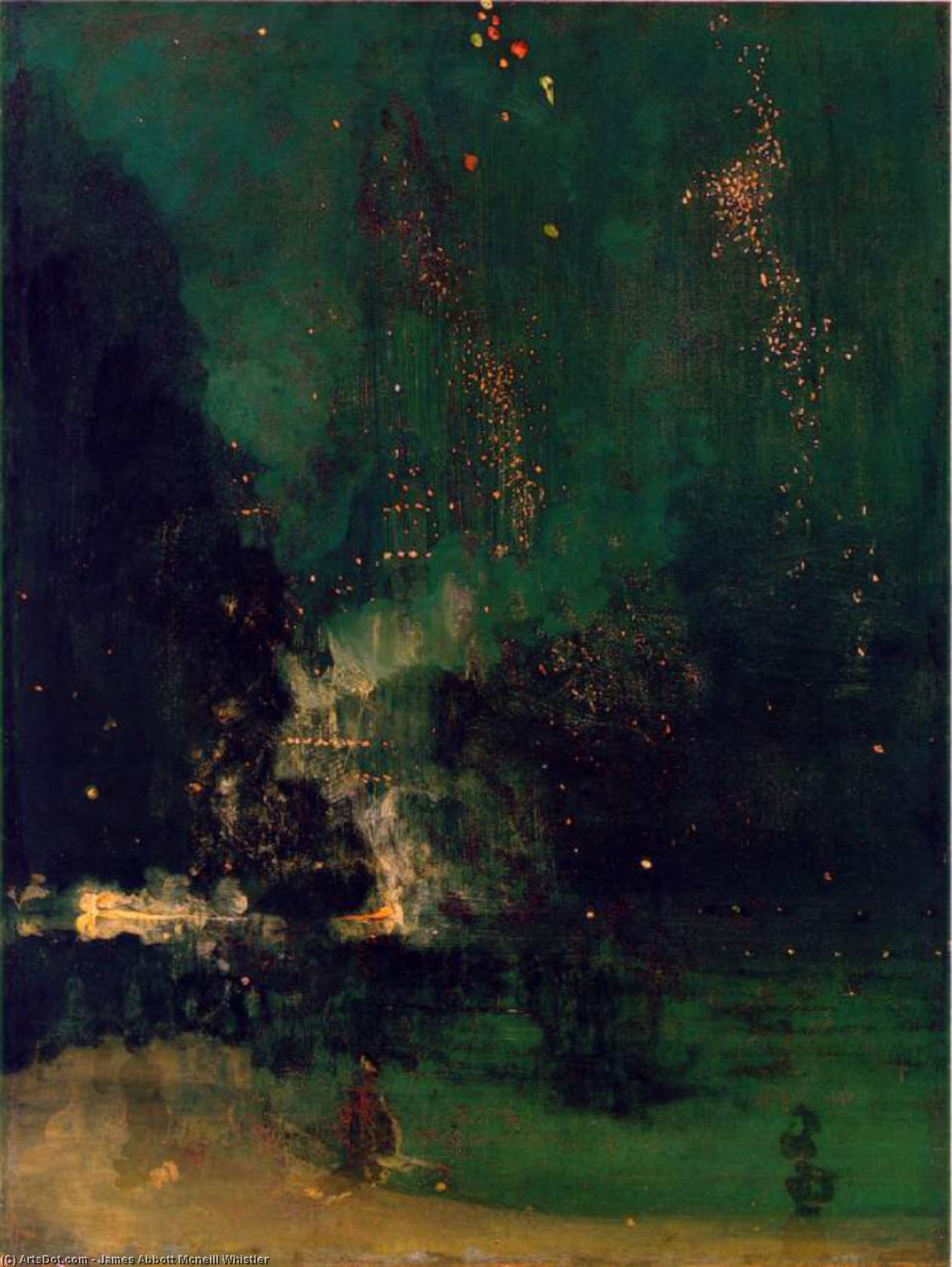
A Nocturnal Reverie: The Ethereal Glow of Whistler’s ‘Falling Rocket’
In the quietude of a moonless night, where the boundary between the sea and the heavens becomes a blurred whisper of shadow, James Abbott McNeill Whistler’s “Falling Rocket” invites us into a moment of profound contemplation. This masterpiece captures a quintessential seaside scene, centered around a lone figure gazing upward toward a vibrant, descending spectacle. Whether one perceives a celebratory firework or the melancholic descent of a rocket, the composition prioritizes the act of observation itself. As viewers, we are placed alongside the protagonist, sharing in that breathless pause where the world falls away, leaving only the silent, luminous trail of light against the dark expanse.
Whistler’s approach to this piece is a masterclass in the Aestheticism movement, a philosophy that famously championed “art for art’s sake.” Eschewing the heavy-handed moralizing and dramatic storytelling prevalent in much of the 19th-century art world, Whistler focused instead on pure sensory experience. There is no didactic lesson to be found here; rather, there is only the pursuit of beauty. The painting does not seek to tell us a story of triumph or tragedy, but to capture a fleeting moment of visual delight, making it an exquisite choice for those who appreciate art that evokes mood and atmosphere over explicit narrative.
Mastery of Tone and Atmospheric Depth
The technical brilliance of “Falling Rocket” lies in Whistler’s sophisticated use of tonal painting. Moving away from the traditional, high-contrast chiaroscuro, he employed a meticulous layering of deep blacks and muted greens to create an illusionistic depth that feels almost infinite. This technique, often described as atmospheric perspective, allows the viewer to feel the damp, cool air of the coast and the immense weight of the night sky. The subtle gradations of color do not merely represent a landscape; they evoke a sense of stillness and profound quietude, even amidst the energetic descent of the rocket.
Historically, this work emerged during Whistler’s formative years in Paris, a period where he was deeply immersed in the burgeoning Impressionist movement. Yet, true to his rebellious spirit, Whistler deliberately distanced himself from the trend. While his contemporaries were obsessed with capturing the fleeting effects of sunlight, Whistler sought something more permanent and structural through color and tone. This deliberate rejection of popular convention solidified his reputation as a pioneer of independent expression, offering a vision that is both deeply personal and universally evocative.
A Symbol of Aspiration and Timeless Elegance
Beyond its visual splendor, the painting carries a potent symbolic weight. The falling rocket serves as a metaphor for aspiration and ambition—a bright, singular burst of energy that inevitably descends back into the darkness. It represents the ephemeral nature of beauty and the fleeting moments of brilliance that define the human experience. For the discerning collector or interior designer, this piece offers more than just decoration; it provides a focal point of intellectual and emotional depth.
Integrating a high-quality reproduction of “Falling Rocket” into a living space can transform an environment, adding a layer of sophisticated mystery and calm. Its dark, tonal palette is particularly effective in creating a sense of intimacy in study areas, bedrooms, or elegant lounges. It is a work that rewards long periods of looking, offering new layers of shadow and light to discover with every glance, much like the nocturnal mysteries it so beautifully depicts.