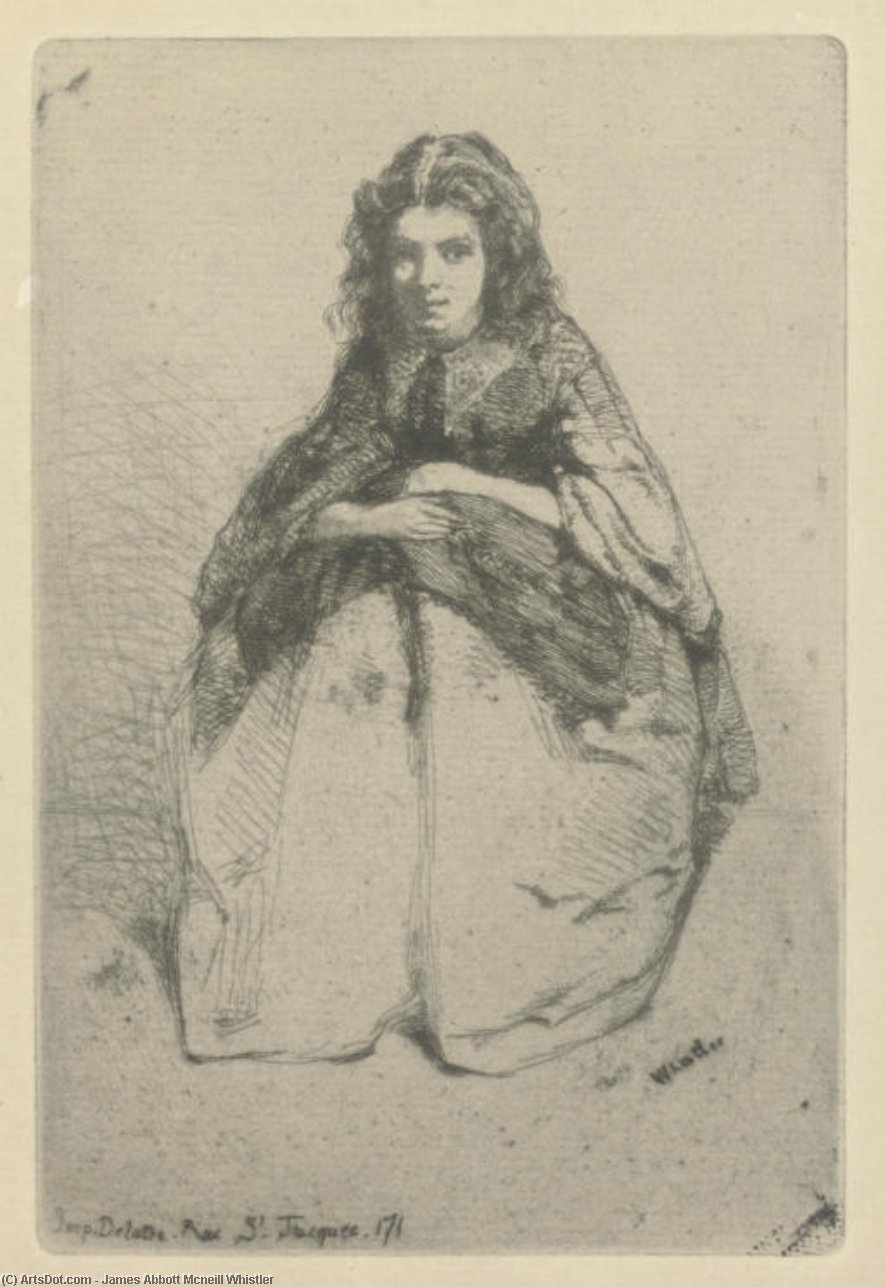
James Abbott McNeill Whistler’s Fumette: A Study in Quiet Contemplation
James Abbott McNeill Whistler (1834–1903), an artist profoundly shaped by Aestheticism, stands apart from his contemporaries—championing “art for art’s sake” during a period prioritizing moral instruction. His formative years instilled within him adaptability and exposure to diverse environments as he navigated frequent relocations due to his father's railroad engineering career. A brief, unsuccessful stint at West Point followed by work with the U.S. Coast and Geodetic Survey—despite delaying artistic pursuits—did not extinguish his innate talent for drawing and unwavering desire to forge a path as a professional artist. These experiences fueled his conviction that art should exist independently of didactic purpose, mirroring the core tenets of the Aesthetic movement he embraced.
- Subject Matter: Whistler’s “Fumette” depicts a seated woman—likely Heloise, his mistress—whose posture exudes quiet contemplation and introspection. The image captures a moment of stillness, devoid of narrative complexity, aligning perfectly with Whistler's artistic philosophy.
- Style & Influence: The artwork exemplifies Whistler’s Aesthetic movement style, heavily influenced by Japanese prints (ukiyo-e). This influence manifests in the simplified composition—a deliberate rejection of elaborate storytelling—and a pronounced emphasis on line as the primary expressive element.
- Technique: “Fumette” is executed as an etching, utilizing a meticulous process where lines are scratched into a metal plate with acid-resistant ground before being inked and pressed onto paper to create the final image. Whistler’s masterful use of hatching and crosshatching contributes significantly to the artwork's textural quality and tonal depth.
Historical Context: Created in 1858, “Fumette” emerged during a period marked by intellectual ferment—the Aesthetic movement challenged prevailing Victorian sensibilities regarding artistic representation. Whistler consciously avoided incorporating moral or didactic themes, prioritizing beauty and formal considerations above narrative content. This decision reflects a broader rejection of sentimentalism and melodrama prevalent in the art world at the time.
- Composition: The image’s central placement creates visual balance and symmetry, guiding the viewer's gaze directly to the woman’s figure. The background is deliberately muted, allowing Whistler to concentrate on capturing the subtleties of tonal variation—a technique known as Tonalism—which became synonymous with his artistic vision.
- Color Palette: Strikingly monochromatic in shades of gray, “Fumette” underscores Whistler's commitment to pure form and color’s absence. This deliberate choice reinforces the artwork’s contemplative mood and emphasizes its textural richness.
Symbolism & Emotional Impact: The woman’s clasped hands convey a sense of inner peace and vulnerability, inviting viewers to contemplate themes of solitude and introspection. Whistler's intention was not to depict an idealized figure or convey a grand narrative but rather to evoke a feeling of quiet melancholy—a characteristic hallmark of his artistic aesthetic. “Fumette” serves as a testament to Whistler’s belief that art should transcend mere representation, resonating with viewers on an emotional level through its masterful use of line and tonal gradation.
Further Research: Explore the broader context of Whistler's life and work by visiting resources for research:
The Met’s Open Access API and
Complete and submit this form to request images under copyright and other restrictions.