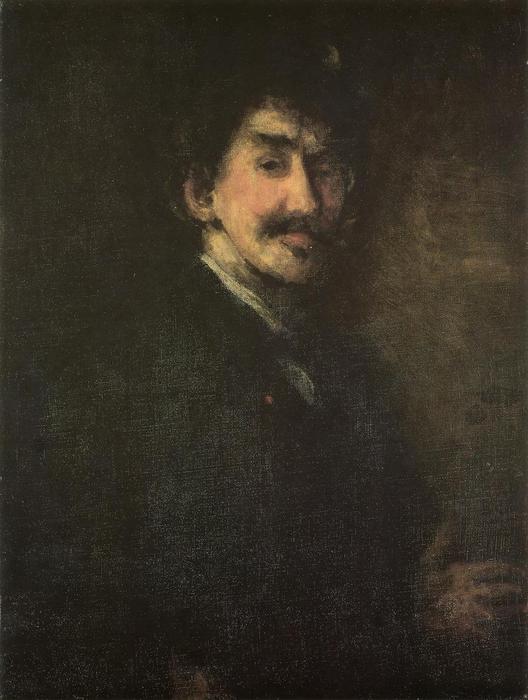
James Abbott McNeill Whistler’s ‘Gold and Brown’ – A Portrait of Introspection
James Abbott McNeill Whistler's “Gold and Brown,” often recognized as his “Self Portrait,” is more than just a likeness; it’s a carefully constructed meditation on the artist himself, his artistic philosophy, and the evolving nature of portraiture in the late 19th century. Painted in 1896, during a period of profound reflection for Whistler, this oil-on-canvas work transcends the traditional conventions of self-representation, offering a glimpse into the mind of a revolutionary artist grappling with his legacy and the shifting landscape of art criticism.
Whistler’s aesthetic principles, deeply rooted in the tenets of “art for art's sake,” profoundly shaped this portrait. He rejected the prevailing Victorian emphasis on narrative and moralizing within art, advocating instead for an exploration of pure form, color, and tonal harmony – a philosophy he famously articulated through his ‘Nocturnes’ and ‘Harmonies.’ “Gold and Brown” embodies this shift; it's not about depicting Whistler as a specific individual or telling a story, but rather capturing the essence of his artistic sensibility. The painting is a deliberate rejection of the overly sentimentalized self-portraits that were popular at the time, opting instead for a quiet dignity and an understated elegance.
A Study in Color and Light
The painting’s remarkable power lies in Whistler's masterful manipulation of color and light. The palette is dominated by rich, earthy tones – deep browns, ochres, and golds – creating a sense of warmth and intimacy. These colors aren’t applied with bold strokes but rather layered subtly to achieve a velvety texture and an almost luminous quality. Whistler employed a technique he termed “broken color,” applying small, separate dabs of paint that blend optically when viewed from a distance. This creates a shimmering effect, particularly noticeable in the folds of his clothing and the subtle gradations of light across his face. The careful use of chiaroscuro – the contrast between light and dark – further emphasizes the three-dimensionality of the figure and draws the viewer’s eye to the central subject.
Notice how Whistler uses gold not as a flamboyant accent, but as a grounding element, subtly reflecting in the shadows and contributing to the painting's overall sense of quiet sophistication. The muted palette is a deliberate choice, signaling a move away from the vibrant colors favored by earlier generations of portraitists.
The Man and the Artist
Whistler presents himself with an air of contemplative reserve. He’s dressed in a dark suit and tie, suggesting a certain formality, yet his gaze is directed slightly off-camera, as if lost in thought. The subtle upward tilt of his head and the faint smile hint at a quiet amusement, perhaps even a touch of self-awareness. The inclusion of the monocle – a fashionable accessory of the era – adds a layer of visual interest and subtly reinforces Whistler’s image as an intellectual and discerning observer.
Crucially, “Gold and Brown” is not a portrait in the traditional sense; it's a study of mood and atmosphere. Whistler sought to capture not just the appearance of his subject but also the feeling he evoked – a sense of quiet contemplation, artistic integrity, and perhaps even a touch of melancholy. The painting invites us to step into Whistler’s world, to share in his introspective gaze, and to contemplate the complexities of being an artist in a rapidly changing society.
A Legacy of Innovation
“Gold and Brown” stands as a pivotal work in Whistler's oeuvre and a testament to his radical artistic vision. It exemplifies his rejection of academic conventions and his embrace of a more subjective, expressive approach to painting. The painting’s influence can be seen in the subsequent development of Impressionism and Post-Impressionism, where artists increasingly focused on capturing fleeting moments of light and color rather than adhering to strict representational standards.
Today, “Gold and Brown” resides at the National Gallery of Art in Washington D.C., a testament to Whistler’s enduring legacy. Reproductions of this captivating portrait continue to inspire art lovers and collectors alike, offering a window into the mind of one of the most innovative and influential artists of the 19th century. Consider commissioning a high-quality handmade oil painting reproduction from ArtsDot.com to bring this masterpiece into your own space – a tangible reminder of Whistler’s profound contribution to the world of art.