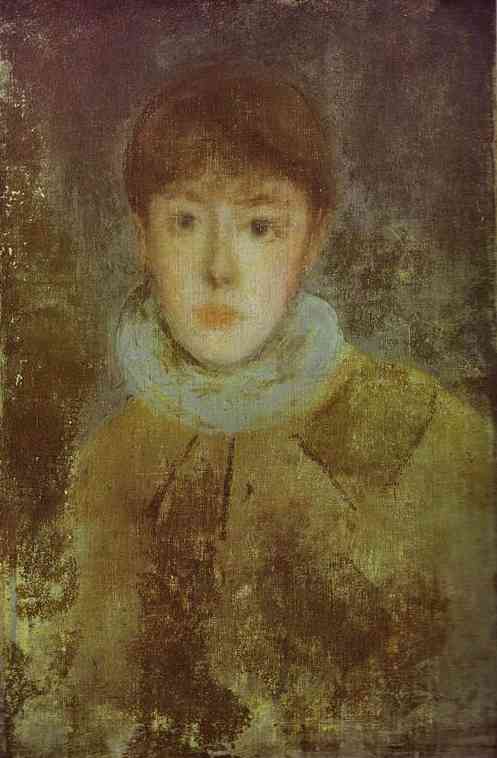
Discover 'Maud Franklin' by Whistler – a poignant portrait of his muse and model, exploring themes of love, art, and Victorian society through evocative tones and delicate details.
A Portrait of Quiet Intensity: Unveiling Whistler’s ‘Maud Franklin’
James Abbott McNeill Whistler's “Maud Franklin,” painted in 1876, isn’t merely a portrait; it’s a carefully constructed tableau of mood and suggestion. The image captures Maud Franklin, Whistler’s mistress and model, not as a flamboyant subject for the viewer’s gaze, but rather as a figure lost in contemplative introspection. Her posture—head resting gently on her hand, eyes averted towards an unseen point beyond the canvas—immediately invites us into her private world. This deliberate restraint is characteristic of Whistler's Tonalism style, a movement he championed that prioritized subtle shifts in tone and color over sharp outlines and dramatic subject matter. The painting’s power lies not in overt emotion, but in its ability to evoke a profound sense of quietude and unspoken feeling.
- The Palette of Restraint: Whistler masterfully employs a muted palette dominated by browns, greens, and greys—a deliberate choice that reflects the somber atmosphere he sought to create. These earthy tones are not applied with bold strokes but rather layered delicately, building up subtle gradations of color that suggest texture and depth. The use of umber and sienna creates a velvety quality in her hair and clothing, while hints of olive green and grey contribute to the overall sense of tranquility.
- Tonalism’s Embrace: Whistler's Tonalism sought to capture the essence of light and atmosphere rather than meticulously rendering form. Notice how he avoids sharp details, allowing the colors to blend seamlessly into one another. This technique creates a dreamlike quality, as if we are peering through a veil into Maud’s inner world.
- Compositional Harmony: The composition itself is remarkably balanced. Maud occupies the lower half of the canvas, grounding the image while her gaze directs our attention upwards and outwards. The simple background—a hazy blue sky—further emphasizes her isolation and introspective state.
The Woman Behind the Canvas: Maud Franklin’s Life and Whistler's Affection
Understanding “Maud Franklin” requires delving into the personal context of its creation. Maud Franklin, born in 1857, was a captivating figure—an artist herself, exhibiting under the pseudonym Clifton Lin—and a woman deeply intertwined with Whistler’s life and artistic vision. Their relationship was complex, marked by both passionate affection and professional collaboration. Whistler frequently depicted her as his muse, capturing not just her physical likeness but also the elusive quality of her personality. The portrait wasn't simply a representation of Maud; it was an exploration of their shared aesthetic sensibilities and emotional connection.
Historical Context:** Whistler’s life in Europe, particularly in France and London, was shaped by the Aesthetic movement, which prioritized beauty and artistic expression above all else. He sought to elevate painting to a higher plane, arguing that it should be judged on its visual impact rather than its narrative content. Maud Franklin became an integral part of this aesthetic philosophy, serving as both model and collaborator in Whistler’s artistic endeavors.
Whistler's Letters:* Numerous letters between Whistler and Maud reveal the depth of their connection and his profound admiration for her intelligence, creativity, and spirit. He frequently described her as a source of inspiration, a catalyst for his artistic growth. These intimate exchanges offer invaluable insights into the creation of “Maud Franklin” and the emotional landscape that informed it.
Symbolism in Shadow and Light: Decoding the Portrait’s Layers
Beyond its technical mastery, "Maud Franklin" is rich with symbolic meaning. The averted gaze suggests a withdrawal from the external world, inviting us to contemplate her inner thoughts and emotions. The resting head symbolizes both vulnerability and contemplation—a moment of quiet reflection amidst the complexities of life. The muted colors contribute to a sense of melancholy and introspection, while the hazy background creates an atmosphere of mystery and ambiguity.
- The Unseen Horizon: Maud’s gaze directed towards something beyond the frame represents her engagement with ideas, emotions, or memories—a realm that remains inaccessible to the viewer.
- Rest as a Reflection: The pose itself is significant. Resting her head on her hand suggests both fatigue and a desire for solace—a yearning for peace amidst the demands of life.
- Color as Mood: Whistler’s deliberate use of muted colors reinforces the painting's contemplative mood, creating an atmosphere of quiet introspection and emotional depth.
A Legacy of Intimacy: Reproductions and the Enduring Power of ‘Maud Franklin’
Today, “Maud Franklin” stands as a testament to Whistler’s artistic vision and his profound understanding of human emotion. ArtsDot.com offers meticulously crafted hand-painted oil reproductions that capture the essence of this iconic portrait, allowing you to bring its quiet intensity into your own home or office. These reproductions are not mere copies; they are faithful interpretations created by skilled artists who share Whistler’s commitment to capturing subtle nuances and emotional depth. Whether you're an art collector, a design enthusiast, or simply someone seeking a piece that speaks to the soul, “Maud Franklin” remains a timeless masterpiece—a poignant exploration of beauty, introspection, and the enduring power of human connection.