A Symphony of Shadows: Unveiling Whistler’s Nocturne
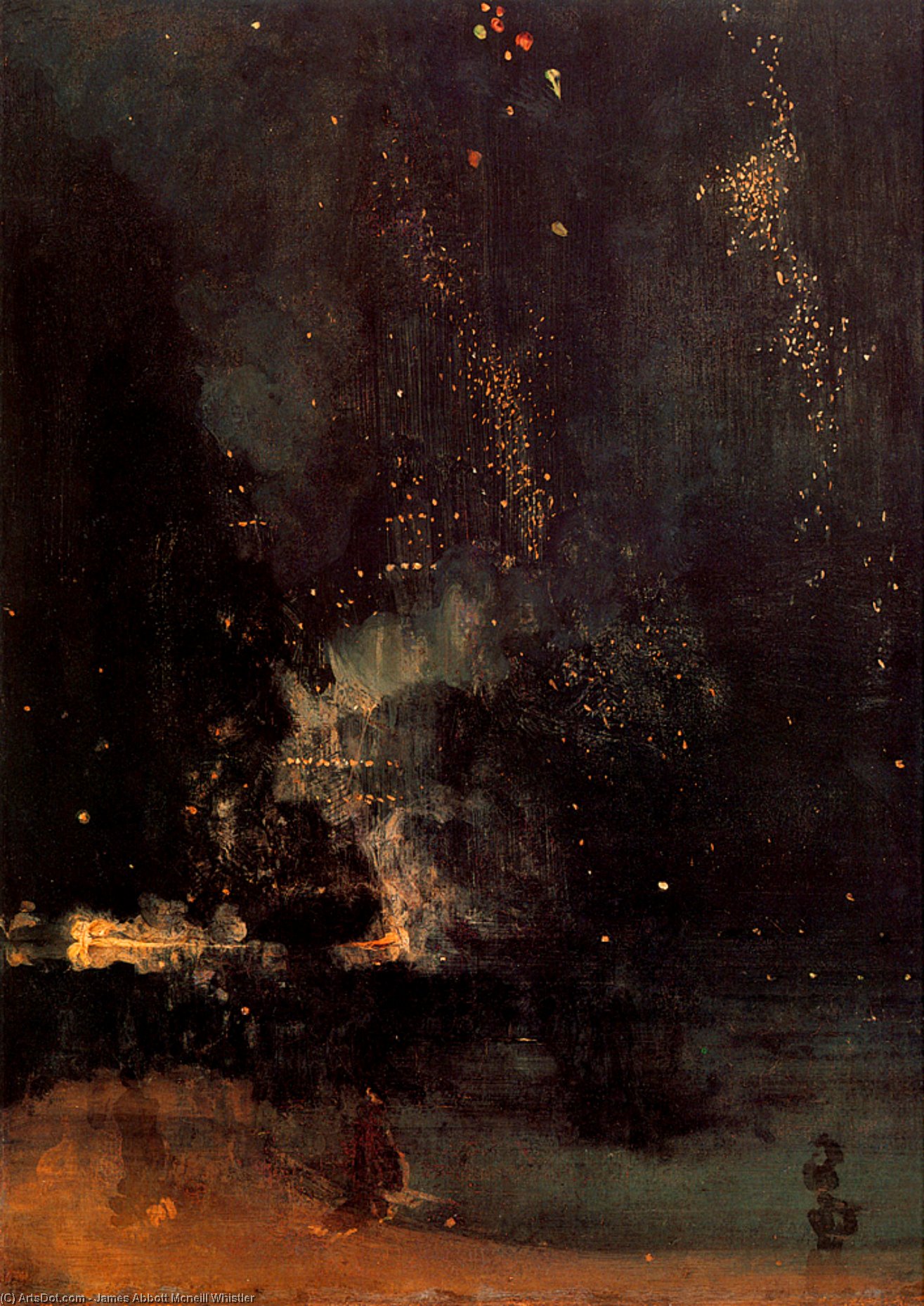
James Abbott McNeill Whistler's “Nocturne in Black and Gold, The Falling Rocket,” painted around 1875, isn’t merely a depiction of a fireworks display; it’s an immersive experience, a carefully constructed mood piece that embodies the core tenets of Tonalism and the burgeoning aesthetic movement. Imagine stepping into a darkened London night, the air thick with anticipation as brilliant bursts of color explode against the velvet canvas of the sky. Whistler masterfully captures this fleeting moment, not through meticulous detail or realistic representation, but through an orchestration of subtle tones, diffused light, and a deliberate rejection of narrative—a radical departure from the prevailing artistic conventions of his time.
The painting unfolds within the confines of Cremorne Gardens, a popular entertainment venue in London. Whistler wasn’t interested in documenting a specific event; instead, he sought to evoke the *feeling* of that evening – the hushed excitement, the ephemeral beauty of the fireworks, and the profound sense of mystery inherent in the darkness. The falling rocket itself isn't the focal point, but rather an element within a larger composition, a fleeting spark against the dominant blackness. It’s this deliberate ambiguity, this refusal to offer easy answers or clear narratives, that makes the painting so compelling and enduring.
The Language of Tone: Whistler’s Tonalist Technique
Whistler's approach to painting is profoundly unique, rooted in his belief that art should be judged on its aesthetic qualities alone – “art for art’s sake.” He abandoned the traditional emphasis on color and detail, embracing instead a technique known as Tonalism. This involved manipulating subtle variations in tone—the lightness and darkness of paint—to create an atmosphere and evoke emotion. Notice how he uses layers of gray and black to build depth and suggest form, rather than relying on sharp outlines or vibrant hues. The hazy edges of the fireworks, the indistinct shapes of the trees, all contribute to this dreamlike quality.
The painting’s limited palette – primarily blacks, golds, and grays – is deliberately restrained. Whistler wasn't striving for photographic accuracy; he was aiming for a tonal harmony that resonated with the viewer on an emotional level. He meticulously built up these tones through countless thin layers of paint, creating a luminous surface that seems to glow from within. This technique, combined with his careful attention to light and shadow, is what gives “Nocturne in Black and Gold” its mesmerizing effect.
A Revolutionary Vision: Context and Controversy
“Nocturne in Black and Gold” wasn’t universally embraced upon its debut at the Grosvenor Gallery in 1877. The conservative art establishment, accustomed to grand historical scenes and meticulously rendered portraits, reacted with hostility. Critics like John Ruskin famously denounced the painting as “a pot of paint flung in the public’s face,” accusing Whistler of sacrificing craftsmanship for mere aestheticism. This controversy ignited a fierce debate about the very definition of art – was it meant to imitate reality, or to express an artist's inner vision?
Despite the initial criticism, Whistler’s painting ultimately became a landmark work in the Tonalist movement and played a crucial role in shaping the aesthetic philosophy. It championed the idea that art could exist independently of moral or narrative content, focusing instead on its ability to evoke emotion and create beauty through pure form and tone. The subsequent lawsuit further cemented Whistler's position as a rebellious figure challenging established artistic norms.
Bringing “Nocturne in Black and Gold” Home: A Reproduction for Your Space
At ArtsDot, we are proud to offer meticulously crafted oil painting reproductions of “Nocturne in Black and Gold, The Falling Rocket.” Our artisans painstakingly recreate Whistler’s delicate tonal harmonies and atmospheric mood using the finest materials and traditional techniques. Each reproduction captures the essence of the original while providing an affordable way to bring this iconic artwork into your home or office.
Imagine the painting gracing your walls, casting a subtle, evocative glow – a reminder of Whistler’s revolutionary vision and his belief in the power of art for its own sake. Explore our collection today and discover how you can experience the magic of “Nocturne in Black and Gold” firsthand. Browse reproductions here.