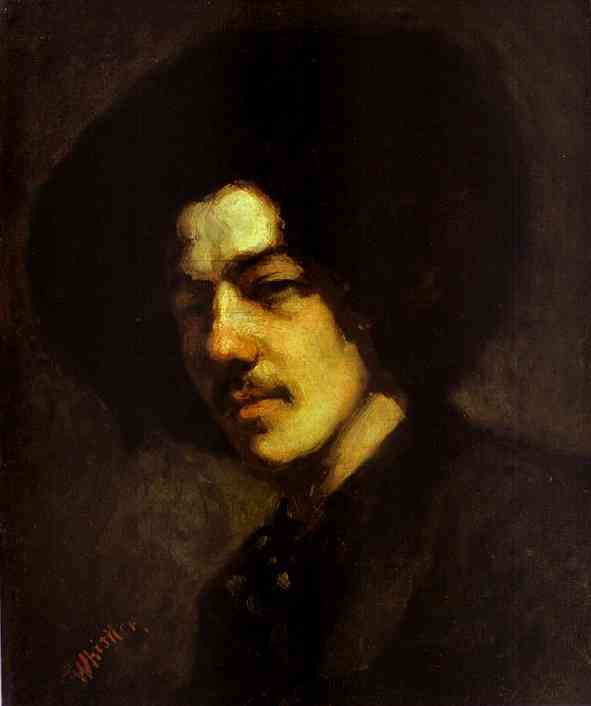
Portrait of Whistler with Hat: A Glimpse into Aesthetic Vision
James Abbott McNeill Whistler’s “Portrait of Whistler with Hat,” painted in 1857, is more than just a likeness; it's a carefully constructed statement about art itself. This captivating oil on canvas offers a rare and intimate view of the artist at the height of his creative fervor, revealing not merely his physical appearance but also his profound philosophical stance on the nature of beauty and artistic expression. Housed within the Freer Gallery of Art, this work stands as a pivotal moment in Whistler’s career – a declaration that he was determined to move beyond the conventional expectations of portraiture and forge a new path for painting.
Whistler, already a prominent figure in the American art scene during the Gilded Age, had embraced the aesthetic movement. This meant rejecting sentimental subject matter and moralistic narratives in favor of exploring pure form, color, and harmony. “Portrait of Whistler with Hat” embodies this philosophy perfectly. The painting isn’t about depicting a man; it's about capturing an *arrangement* – a carefully balanced composition of light, shadow, and tone that evokes a specific mood and atmosphere. Notice how the dark clothing and hat create a sense of somber elegance, while the subtle gradations of color suggest a quiet contemplation.
The Artist’s Aesthetic Philosophy
Whistler's artistic philosophy was deeply rooted in his belief that painting should be considered akin to music. He famously titled many of his works with musical terms – “Nocturne,” “Arrangement,” “Harmonies” – reflecting his conviction that both disciplines shared a fundamental principle: the creation of an emotional experience through carefully orchestrated elements. In "Portrait of Whistler with Hat," this is evident in the painting’s tonal harmony and its deliberate avoidance of dramatic contrasts. The muted palette, dominated by grays, blacks, and subtle yellows, creates a sense of understated elegance and quiet introspection.
Furthermore, Whistler's approach to portraiture was revolutionary for his time. He eschewed the traditional emphasis on capturing individual likenesses, instead prioritizing the creation of an evocative mood or atmosphere. He famously stated that he painted “not what is seen but what is felt.” This is powerfully demonstrated in this self-portrait; it’s less about a photographic representation and more about conveying Whistler's personality, his artistic sensibility, and his commitment to aesthetic principles.
A Study in Detail and Technique
The painting’s technical execution is as remarkable as its conceptual framework. Whistler meticulously rendered every detail – the texture of Whistler’s dark hair and mustache, the folds of his shirt, the subtle sheen of his hat. Yet, he achieves this level of precision without sacrificing the overall sense of tonal harmony. His brushstrokes are delicate and controlled, creating a smooth, almost velvety surface. The use of *sfumato* – a technique borrowed from Renaissance masters – softens the edges and blends the colors seamlessly, contributing to the painting’s atmospheric quality.
The choice of a simple black shirt is also significant. It serves as a grounding element, anchoring the composition and preventing it from becoming overly ornate. It's a deliberate decision that underscores Whistler’s commitment to simplicity and restraint – core tenets of his aesthetic philosophy. The hat itself—a fashionable “Quartier Latin” style—adds a touch of urban sophistication, reflecting Whistler’s life in London.
Symbolism and Enduring Legacy
"Portrait of Whistler with Hat" is not merely a portrait; it's a manifesto. It represents Whistler’s rejection of academic conventions and his embrace of a new artistic vision—one that prioritized beauty, harmony, and emotional experience over traditional notions of representation. The painting’s enduring legacy lies in its influence on subsequent generations of artists who sought to break free from the constraints of realism and explore the expressive potential of color and form.
As a testament to Whistler's artistic genius, ArtsDot offers meticulously crafted, hand-painted oil reproduction reproductions of this iconic work. These reproductions capture the painting’s subtle nuances and atmospheric quality with remarkable fidelity, allowing you to experience Whistler’s vision in stunning detail. Explore our collection today and bring a piece of art history into your home.
View the painting on ArtsDot | Learn more about James Abbott McNeill Whistler on Wikipedia