A Portrait of Quiet Elegance: Exploring Whistler’s “Purple and Rose”
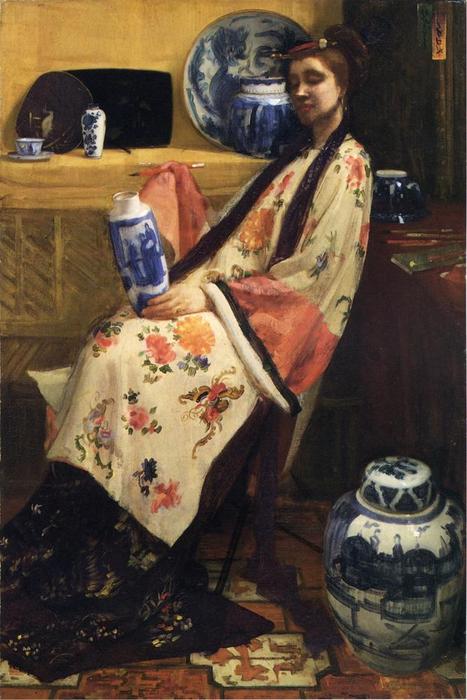
James Abbott McNeill Whistler's "Purple and Rose," painted in 1864, transcends mere representation; it embodies the core tenets of Aestheticism—a movement that prioritized beauty and sensory experience above moral didacticism. This captivating portrait captures a woman seated gracefully in a chair, her legs crossed with an air of serene composure. The artist’s deliberate choice of muted hues – predominantly lavender and rose – immediately establishes a mood of refined tranquility, mirroring the prevailing artistic sensibilities of the Victorian era.
- Subject Matter: Whistler focuses on capturing the essence of femininity through subtle gestures and posture. The woman's stillness speaks volumes about inner peace and contemplation, reflecting the Aesthetic ideal of observing beauty without imposing judgment.
- Style: Whistler’s style is characterized by tonal harmony—a technique he termed “Harmonic Color,” where colors are blended seamlessly to create an illusion of depth and luminosity. Unlike Impressionists who sought to depict fleeting moments of light, Whistler aimed for a more enduring impression of form and atmosphere.
- Technique: Employing oil paints on canvas, Whistler meticulously layered thin glazes upon glazes—a painstaking process that resulted in surfaces shimmering with subtle variations of color. This layering technique contributes significantly to the painting’s ethereal quality and reinforces its connection to Japanese prints (ukiyo-e), which Whistler greatly admired.
Historical Context: Aestheticism and Its Influence
Whistler's artistic vision emerged during a period of profound intellectual upheaval. The Victorian obsession with narrative storytelling was challenged by thinkers like Oscar Wilde and Henri Bergson, who championed the notion that art should exist for its own sake—a radical departure from the prevailing cultural norms. Whistler’s embrace of Aestheticism reflected this broader movement’s rejection of sentimentalism and moralizing themes, prioritizing instead the pursuit of pure visual pleasure.
- Japanese Inspiration: Whistler's fascination with Japanese prints profoundly impacted his artistic practice. He meticulously studied their compositional principles—particularly asymmetrical arrangements and flattened perspectives—incorporating these elements into his own paintings to achieve a similar sense of understated beauty.
- Reaction Against Academic Tradition: Whistler deliberately distanced himself from the rigid conventions of academic painting, rejecting its emphasis on anatomical accuracy and dramatic narratives. He sought instead to create works that resonated with emotion and intuition, prioritizing aesthetic experience over intellectual analysis.
Symbolism Beyond Surface Beauty
While “Purple and Rose” appears deceptively simple at first glance, Whistler imbues it with symbolic significance. The muted color palette—purple representing royalty and spirituality, rose symbolizing passion and tenderness—suggests a contemplation of inner life and emotional depth. Furthermore, the carefully arranged vases serve as visual anchors, grounding the composition while simultaneously referencing Japanese decorative arts.
- The Vase Arrangement: The placement of vases on shelves contributes to the painting’s overall sense of serenity and sophistication. They echo the aesthetic principles found in Japanese gardens—spaces designed for contemplation and harmony—underscoring Whistler's commitment to exploring beauty beyond mere visual spectacle.
Emotional Resonance: A Moment Frozen in Time
Ultimately, “Purple and Rose” succeeds in capturing a fleeting moment of grace—a portrait not merely depicting a woman but conveying an atmosphere of quiet contemplation. Whistler’s masterful use of tonal harmony and layering technique creates an illusion of depth and luminosity that draws the viewer into the scene, inviting them to savor its subtle beauty and emotional resonance. It remains a testament to Whistler's unwavering belief in art as a source of spiritual nourishment—a timeless masterpiece celebrating the power of visual experience.