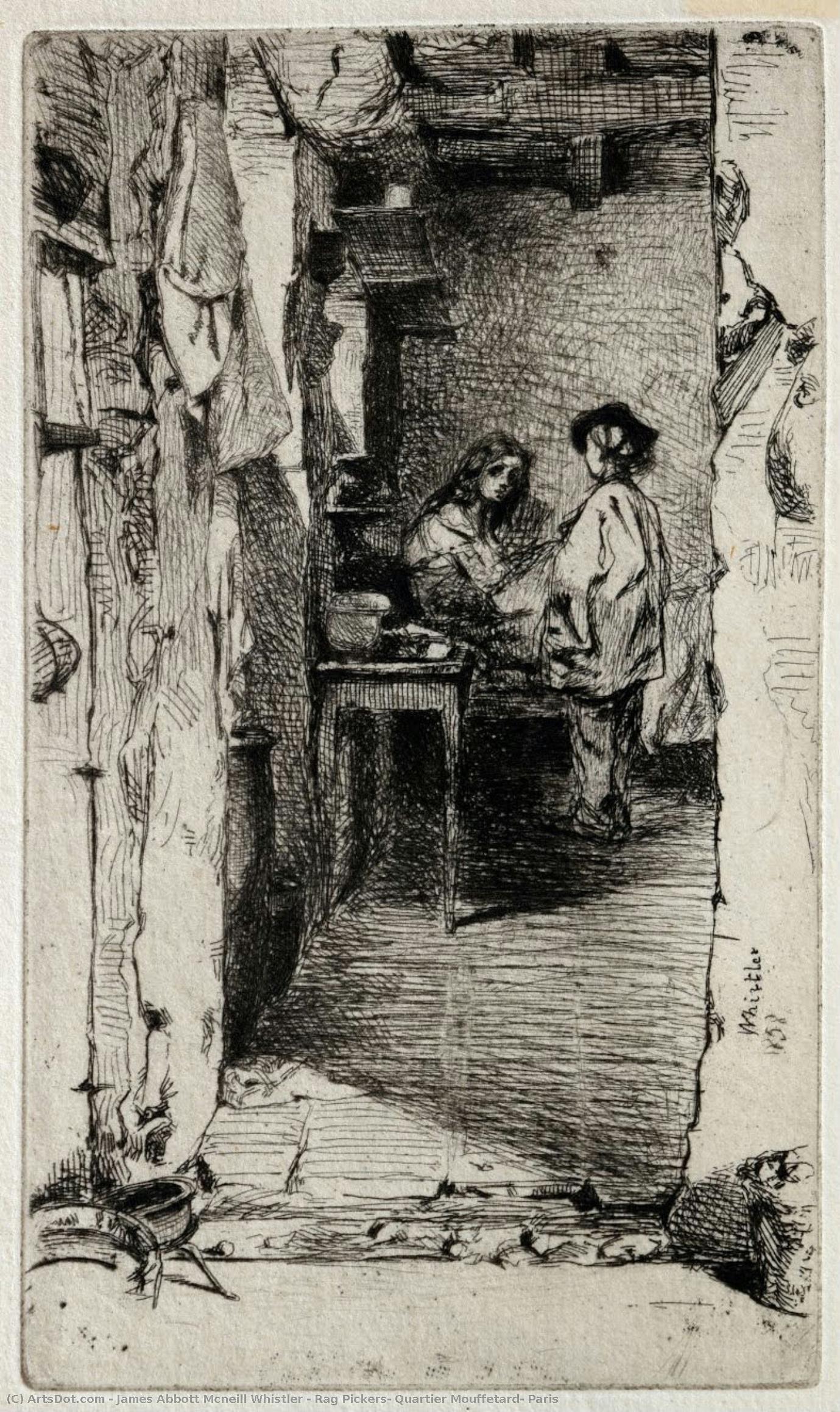
A Glimpse of Parisian Life: Whistler’s “Rag Pickers, Quartier Mouffetard”
James Abbott McNeill Whistler's "Rag Pickers, Quartier Mouffetard, Paris," created in 1858, is more than just a depiction of two figures engaged in a humble task; it’s a carefully constructed meditation on perception and the essence of art. This evocative etching, rendered entirely in shades of gray, transports us to the narrow, bustling streets of the Quartier Mouffetard in Paris – a district renowned for its poverty and vibrant street life. Whistler, a pivotal figure in the Aesthetic movement, deliberately eschewed grand narratives and moralizing themes, famously declaring “art for art’s sake.” Here, he offers not judgment or commentary, but a quiet observation of a specific moment, inviting the viewer to contemplate the beauty inherent in everyday existence.
The Language of Line: Technique and Texture
Whistler's mastery lies in his meticulous control of line. The etching process itself—scratching lines into a metal plate and then applying ink—dictates the artwork’s stark monochrome palette, yet it simultaneously allows for an astonishing range of tonal values. The artist employs a sophisticated system of hatching and cross-hatching to build up texture and form. Notice how the rough, granular effect created by dense cross-hatching defines the walls of the building, suggesting age and wear, while finer, more delicate hatching subtly captures the folds of the women’s clothing or the contours of their faces. This deliberate manipulation of line isn't merely representational; it’s a fundamental element of Whistler’s artistic language – a way to evoke feeling and atmosphere through purely visual means.
Symbolism in Simplicity: A Portrait of Working-Class Life
The scene depicted is remarkably devoid of overt symbolism, yet profoundly resonant. The two figures—a man and woman—are engaged in the task of rag picking, a common occupation in the impoverished districts of Paris during the 19th century. Their focused interaction suggests a shared labor, a quiet intimacy born from necessity. The modest kitchen setting – the table, the hanging cloths, the simple chairs – speaks volumes about their circumstances, offering a poignant glimpse into the lives of working-class Parisians. Whistler’s choice to portray this scene with such understated dignity elevates it beyond mere documentation; he imbues it with a sense of respect and humanity.
Echoes of Japan: Aestheticism and Whistler's Vision
Whistler’s fascination with Japanese prints profoundly influenced his artistic approach. The flattened perspective, the emphasis on line and texture, and the deliberate avoidance of dramatic lighting are all hallmarks of this influence. He sought to capture a sense of atmosphere and mood rather than striving for photographic realism. “Rag Pickers” exemplifies this aesthetic sensibility – prioritizing visual harmony and emotional resonance over detailed representation. It’s a testament to Whistler's belief that art should be judged on its own merits, independent of any external purpose or didactic message. The work stands as a bridge between European artistic traditions and the emerging aesthetics of the East, reflecting Whistler’s innovative spirit.
ArtsDot offers exquisite hand-painted reproductions of “Rag Pickers, Quartier Mouffetard, Paris,” allowing you to bring this captivating piece into your home or office. Each reproduction is meticulously crafted by skilled artists, ensuring a faithful representation of Whistler's original vision while retaining the beauty and nuance of the etching process. Consider how this evocative image can add depth and character to any space – a subtle reminder of Parisian life, artistic innovation, and the enduring power of art for its own sake.