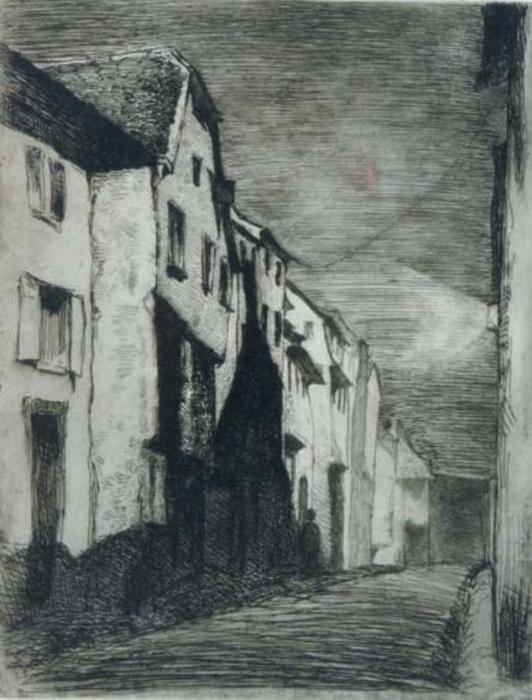
A Nocturne of Quietude: The Soul of Street at Saverne
In the quiet, shadowed corners of art history, few works capture the essence of atmospheric stillness as profoundly as James Abbott McNeill Whistler’s “Street at Saverne.” Created in 1858, this evocative etching serves as a foundational moment in the development of Tonalism, acting as a precursor to the artist's later, more famous Nocturnes. The piece does not merely depict an Alsatian streetscape; it invites the viewer into a meditative state, where the boundaries between light and shadow begin to dissolve. As one gazes upon the receding perspective of the narrow, sloping street, there is an immediate sense of entering a world hushed by the weight of evening, a place where the bustle of daily life has surrendered to a profound, urban solitude.
The technical mastery behind this print is nothing short of extraordinary, showcasing Whistler’s early command over the delicate interplay of line and tone. Utilizing the intricate method of drypoint combined with chine collé, the artist achieved a velvety depth that traditional etching alone could not provide. The drypoint technique allows for a rich, soft texture—created by scratching directly into the metal plate—which lends a tactile, almost organic quality to the architectural forms. When layered with the delicate sheen of chine collé, the paper takes on a luminous, ethereal glow, amplifying the subtle gradations of light that seem to emanate from an unseen overhead lantern. Every hatch and cross-hatch serves a purpose, building up the weight of the buildings and defining the rugged, uneven texture of the cobblestone path.
The Convergence of Japonisme and Aestheticism
To understand “Street at Saverne,” one must look toward the broader artistic revolutions of the 19th century. The work sits at a fascinating crossroads where Impressionism meets Japonisme. Whistler’s deep fascination with Japanese woodblock prints is evident in his rejection of excessive ornamentation and his embrace of asymmetrical, balanced compositions. Much like the masters of Ukiyo-e, Whistler prioritizes the formal beauty of the arrangement over a didactic narrative. He does not seek to tell a story of historical importance or moral lesson; instead, he champions the philosophy of “art for art’s sake.” In this view, the artwork is a self-contained universe of aesthetic harmony, where the subject matter—a simple street in France—is merely a vessel for exploring tonal subtleties and visual rhythm.
For the discerning collector or interior designer, this piece offers an unparalleled sense of sophisticated tranquility. The monochromatic palette, composed of nuanced grays and deep, velvety blacks, provides a timeless elegance that integrates seamlessly into diverse decor styles, from classical to contemporary minimalist settings. There is a haunting, melancholic beauty in its emptiness; the absence of human figures allows the architecture itself to become the protagonist, breathing with a quiet, rhythmic life. Owning a high-quality reproduction of this masterpiece is not merely about acquiring an image, but about bringing a sense of contemplative peace and historical depth into a living space—a window into a moment of perfect, frozen stillness.