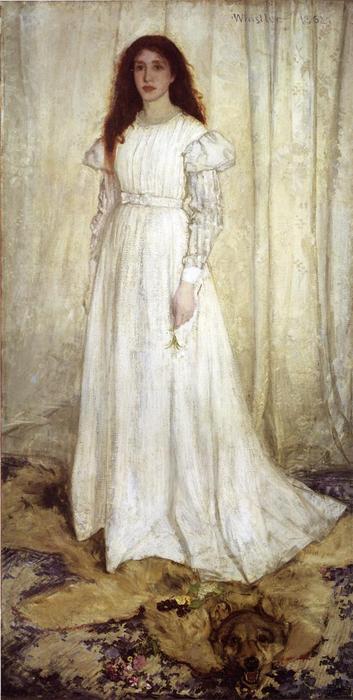
Whistler’s artistic theories profoundly impacted the art world of his time. His fascination with music informed his painting practice—he titled many works ‘arrangements,’ ‘harmonies,’ and ‘nocturnes.’ Symphony in White No. 1 remains a celebrated example of Tonalism, demonstrating Whistler's commitment to capturing subtle tonal variations and prioritizing visual harmony.
Symphony in White, No. 1: The White Girl – A Study in Aestheticism
James Abbott McNeill Whistler’s “Symphony in White,” No. 1: “The White Girl” stands as a cornerstone of Tonalist painting and embodies the core tenets of Aestheticism—art for art's sake—a movement that profoundly shaped the visual arts landscape of Victorian England. Completed in 1862, this portrait transcends mere representation; it aspires to capture an elusive emotional resonance achieved through subtle tonal harmonies and masterful brushwork, prioritizing beauty over narrative content. The painting’s impact reverberates beyond its formal qualities, reflecting Whistler's philosophical stance against didactic art and championing the primacy of sensory experience.
- Subject Matter: Joanna Hiffernan, Whistler’s mistress, occupies a central position within the composition. She stands gracefully beside a window, gazing outwards with an expression that hints at contemplation—a deliberate avoidance of direct engagement intended to foster introspection in the viewer. Alongside her is a pair of dogs, carefully positioned to contribute to the overall visual balance and subtly enriching the narrative atmosphere.
- Style & Technique: Whistler’s approach distinguishes him from his contemporaries who favored detailed realism. Instead, he employs Tonalism—a technique characterized by muted colors and gradual gradations of tone—to create an ethereal effect that prioritizes mood and atmosphere over precise depiction. The painting's surface is treated with a velvety smoothness achieved through meticulous layering of thin glazes, resulting in luminous washes of color that convey a sense of serenity and understated elegance.
- Historical Context: Whistler’s work emerged during the Gilded Age, a period marked by opulent materialism alongside burgeoning artistic experimentation. The painting was conceived as a response to prevailing artistic conventions—particularly those championed by the Pre-Raphaelites—who sought to infuse their art with moral and imaginative narratives. Whistler deliberately rejected this trend, asserting that “art should be for art’s sake,” aligning himself with the influential Aesthetic Movement led by Walter Pater.
- Symbolism: The painting is laden with symbolic references. The white dress embodies purity and innocence—a motif frequently explored in Victorian art—while the lily held by Hiffernan symbolizes virginity and spiritual grace. The window serves as a visual conduit to the outside world, representing both beauty and potential distraction. Whistler’s careful consideration of compositional elements underscores his desire to elevate painting beyond mere representation into a realm of pure aesthetic contemplation.
- Emotional Impact: “Symphony in White,” No. 1” evokes feelings of tranquility, melancholy, and quiet introspection. Whistler's masterful manipulation of tonal harmony creates an immersive experience for the viewer—one that invites contemplation on themes of beauty, solitude, and the elusive nature of emotion. The painting’s enduring appeal lies in its ability to transcend time and place, resonating with audiences who appreciate art’s capacity to inspire wonder and provoke profound emotional responses.
Provenance & Recognition
The painting's journey through history began with Whistler selling it shortly after its creation to his half-brother George W. Whistler. It was subsequently bequeathed to Whistler’s wife, Mrs. George W. Whistler, and passed through several subsequent owners before finding its permanent home in the National Gallery of Art in Washington D.C., where it continues to captivate visitors today. Its acceptance at the Salon des Refusés solidified Whistler's position as a champion of artistic innovation and challenged the conservative tastes of Parisian society.
Further Exploration
To delve deeper into Whistler’s artistic vision, consider exploring related artworks such as “The White Girl,” No. 2: “The Little White Girl” and “Whistler's Mother.” Examining these pieces alongside "Symphony in White," No. 1" provides invaluable insight into Whistler’s stylistic evolution and his unwavering commitment to the principles of Aestheticism—a legacy that continues to inspire artists and collectors alike.