James Abbott McNeill Whistler: A Life in Art
Early Life and Influences
- Born July 14, 1834, in Lowell, Massachusetts, James Abbott McNeill Whistler’s early life was shaped by his father's career as a railroad engineer.
- Frequent relocations instilled in him adaptability and exposure to diverse environments.
- He briefly attended the United States Military Academy at West Point but found it unsuited to his artistic inclinations.
- A subsequent role with the U.S. Coast and Geodetic Survey further delayed, but didn’t extinguish, his pursuit of art.
- His formative years were marked by an early interest in drawing and a desire to become a professional artist.
"The Forge": A Moment Captured in Charcoal
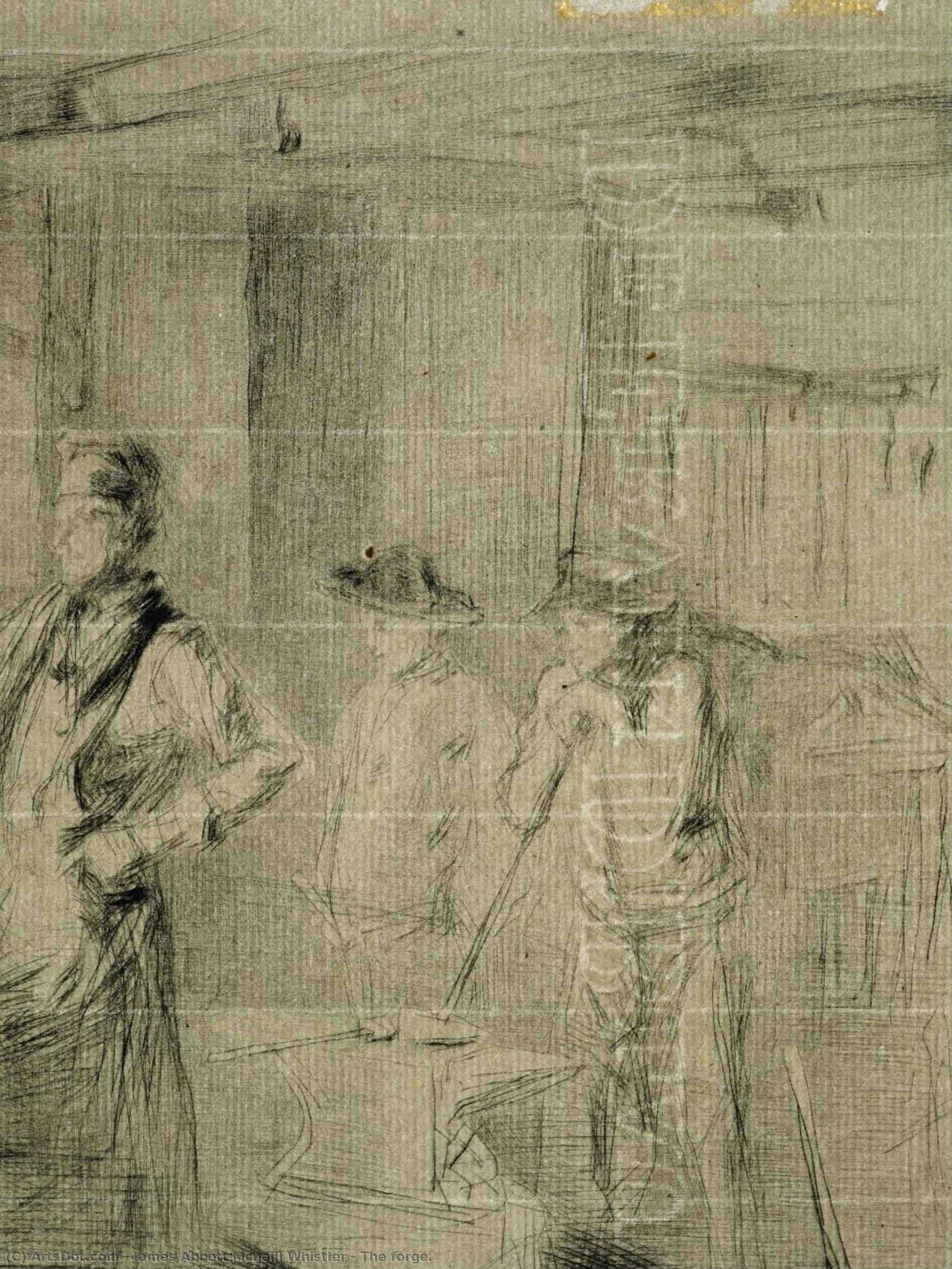
“The Forge,” created in 1861 by James Abbott McNeill Whistler, is a striking monochromatic charcoal drawing that offers a glimpse into everyday life with an understated elegance. This work exemplifies Whistler’s evolving artistic style and his growing interest in printmaking techniques. Rather than depicting a grand narrative or symbolic scene, the artwork focuses on capturing a fleeting moment – a group of men engaged in conversation or activity within what appears to be a workshop or tavern setting.
Style and Technique: Tonalism and Observational Realism
The drawing is rendered in a style that leans towards realism but infused with elements of tonalism, an artistic movement emphasizing the subtle gradations of light and shade. Whistler’s masterful use of charcoal allows him to create a sense of depth and texture through varying pressure applied to the paper. Dense shading defines forms while lighter lines suggest details, resulting in a grainy surface that adds to the drawing's immediacy. The perspective is shallow, focusing on the foreground figures and creating a feeling of intimacy. There are no overt symbolic elements; instead, Whistler presents a documentary-like observation of an ordinary scene.
Historical Context: Etching Innovation and Parisian Influence
“The Forge” was created during a pivotal period in Whistler’s career. Having spent his teenage years in London with his half-sister and her husband, an avid etcher, he developed an early appreciation for printmaking. Following his move to Paris in 1855, Whistler immersed himself in the study of art under figures like Sébastien Bouré. He began experimenting with etching techniques, breaking new ground by moving beyond reproductive prints to explore the medium's expressive potential. This work reflects that experimentation and demonstrates his growing mastery of charcoal as a tool for capturing fleeting moments and subtle tonal variations.
Emotional Impact: Quiet Observation and Understated Drama
“The Forge” evokes a sense of quiet observation and understated drama. The lack of overt narrative allows the viewer to project their own interpretations onto the scene, fostering a personal connection with the artwork. Whistler’s skill in capturing the nuances of light and shadow creates an atmosphere of intimacy and realism, inviting contemplation on the simple beauty of everyday life. It is a testament to his ability to find artistic merit in ordinary moments, transforming them into compelling works of art.