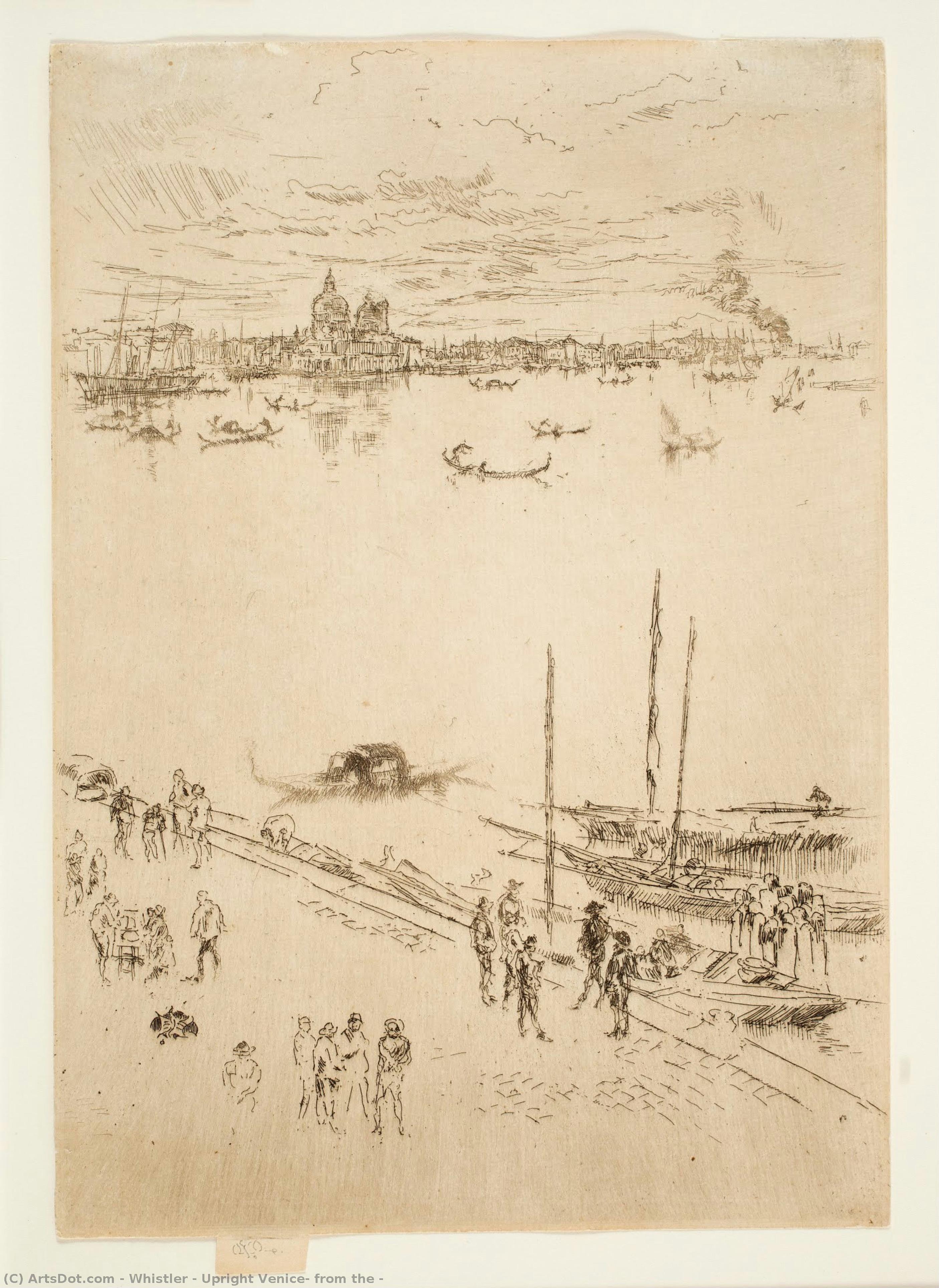
A Study in Tone and Atmosphere: Whistler’s “Upright Venice”
James Abbott McNeill Whistler's "Upright Venice," created around 1879-1880, isn’t merely a depiction of a Venetian canal; it’s an embodiment of the Aesthetic movement’s core philosophy – ‘art for art’s sake.’ This etching, rendered in a remarkably restrained palette of browns and beiges, invites us to linger not on precise detail, but on the subtle interplay of light, shadow, and texture. It's a piece that whispers rather than shouts, demanding contemplation and offering a deeply personal experience to each viewer.
Whistler’s approach deliberately eschews the conventions of academic realism prevalent at the time. Instead, he embraces a tonalist style, prioritizing the evocative power of color and line over meticulous representation. The composition is cleverly divided: a hazy upper section suggests distant architectural grandeur receding into atmospheric distance, while the lower portion focuses on the bustling activity of boats and figures navigating the canal. This division creates a sense of depth and perspective, yet avoids sharp outlines or dramatic contrasts – a hallmark of Whistler’s deliberate flattening of space.
The Language of Line and Hatching
The etching itself is a testament to Whistler's mastery of technique. He employs an extensive vocabulary of lines—hatching, cross-hatching, and delicate contours—to build up form and texture without resorting to heavy shading. Notice how the repetitive strokes create a shimmering effect on the water’s surface and subtly define the shapes of buildings and boats. The limited tonal range – primarily browns and beiges – amplifies this effect, creating an almost monochromatic dreamscape. The absence of strong shadows further emphasizes the work's focus on atmospheric qualities, contributing to its overall sense of quiet contemplation.
Whistler’s decision to utilize etching was crucial to achieving his desired aesthetic. The medium allowed for a nuanced control over tone and line, perfectly suited to his exploration of tonal harmony and the ephemeral nature of light and atmosphere. The paper itself plays a vital role; its texture subtly enhances the etched lines, adding another layer of tactile interest.
A Window into Aestheticism
“Upright Venice” is inextricably linked to Whistler’s broader artistic philosophy – Aestheticism. Rejecting the Victorian obsession with moralizing narratives and historical subject matter, Whistler sought to create art that was beautiful in its own right, independent of any didactic purpose. He believed that art should be experienced purely for its sensory qualities—its color, line, texture, and form. This piece exemplifies this belief perfectly; it’s a study in beauty divorced from narrative, inviting the viewer to lose themselves in the atmosphere and sensation of Venice.
The work reflects Whistler's fascination with music, mirroring his conviction that painting should evoke similar emotional responses as listening to a symphony. Like a carefully composed musical piece, “Upright Venice” relies on subtle shifts in tone and rhythm to create a harmonious and evocative experience. It’s a testament to the power of suggestion—a reminder that sometimes, less is truly more.
Collecting a Whistler Reproduction
ArtsDot offers meticulously crafted hand-painted reproductions of “Upright Venice,” allowing you to bring this iconic work into your home or office. Our skilled artists faithfully recreate Whistler’s tonal harmonies and delicate lines, ensuring that the essence of the original etching is preserved with stunning accuracy. Whether you're an art enthusiast, a collector, or simply seeking a beautiful addition to your décor, a ArtsDot reproduction offers a timeless piece of art history – accessible and affordable.