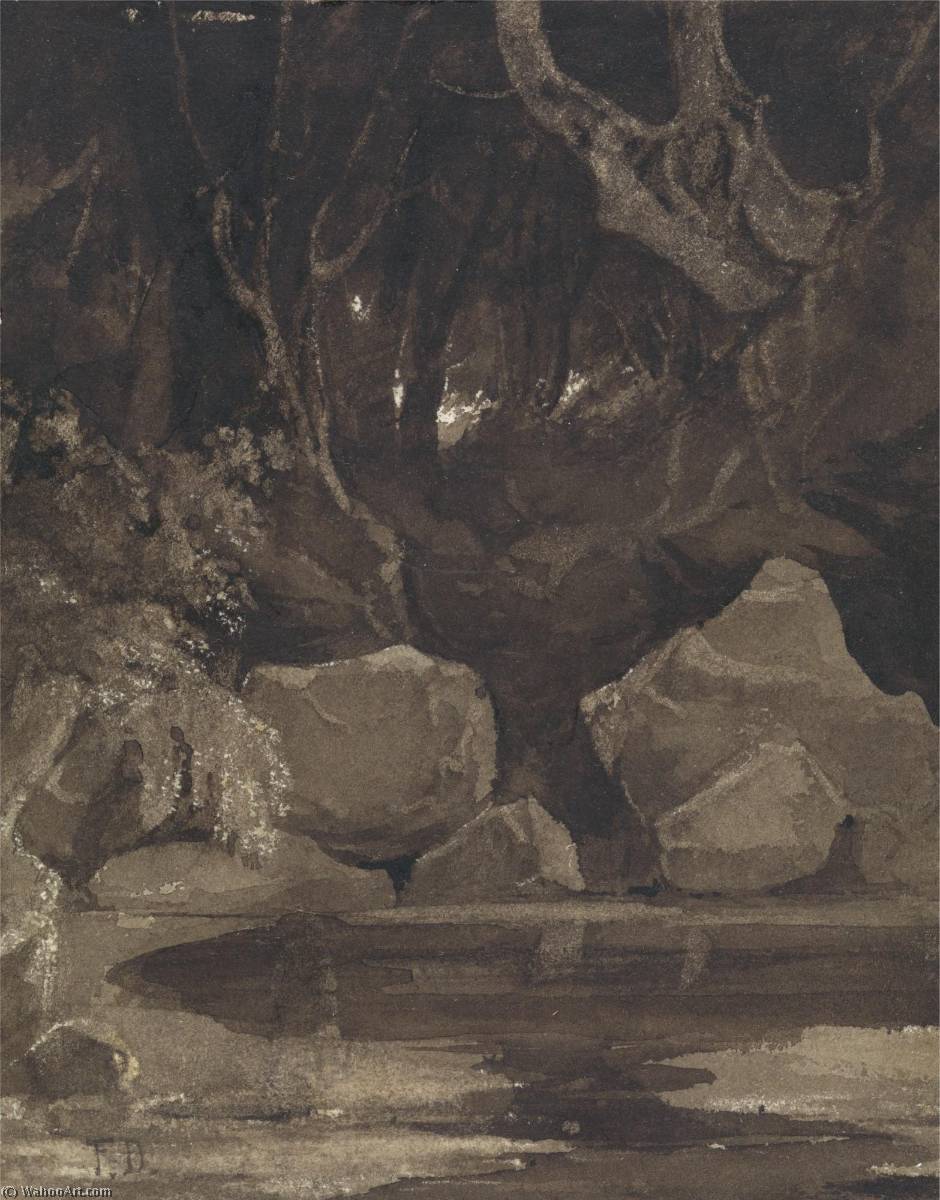
Explore James Francis Danby’s ‘The Haunted Wood,’ a moody watercolor landscape of rocky streams & ancient roots. A masterpiece of realism & atmospheric perspective, evoking tranquility & mystery.
Explore the dramatic Romantic landscapes of James Francis Danby (1793-1861). Discover his imaginative scenes, Byronic themes & influence on British art!
Explore British art's evolution at the Yale Center for British Art! From Hogarth to Turner, discover masterpieces in a Louis Kahn-designed space—a hub for scholarship and vibrant exhibitions.
James Francis Danby: Echoes of Romantic Gloom in ‘The Haunted Wood’
James Francis Danby (1793-1861), a name often overshadowed by Turner and Martin, nevertheless carved out a distinctive place within the British Romantic movement—a movement obsessed with sublime landscapes and emotionally charged narratives. His painting, “The Haunted Wood,” exemplifies this aesthetic perfectly, presenting a scene of brooding beauty that speaks to the anxieties and aspirations of its time while retaining an enduring power of visual expression. More than just a depiction of nature, Danby’s work is imbued with symbolic resonance, inviting contemplation on themes of isolation, decay, and the confrontation between humanity and untamed wilderness.
A Landscape Steeped in Atmospheric Perspective
“The Haunted Wood” immediately captivates viewers with its dominant palette—a symphony of browns, grays, and muted greens that coalesce into an oppressive yet mesmerizing atmosphere. Danby skillfully employs atmospheric perspective, layering shades to convey depth and recession. The jagged edges of dark rocks dominate the foreground, sharply contrasted against the smoother surfaces of moss-covered stones further back in the composition. These rocky formations are punctuated by thick, branching roots—a motif recurrent throughout Danby’s oeuvre—that ascend towards the upper portion of the canvas, creating a vertical axis that draws the eye upwards into the shadowed recesses of the woodland. The artist's meticulous attention to detail captures the textures of bark, stone, and foliage with remarkable accuracy, fostering an immersive experience for the observer.
Watercolor Technique: Softening Reality’s Edge
Danby’s chosen medium—watercolor—further enhances the painting’s ethereal quality. Unlike oil paints which offer immediate brilliance and solidity, watercolor allows for gradual blending and subtle tonal shifts, mirroring the diffused light of a misty forest floor. The artist utilizes wet-on-wet technique extensively, applying pigment to damp paper and allowing it to bleed into adjacent areas—a technique that lends itself beautifully to capturing the hazy luminescence characteristic of Romantic landscapes. This deliberate softness contrasts with the sharp delineation of forms, creating a tension between realism and imagination. It’s this juxtaposition that contributes significantly to the painting's emotional impact.
Romantic Symbolism: Confrontation and Transcendence
The scene depicted transcends mere topographical representation; it embodies core tenets of Romantic thought. The dark wood itself symbolizes the subconscious mind—a realm fraught with anxieties and unresolved emotions—while the towering roots represent resilience and enduring strength amidst adversity. Danby’s depiction of a solitary figure, barely discernible amongst the rocks and foliage, underscores the theme of human insignificance in the face of nature's grandeur. Yet, simultaneously, the upward gaze suggests an aspiration for transcendence—a yearning to connect with something larger than oneself and to find solace within the sublime beauty of the natural world.
A Legacy of Mood and Texture
“The Haunted Wood” stands as a testament to Danby’s mastery of watercolor and his profound engagement with Romantic ideals. Its enduring appeal lies not only in its exquisite rendering of landscape but also in its ability to evoke feelings of melancholy, contemplation, and awe—qualities that continue to resonate with audiences today. Reproductions of this evocative artwork offer an opportunity to bring a piece of Victorian Romanticism into the modern home, capturing the spirit of a bygone era while celebrating the enduring power of artistic vision.