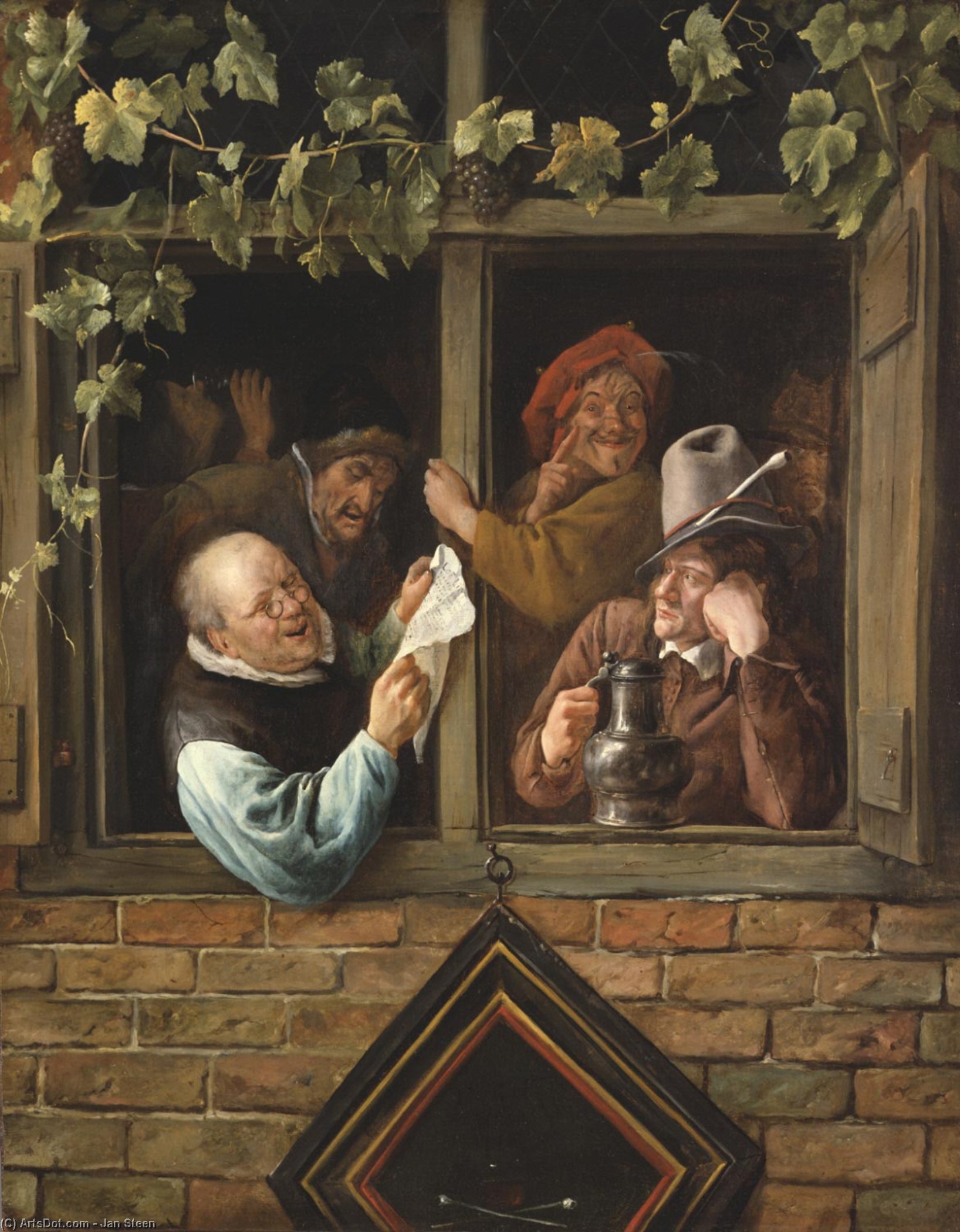
A Window into the Golden Age
In the quiet, amber-hued atmosphere of a seventeenth-century interior, Jan Havickszoon Steen invites us to witness a moment of profound human connection. Rhetoricians at the Window is not merely a depiction of a gathering; it is a masterful window into the social fabric of the Dutch Golden Age. The scene unfolds with a group of at least nine individuals, their figures layered in a delicate dance of light and shadow, gathered around a luminous window. Some lean forward, captivated by something unseen in the world outside, while others remain anchored in the warmth of the room, lost in the rhythmic ebb and flow of conversation. There is a palpable sense of shared breath and collective focus, as if the very air within the frame is thick with the weight of unspoken thoughts and the gentle murmur of debate.
Steen, a master of capturing the vibrant pulse of everyday life, employs a technique that breathes life into the mundane. Through his expert use of chiaroscuro, he directs our gaze across the composition, moving from the bright, inviting light of the window to the deeper, more intimate corners of the room. The placement of objects—a solitary cup resting on the left, and two bottles positioned with careful intent near the center and right—serves as more than mere still-life detail. These elements ground the social scene in a tangible reality, suggesting the comforts of hospitality and the slow, deliberate pace of a life lived through communal engagement. The brushwork, while precise enough to render the textures of fabric and glass, retains a fluid, painterly quality that mirrors the spontaneous energy of the gathering itself.
The Art of Observation and Moral Resonance
Beyond its surface beauty, this work resonates with the psychological depth for which Steen is celebrated. As a painter who often infused his genre scenes with subtle moral lessons, he utilizes this assembly of rhetoricians to explore themes of intellect, community, and observation. The window acts as a powerful symbol—a threshold between the private, contemplative interior and the expansive, unpredictable world beyond. By positioning his subjects at this boundary, Steen prompts the viewer to reflect on our own relationship with the external world: are we observers of life, or active participants in its unfolding drama?
For the discerning collector or interior designer, Rhetoricians at the Window offers an unparalleled opportunity to introduce a sense of historical gravity and intellectual elegance into a space. The painting’s rich, earthy palette and complex composition provide a sophisticated focal point that complements both classical and contemporary settings. It is a piece that does not merely decorate a wall; it commands a room, inviting guests to linger, to observe, and to engage in their own silent dialogues with the past. To possess a reproduction of this masterpiece is to bring home a fragment of history—a timeless celebration of the human spirit caught in a moment of quiet, communal grace.