The Drunken Revelry of Jan Steen: A Window into Dutch Domestic Life
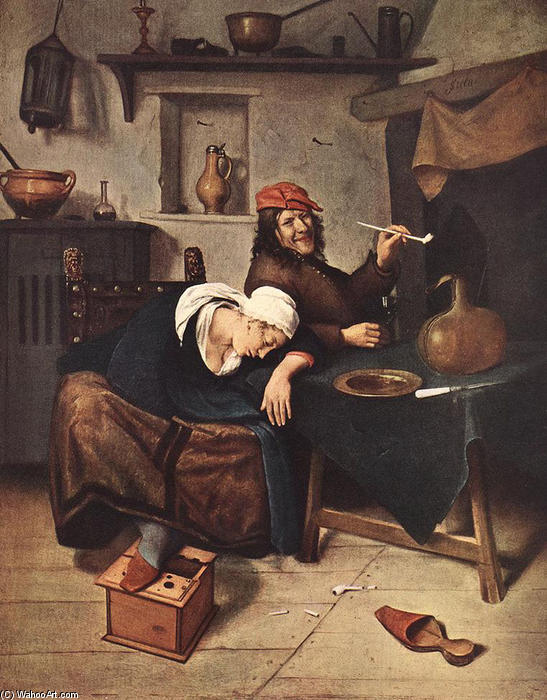
Jan Havickszoon Steen’s “The Drinker,” painted around 1660, isn't merely a depiction of a tavern scene; it’s a vibrant snapshot of everyday life in the bustling Netherlands during the Golden Age. More than just a charming illustration, this painting offers a remarkably astute and subtly satirical commentary on human behavior – a testament to Steen’s unique ability to capture the complexities of domesticity with an almost uncanny psychological acuity. The work, measuring a modest 39 x 30 cm, is deceptively simple in its composition yet profoundly rich in detail and emotional resonance.
Steen, born in Leiden in 1626, distinguished himself from his contemporaries by eschewing the grand narratives favored by many of his era. While other artists focused on mythological scenes or historical portraits, Steen dedicated his considerable talent to portraying the ordinary: farmers’ families gathered around a table, schoolboys disrupting lessons, and, as here, the boisterous gatherings within a local tavern. This deliberate choice established him as an innovator, prioritizing the portrayal of human experience with a level of realism and psychological depth rarely seen at the time. His style is characterized by a remarkable attention to detail – from the meticulously rendered bottles and tankards to the expressive faces of the figures – all contributing to a sense of immediacy and authenticity.
A Symphony of Color and Gesture
Steen’s technique is immediately striking, employing a rich palette of earthy tones punctuated by vibrant reds, yellows, and blues. The scene bursts with life, illuminated by an unseen light source that casts dramatic shadows and highlights the figures' gestures. Notice how Steen masterfully uses brushstrokes to convey movement – the spilling wine, the reaching hands, the drunken stagger – creating a dynamic and engaging composition. He wasn’t interested in idealized beauty; instead, he embraced the imperfections of life, capturing the messy reality of human interaction with remarkable skill.
The painting's composition is deliberately chaotic, mirroring the scene it depicts. Figures are crammed together, overlapping one another, creating a sense of crowded intimacy. This density isn’t haphazard; it reflects the close-knit nature of Dutch communities and the importance of social gatherings in daily life. The placement of objects – bottles, bowls, and scattered items – adds to the overall feeling of disorder and merriment.
Symbolism and Social Commentary
“The Drinker” is laden with subtle symbolism, offering a gentle critique of societal norms and human folly. The central figure, often identified as Steen himself alongside his wife, Margarete van Goyen (a daughter of the renowned landscape painter Jan van Goyen), embodies a relaxed acceptance of indulgence. However, observe the other figures – a man attempting to steal a bottle, a woman playfully pouring wine over another’s head, and a young boy attempting to drink from a tankard far too large for him. These actions aren't presented as scandalous but rather as commonplace occurrences within this particular social setting.
The presence of the two vases, one near the top left corner and another towards the center-right, adds an element of quiet contemplation amidst the revelry. They serve as a visual reminder of the fleeting nature of pleasure and the importance of moderation – a subtle moral lesson woven into the fabric of the scene. The painting’s overall tone is far from judgmental; rather, it invites viewers to observe and reflect on their own behaviors and those of others.
A Legacy of Human Observation
Jan Steen's “The Drinker” remains a captivating masterpiece, offering a rare glimpse into the everyday lives of 17th-century Dutch society. It’s a testament to his extraordinary ability to capture human nature with honesty and humor, cementing his place as one of the most original and influential artists of the Dutch Golden Age. Reproductions of this work continue to resonate today, providing a window into a bygone era while reminding us of the timeless appeal of observing – and laughing at – the quirks of human behavior. Consider acquiring a high-quality reproduction to bring this vibrant scene into your home or office—a delightful conversation starter and a poignant reminder of life’s simple pleasures.