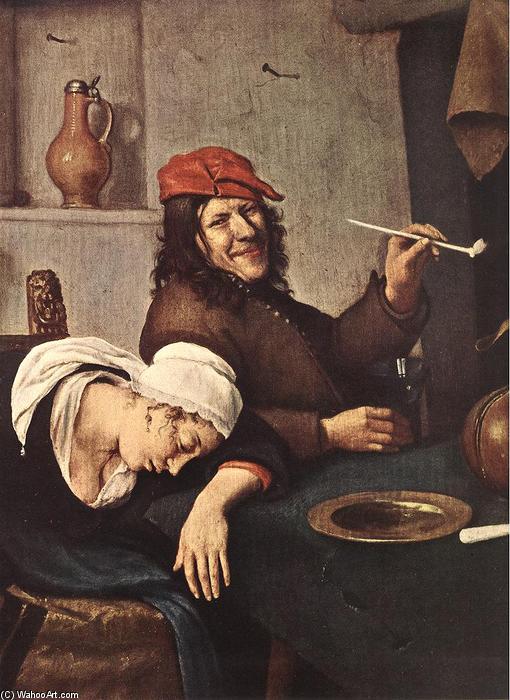
Explore Jan Steen's masterpiece 'The Drinker,' capturing everyday life with humor and psychological depth. Admire the vibrant colors and detailed depiction of a Dutch tavern scene.
Jan Steen (1626-1679) was a leading Dutch Golden Age genre painter known for lively, humorous scenes filled with psychological insight & moral themes. Explore his colorful depictions of everyday life and influence on Baroque art.
Explore the Hermitage Museum in St. Petersburg! Discover masterpieces from Renaissance to modern times within stunning historic palaces – a cultural journey awaits.
Jan Steen’s “The Drinker”: A Snapshot of Everyday Life Illuminated by Baroque Genius
Jan Havickszoon Steen (1626–1679) occupies a unique position within the Dutch Golden Age artistic landscape—a painter who eschewed grand narratives for an unflinching gaze upon the commonplace. Unlike many contemporaries preoccupied with mythological grandeur or regal portraits, Steen’s singular focus was on portraying scenes of domestic life: farmers' families, tavern gatherings, schoolrooms – all rendered with remarkable psychological depth and subtly didactic moral lessons. This distinctive stylistic choice solidified his reputation as one of the most original voices of his era and exerted a profound influence on Baroque art across Europe.
Born in Leiden, Netherlands, Steen’s artistic upbringing was somewhat unconventional for the period; he apprenticed under Hendrick Jacobsz. Stoffels, a painter celebrated primarily for portraits and landscapes, providing him with foundational skills while simultaneously exposing him to a stylistic tradition that would later permeate his own distinctive oeuvre. However, Stoffels' influence didn’t stifle Steen’s creativity but rather served as a springboard for developing an approach radically different from prevailing artistic conventions.
Steen’s technique was characterized by meticulous detail and vibrant color palettes—a hallmark of Baroque painting—though he deliberately avoided the theatrical grandeur favored by some artists. He employed oil paint on canvas, applying brushstrokes with considerable precision to capture textures and nuances that conveyed a palpable sense of realism. This painstaking attention to observation wasn't merely stylistic; it reflected Steen’s conviction that art should illuminate the human condition, presenting familiar scenes with unexpected insight into character motivations and social dynamics.
“The Drinker,” completed in 1660, exemplifies this ethos perfectly. The painting depicts a tavern interior populated by figures engaged in various activities—drinking, gambling, conversing—yet Steen’s genius lies not in depicting spectacle but in capturing the unspoken tensions and anxieties beneath the surface of everyday interaction. A man sits at a table with his wife, seemingly enjoying a drink, while another figure observes him intently. The woman leans against a wall, appearing lost in thought or perhaps simply exhausted by the day's exertions. These figures are surrounded by objects—a vase, bottles, and a shelf laden with curiosities—that contribute to the painting’s rich visual tapestry.
Symbolically, “The Drinker” speaks volumes about societal anxieties surrounding indulgence and moral responsibility. The watchful gaze of the second figure serves as a subtle reminder that actions have consequences, prompting viewers to contemplate the ethical dimensions of human behavior. Furthermore, Steen's masterful use of light and shadow enhances the dramatic effect, emphasizing the emotional states of the characters and creating an atmosphere of palpable tension.
Ultimately, Steen’s “The Drinker” transcends its depiction of a simple tavern scene; it is a profound meditation on human nature—a testament to his ability to transform ordinary moments into enduring symbols of psychological complexity and moral contemplation. It remains a cornerstone of Baroque art, demonstrating that true artistic brilliance resides not in grand pronouncements but in the quiet observation of the human experience.