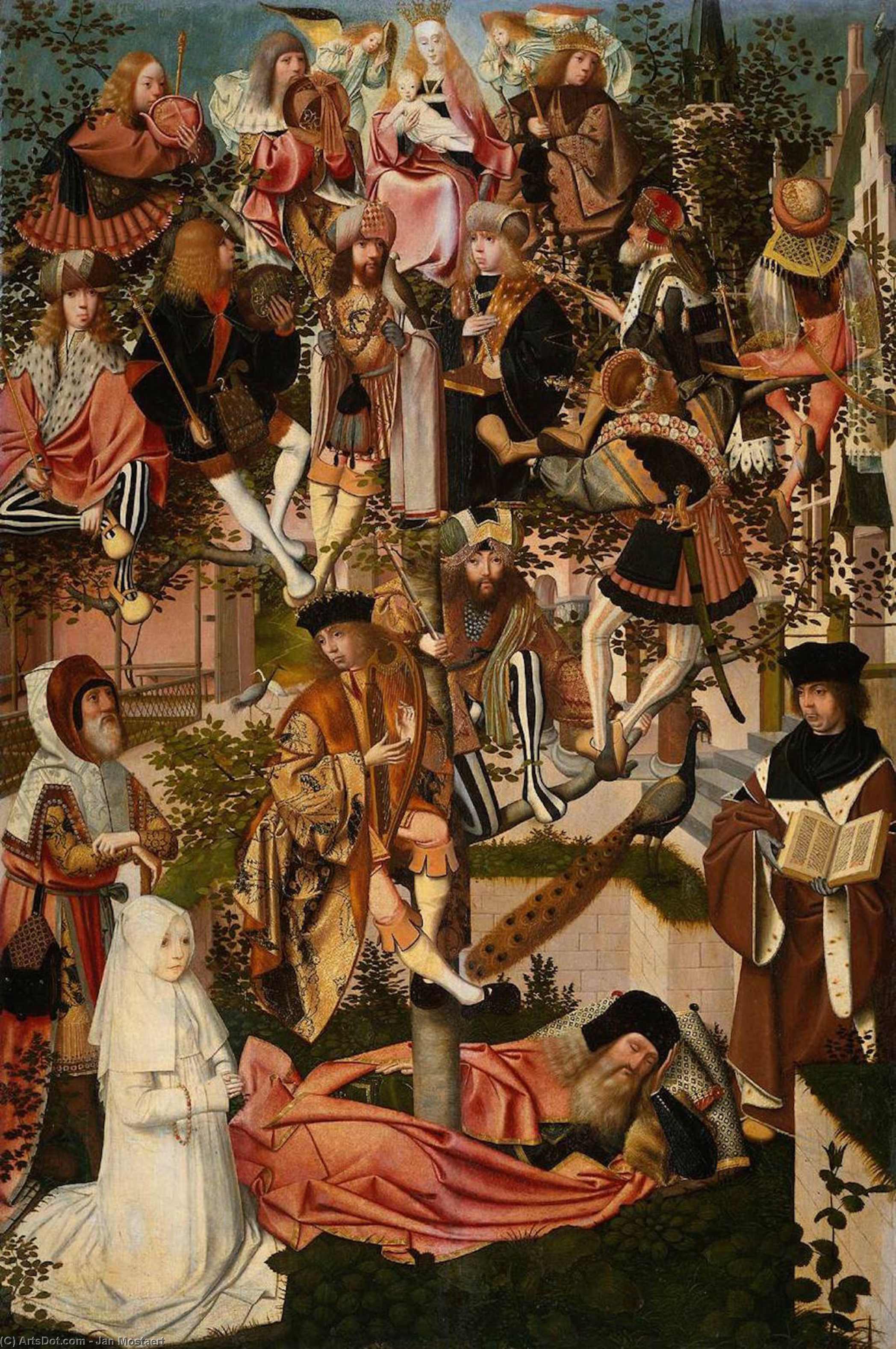
Jan Mostaert: A Synthesis of Medieval Tradition and Renaissance Innovation
Jan Mostaert (c. 1475 – 1552/1553) stands as a pivotal figure in the transition from late medieval to early Renaissance painting within the Netherlands, embodying a remarkable fusion of established artistic conventions with emerging stylistic trends. Unlike many contemporaries who slavishly adhered to prevailing fashions, Mostaert skillfully assimilated influences from earlier Haarlem masters like Geertgen tot Sint Jans while simultaneously responding to the evolving tastes of his aristocratic patrons—particularly Margaret of Austria—governor of the Habsburg Netherlands. His career unfolded amidst turbulent political and religious currents, yet he persevered in producing works that transcended mere imitation, achieving a level of sophistication characterized by meticulous detail and profound symbolic resonance.
- Early Haarlem Influence: Mostaert’s formative years were spent under the tutelage of Jacob van Haarlem, whose distinctive style—evident in his celebrated Altarpiece of St. Bavochurch—served as a cornerstone for Mostaert's artistic development. This connection established a crucial dialogue between medieval and proto-Renaissance aesthetics, shaping his initial compositional choices and rendering techniques.
- Margaret’s Patronage: Evidence suggests that Margaret of Austria commissioned Mostaert to create portraits, marking him among the most prominent artists serving the Habsburg court during this period. Although scholarly debate persists regarding the extent of his involvement with Margaret's entourage—challenging Karel van Mander’s account—the documented commissions underscore Mostaert’s position at the forefront of artistic innovation within a politically charged environment.
- The Landscape Motif: Perhaps Mostaert’s most distinctive contribution to Netherlandish painting lies in his pioneering exploration of landscape as an integral element of religious narrative. His “West Indies Landscape,” executed around 1520–25, represents a radical departure from traditional depictions of biblical scenes—incorporating fantastical elements and challenging conventional perspectival conventions. This ambitious undertaking reflects Mostaert’s fascination with the intersection of pagan and Christian cosmology, foreshadowing developments in Renaissance landscape painting that would soon dominate artistic discourse.
Style and Technique: Mannerism's Delicate Embrace
Mostaert’s oeuvre is predominantly characterized by Mannerist stylistic features—a trend that emerged in Antwerp during the early 1520s and swiftly disseminated throughout Europe. Unlike the idealized forms and harmonious compositions of High Renaissance painting, Mannerism prioritized expressive distortion and stylized elegance, reflecting anxieties about moral decay and spiritual uncertainty. Mostaert’s paintings exhibit elongated figures, exaggerated gestures, and subtly unsettling expressions—techniques that convey psychological depth and heighten emotional impact.
- Elongated Figures: The characteristic elongation of human forms—particularly evident in portraits and altarpiece scenes—is a hallmark of Mannerist style. This deliberate distortion serves to amplify emotional intensity and underscores the artist’s preoccupation with conveying inner turmoil and psychological complexity.
- Stylized Gesture: Mostaert’s figures are imbued with dynamic movement, achieved through stylized gestures that convey profound emotion. These exaggerated postures—often accompanied by dramatic drapery folds—communicate spiritual fervor and underscore the artist's commitment to capturing the essence of human experience.
- Oil Paint Application: Mostaert employed meticulous oil paint application techniques—characterized by layering and glazing—to achieve remarkable textural richness and luminous color palettes. This painstaking process allowed him to render surfaces with exceptional subtlety and nuance, enhancing visual impact and conveying a sense of atmospheric depth.
Symbolism and Narrative Depth: A Moralizing Vision
Beyond stylistic considerations, Mostaert’s paintings resonate deeply with symbolic meaning—reflecting the pervasive influence of humanist thought and theological debate during the Renaissance. Recurring motifs—such as musical instruments (lutes), books, crowns, and stylized representations of virtues and vices—serve to encode moral precepts and illuminate spiritual aspirations. The overarching narrative aims to instruct viewers on matters of faith and ethics—demonstrating Mostaert’s conviction that art could serve as a vehicle for conveying profound philosophical insights.
- Musical Instruments: Musical instruments—particularly the lute—appear frequently in Mostaert's portraits and altarpiece scenes, symbolizing harmony, contemplation, and spiritual enlightenment.
- Religious Imagery: The artist’s canvases are replete with depictions of biblical narratives—often imbued with allegorical symbolism—that underscore Christian dogma and moral responsibility.
- Emotional Resonance: Mostaert's paintings elicit a palpable emotional response from viewers—capturing moments of solemn contemplation, spiritual fervor, and psychological vulnerability. This profound engagement testifies to the artist’s mastery in conveying human experience through visual language.
Concluding Reflections: A Legacy of Artistic Innovation
Jan Mostaert’s enduring legacy resides not merely in his technical prowess—but also in his courageous embrace of Mannerist stylistic conventions and his unwavering commitment to exploring profound symbolic themes. His “West Indies Landscape,” coupled with his meticulously crafted portraits and religious scenes, stands as a testament to the transformative power of artistic innovation—demonstrating Mostaert’s ability to synthesize medieval tradition with Renaissance dynamism—leaving an indelible mark on the history of Netherlandish art.