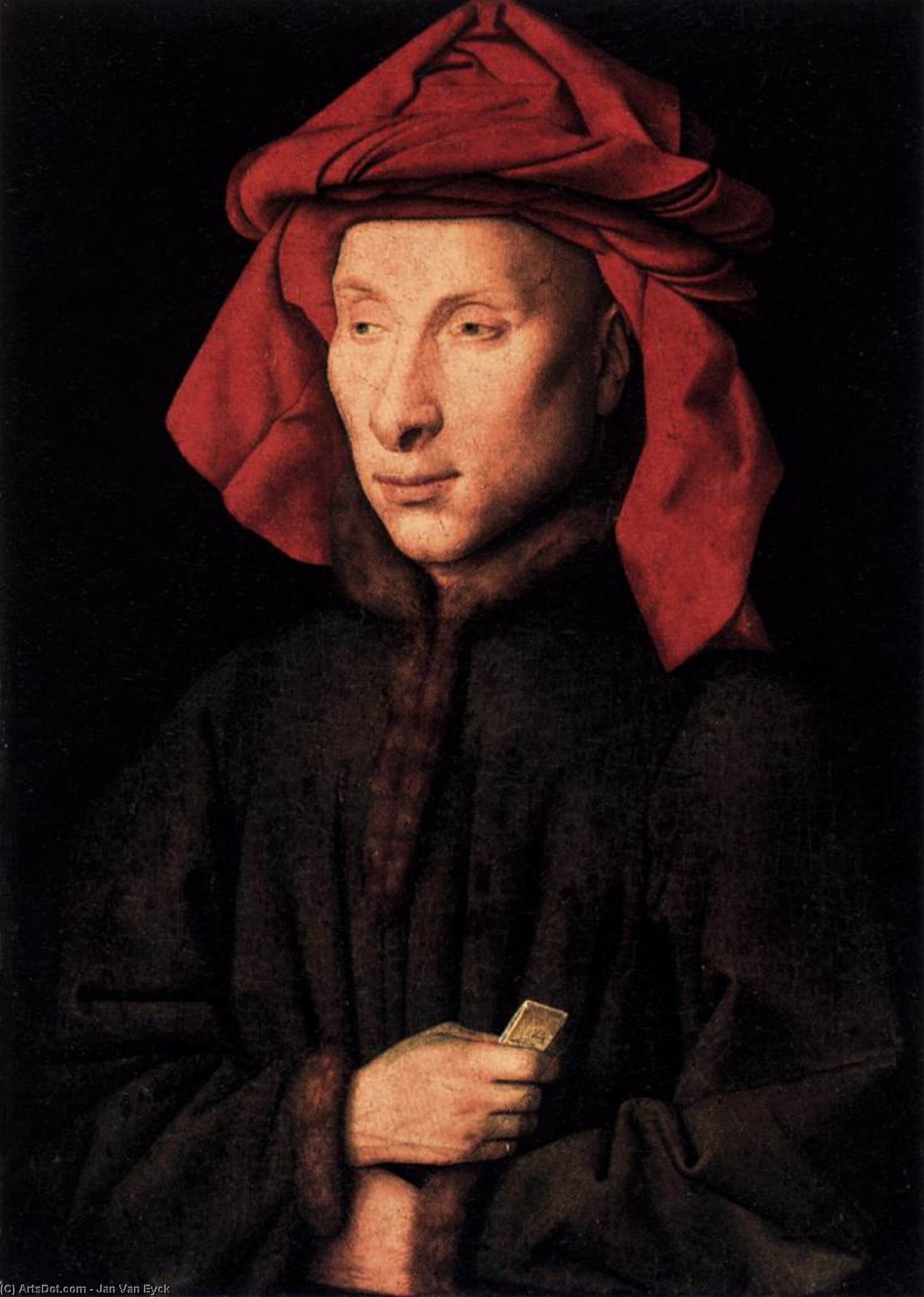
Portrait of Giovanni Arnolfini
Jan van Eyck, a preeminent figure of the Early Netherlandish painting movement and a master of the Early Northern Renaissance art, significantly impacted the art world in the 15th century. He is renowned, albeit erroneously according to some, for pioneering oil painting—a technique that added depth and realism to his works.
The Painting: A Masterpiece of Realism
The Portrait of Giovanni Arnolfini, painted by Jan van Eyck around 1438, is a masterpiece of realism. The painting measures 29 cm in height and 20 cm in width and is housed at the Gemäldegalerie in Berlin, Germany. It depicts Giovanni Arnolfini, a wealthy merchant from Lucca, Italy, who spent most of his life in Flanders. The portrait captures Arnolfini with remarkable detail, showcasing his facial features and attire. He wears a dark green robe with a brown fur lining, a red hat with a twisted bourrelet, and a patte hanging behind his head. The painting's realism is evident in the meticulous depiction of every element, from the folds of his clothing to the texture of the wall behind him.
Symbolism and Interpretation
The Portrait of Giovanni Arnolfini is not just a representation of wealth; it also contains symbolic elements. The red hat and bourrelet signify status, while the dark green robe indicates his profession as a merchant. The patte hanging behind his head may symbolize his connection to the Orient or his involvement in international trade. The painting's significance extends beyond its subject matter. It represents the evolution of oil painting techniques, which allowed for greater depth and realism. Jan van Eyck’s use of light and shadow adds dimensionality to the portrait, making it a landmark piece in the history of art.
Artistic Techniques
Jan van Eyck's mastery of oil painting is evident in the Portrait of Giovanni Arnolfini. The technique allows for rich colors and textures, creating a sense of depth that was unprecedented at the time. The use of chiaroscuro, a strong contrast between light and dark, enhances the three-dimensionality of the subject.
Conclusion
The Portrait of Giovanni Arnolfini by Jan van Eyck is a testament to the artist's skill and innovation. It not only captures the essence of its subject but also represents a significant milestone in the development of oil painting techniques. This masterpiece continues to fascinate art lovers with its realism, symbolism, and historical significance. For those interested in exploring more works by Jan van Eyck, Jan Van Eyck: Portrait of Giovanni Arnolfini and Jan Van Eyck: Portrait of Giovanni Arnolfini and his Wife (detail) are available on ArtsDot.