Jan van Eyck, a preeminent figure of the Early Netherlandish painting movement and a master of the Early Northern Renaissance art, significantly impacted the art world in the 15th century. He is renowned, albeit erroneously according to some, for pioneering oil painting—a technique that added depth and realism to his works.
The Painting: A Masterpiece of Realism
The
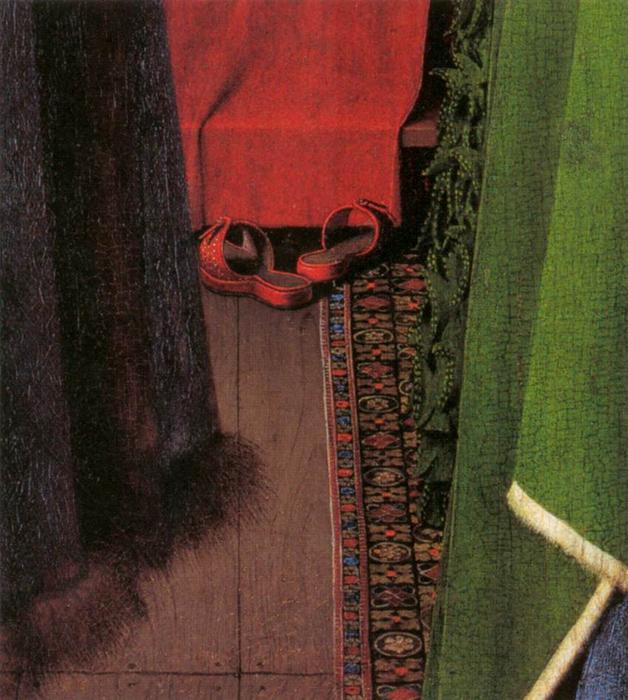
Portrait of Giovanni Arnolfini and his Wife (detail) (10) by Jan van Eyck is a testament to the artist's skill in capturing the essence of his subjects. The painting, dated 1434, is housed at the
National Gallery in London. It depicts Giovanni Arnolfini and his wife in their finest attire, standing in a lavishly decorated room that showcases their wealth. The scene is rich with details, including two pairs of shoes, a chair, a bench, and a vase. The man's shoes are visible on the left side, while the woman's shoes are on the right. This attention to detail highlights van Eyck's mastery in creating a sense of realism and depth in his work.
Technique and Innovation
Jan van Eyck utilized the technique of applying several layers of thin translucent glazes to achieve an intensity of both tone and color. The glowing colors help to highlight the realism and material wealth depicted in the painting. Van Eyck took advantage of the longer drying time of oil paint, compared to tempera, to blend colors by painting wet-in-wet to achieve subtle variations in light and shade. The medium of oil paint also permitted van Eyck to capture surface appearance and distinguish textures precisely. He rendered the effects of both direct and diffuse light by showing the light from the window on the left reflected by various surfaces. It has been suggested that he used a magnifying glass to paint the minute details such as the individual highlights on each of the amber beads hanging beside the mirror.
Historical Significance
The
Arnolfini Portrait is considered one of the most original and complex paintings in Western art. It is a full-length double portrait, believed to depict Giovanni di Nicolao Arnolfini and his wife, presumably in their residence at the Flemish city of Bruges. According to Ernst Gombrich, "in its own way it was as new and revolutionary as Donatello's or Masaccio's work in Italy. A simple corner of the real world had suddenly been fixed on to a panel as if by magic... For the first time in history the artist became the perfect eye-witness in the truest sense of the term." The portrait has been considered by Erwin Panofsky and some other art historians as a unique form of marriage contract, recorded as a painting. Signed and dated by van Eyck in 1434, it is, with the
Ghent Altarpiece by the same artist and his brother Hubert, the oldest very famous panel painting to have been executed in oils rather than in tempera.
Conclusion
Jan van Eyck's
Portrait of Giovanni Arnolfini and his Wife (detail) (10) is a masterpiece that showcases the artist's innovative use of oil paint and his ability to capture the essence of his subjects. The painting's historical significance, coupled with its intricate details and realism, makes it a work of art that continues to captivate audiences today. For those interested in exploring more works by Jan van Eyck or other artists from the Early Netherlandish movement,
ArtsDot offers high-quality handmade oil painting reproductions. Visit their website to discover a wide range of artistic masterpieces.
Early Netherlandish painting, a body of work by artists ac../..