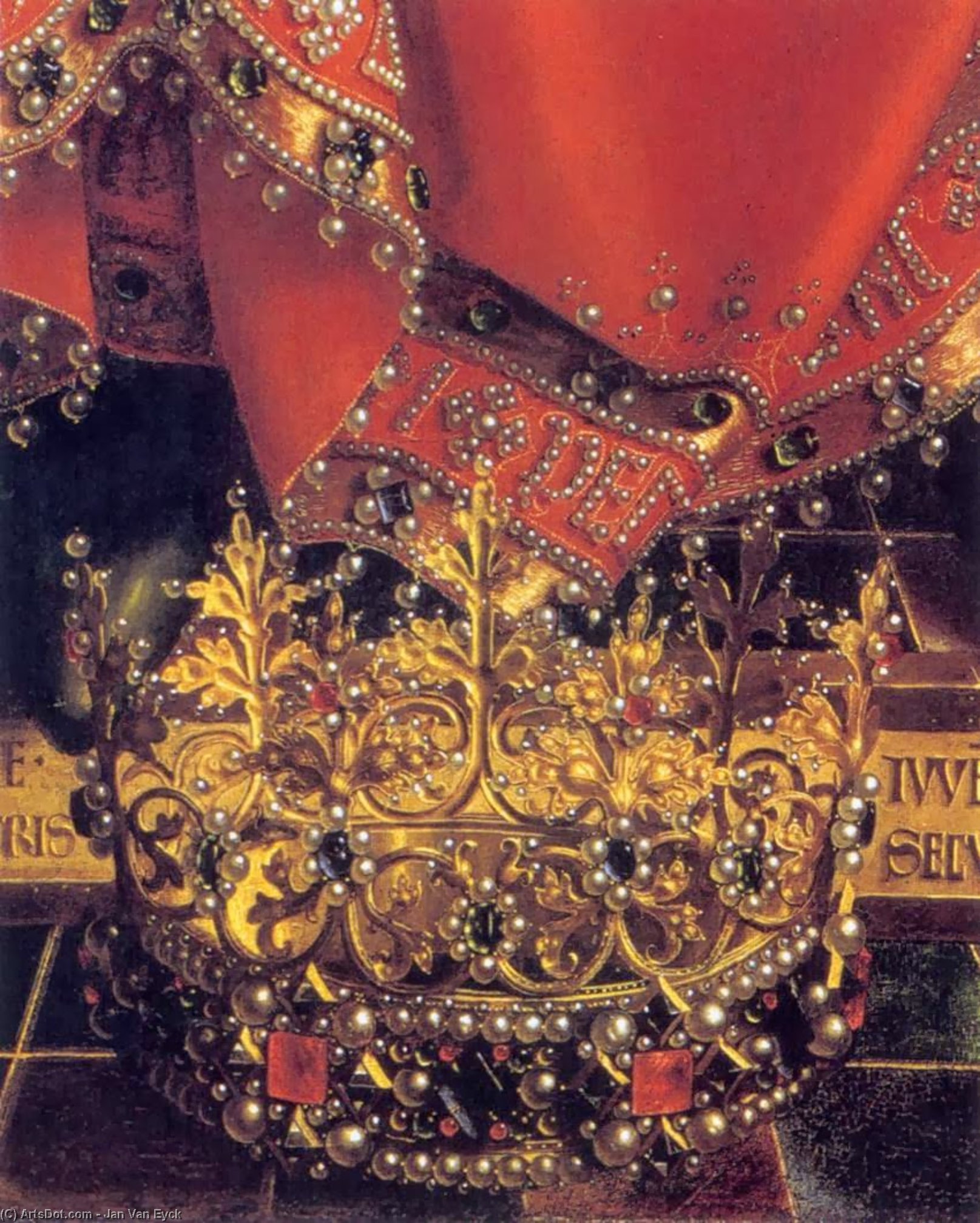
A Divine Revelation: Jan van Eyck’s ‘God Almighty’ from the Ghent Altarpiece
Within the hallowed halls of the St Bavo Cathedral in Ghent, Belgium, resides a monumental achievement – the Ghent Altarpiece. Commissioned by Jodocus Vijd and his wife Lysbette in 1426, this polyptych by Jan van Eyck isn’t merely a painting; it's a portal to a meticulously crafted world of faith, symbolism, and unparalleled artistic skill. The detail presented in ‘God Almighty,’ one of the altarpiece’s six panels, immediately commands attention – a radiant gold crown, adorned with an astonishing array of pearls and jewels, dominates the composition. This isn’t simply decoration; it's a visual representation of divine authority, radiating power and majesty. Van Eyck’s genius lies not just in his technical prowess but also in his ability to imbue inanimate objects – a crown, a bird, even a book – with profound meaning.
The scene itself is deceptively simple yet profoundly rich in symbolism. A regal bird, perched atop the golden crown, represents Christ as the “Son of God,” a common motif in Northern European art of the period. The background figures, rendered with Van Eyck’s signature meticulous detail, are not merely observers but participants in a sacred narrative. Two individuals, likely donors to the altarpiece, stand subtly in the distance, acknowledging the divine presence. A book, positioned prominently at the lower right corner, symbolizes scripture and the word of God – an essential element within the context of a religious commission.
The Dawn of Oil Painting: Technique and Innovation
What truly distinguishes ‘God Almighty’ – and the entire Ghent Altarpiece – is Van Eyck's revolutionary use of oil paint. While not definitively proven as *the* first, it’s widely accepted that this piece represents a pivotal moment in the development of the medium. Prior to this, artists primarily relied on tempera, which offered less vibrancy and flexibility. Oil paints, however, allowed for layering, blending, and subtle gradations of color – techniques that Van Eyck mastered with breathtaking precision. The resulting luminosity and depth are simply astonishing, particularly when viewed closely. The intricate detail, achieved through countless hours of painstaking work, is a testament to his dedication and skill.
Furthermore, the altarpiece’s structure itself was innovative for its time. Organized in two vertical registers, each with double sets of foldable wings, it offered a dynamic visual experience. When closed, the altarpiece presented a serene, contemplative scene; when opened, it revealed a complex narrative unfolding across multiple panels. This multi-layered approach engaged the viewer on both intellectual and emotional levels, inviting them to participate in the story.
A Bridge Between Eras: Historical Context
The Ghent Altarpiece stands as a crucial marker of transition – a bridge between the medieval world and the burgeoning Renaissance. Commissioned during a period of significant social and political change, it reflects both the enduring traditions of religious art and the emerging humanist ideals that would soon reshape European thought. The altarpiece’s meticulous realism, its focus on individual portraits, and its celebration of human dignity all foreshadow the artistic developments of the Renaissance.
The altarpiece's history is also marked by dramatic events. During the Reformation, the original ornate carved frame was destroyed, a devastating loss for this masterpiece. Despite these challenges, the Ghent Altarpiece has been meticulously restored and preserved, ensuring that its beauty and significance continue to inspire awe centuries later. Its current location within the Cathedral of St Bavo remains a testament to its enduring importance.
Bringing History Home: ArtsDot.com’s Reproductions
For art enthusiasts seeking to experience the grandeur and detail of the Ghent Altarpiece, ArtsDot.com offers exquisite handmade oil painting reproductions. These aren't mere copies; they are faithful recreations crafted by skilled artisans using traditional techniques, mirroring Van Eyck’s meticulous approach. Owning a reproduction allows you to bring this iconic masterpiece into your home or office, transforming any space into a sanctuary of art and history. Explore our selection today and connect with the legacy of Jan van Eyck.
View ‘God Almighty’ Reproduction | Learn More on Wikipedia | Explore Eve from the Right Wing