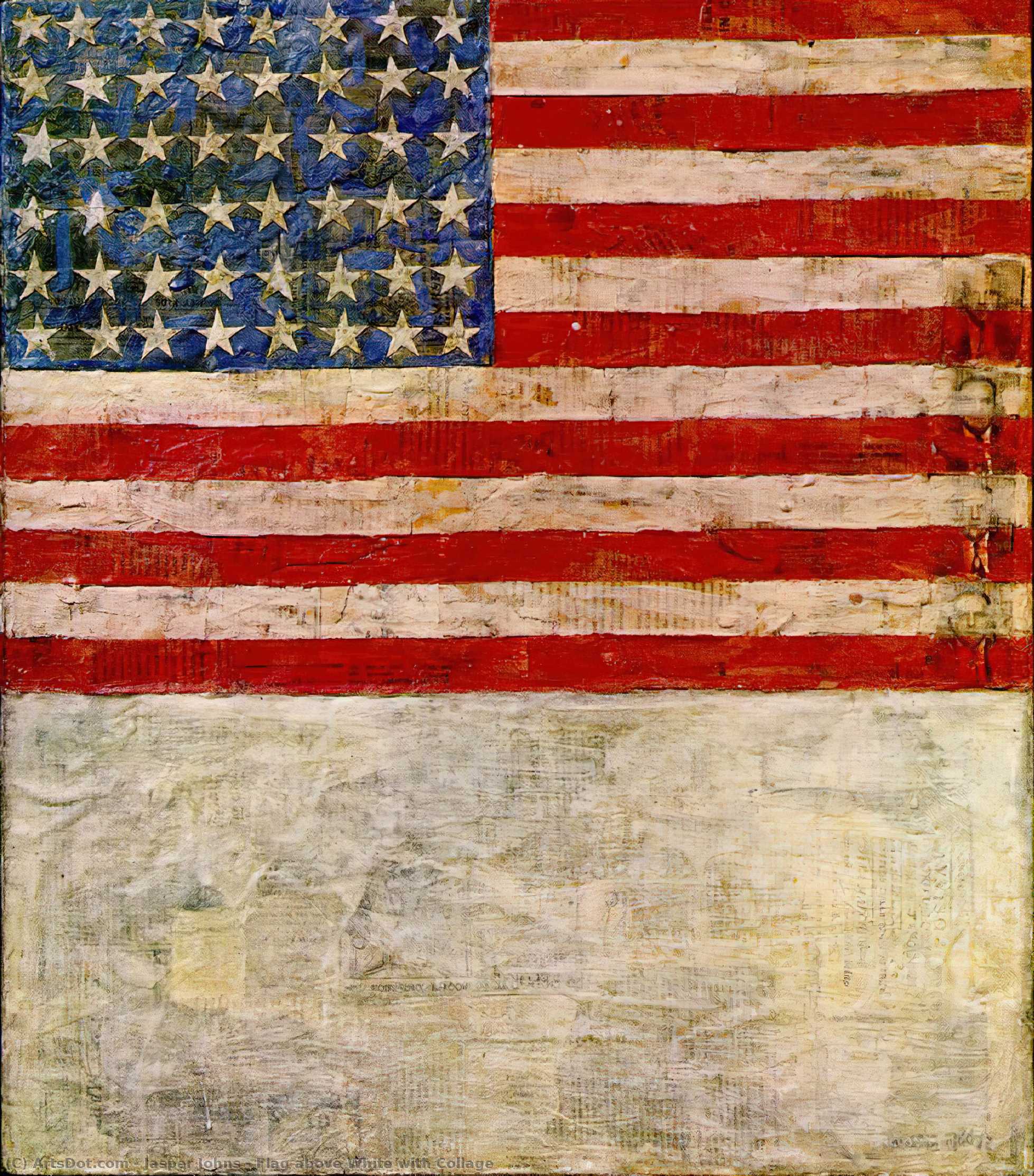
Deconstructing the American Icon: Jasper Johns’ *Flag above White with Collage* (1955)
Jasper Johns irrevocably altered the course of 20th-century art with his audacious reinterpretation of familiar imagery. *Flag above White with Collage*, created in 1955, is a pivotal work demonstrating this shift – a deceptively simple composition that belies layers of complex meaning and innovative technique. This painting isn’t merely *of* a flag; it's an investigation *into* the very nature of representation, symbolism, and American identity.
A Neo-Dada Response to Abstract Expressionism
Emerging in the mid-1950s, the
Neo-Dada movement served as a direct counterpoint to the prevailing emotional intensity of Abstract Expressionism. Artists like Johns rejected purely subjective expression, instead turning towards everyday objects and imagery – things readily recognizable but often taken for granted. *Flag above White with Collage* embodies this ethos perfectly. By choosing the American flag, an emblem steeped in national pride and ideology, Johns immediately introduced a powerful symbolic charge into his work. However, he doesn’t present it as a celebratory image; rather, he subjects it to scrutiny, fragmentation, and abstraction.
Technique & Materiality: Beyond the Surface
Johns' masterful technique is central to understanding this artwork. He employed
encaustic, an ancient painting method using heated beeswax mixed with colored pigments. This allowed him to build up layers of paint, creating a textured surface that reveals glimpses of underlying collage elements – fragments of newspaper and other materials embedded within the wax. The white background isn’t simply flat; it's a carefully constructed field of layered opacity. The flag itself is not rendered with precise realism but appears almost ghostly, its colors muted and slightly off-register. This deliberate lack of perfection contributes to the painting’s unsettling quality. The size of 51 x 59 cm makes it an intimate yet impactful work.
Symbolism & Interpretation: Questioning American Ideals
The symbolism within *Flag above White with Collage* is deliberately ambiguous and open to interpretation. The flag, traditionally a symbol of freedom, unity, and patriotism, is presented in a fragmented state, suggesting perhaps the complexities and contradictions inherent in these ideals. The white background can be read as representing purity or emptiness, while the collage elements hint at the hidden histories and underlying realities beneath the surface of national identity. Is Johns celebrating America? Critiquing it? Or simply presenting an objective observation? The painting resists easy answers, prompting viewers to confront their own assumptions about American culture and symbolism.
Johns’ Artistic Legacy & Related Works
Jasper Johns' influence on subsequent art movements – particularly
Pop Art – is undeniable. His willingness to embrace commonplace imagery paved the way for artists like Andy Warhol and Roy Lichtenstein. Other significant works by Johns that explore similar themes include:
- *Grey Alphabets* (1956)
- *Flags I* (ULAE 128)
- *Three Flags* (1958)
- *Painting with Two Balls* (1960)
- *Flag on Orange Field* (1957)
- *Scott Fagan Record* (1970)
Emotional Impact & Contemporary Relevance
*Flag above White with Collage* evokes a sense of quiet contemplation and subtle unease. It’s not an overtly emotional painting, but its understated power lies in its ability to provoke thought and challenge conventional perspectives. In today's world, where national symbols are often contested and reinterpreted, Johns’ work remains remarkably relevant. It serves as a potent reminder that even the most familiar images can be imbued with new meaning through artistic intervention, prompting us to critically examine the narratives we tell ourselves about our history and identity. This piece is not just a historical artifact; it's a living dialogue about American ideals and their enduring complexities.