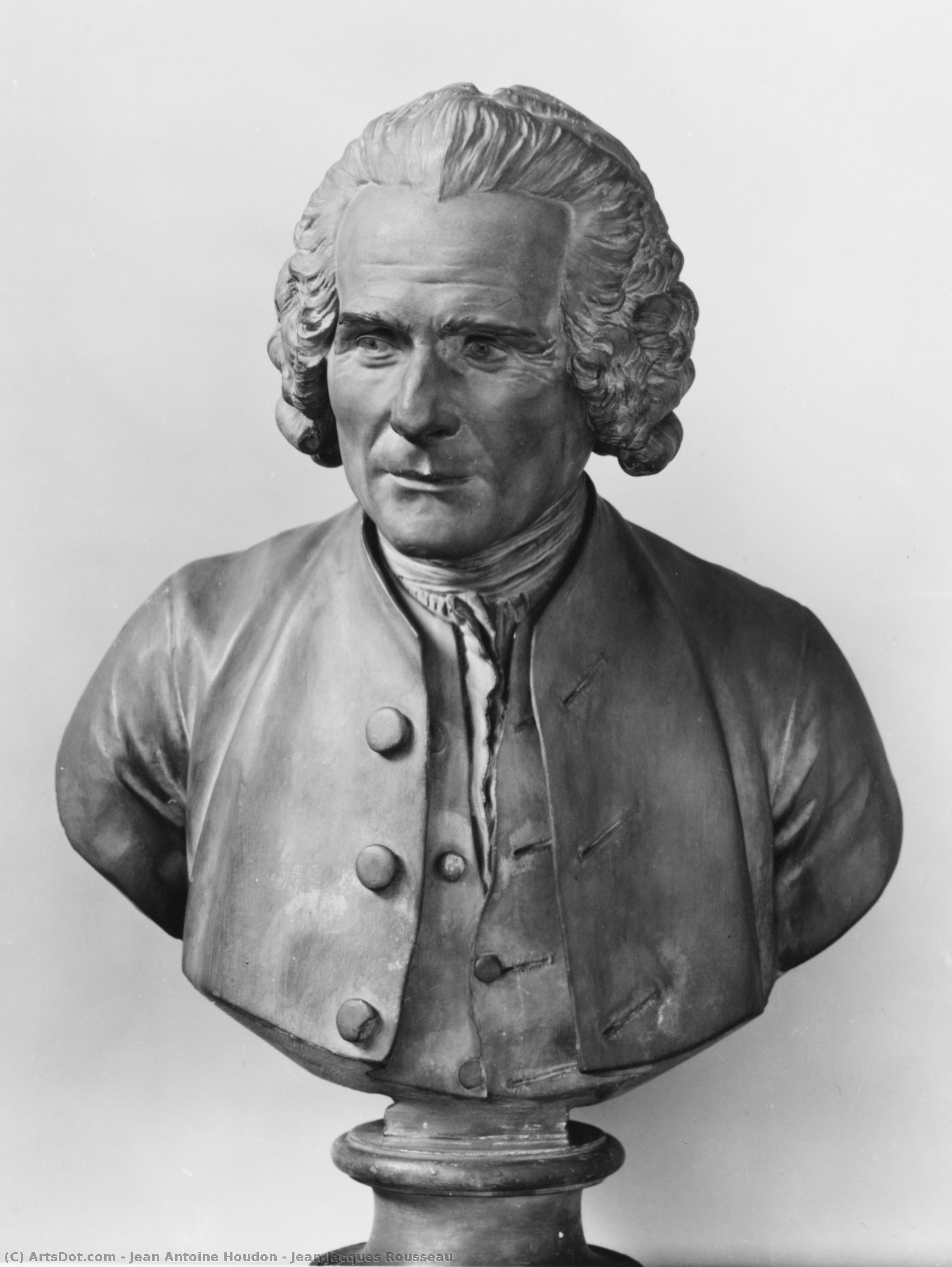
The Soul in Stone: Encountering Houdon’s Rousseau
In the quiet presence of Jean-Antoine Houdon’s 1778 portrait of Jean-Jacques Rousseau, one does not merely encounter a sculpture, but a profound dialogue with the Enlightenment itself. This masterful marble bust transcends the boundaries of traditional portraiture, moving beyond a simple physical likeness to capture the very essence of a man whose intellect reshaped the modern world. As the eye wanders over the weathered features of the philosopher, there is an immediate sense of meeting a mind in deep, perhaps even turbulent, reflection. Set against a somber, dark backdrop that pushes the luminous white marble toward the viewer, the work commands the space with a gravity that is both humbling and deeply moving.
Houdon, a virtuoso of the Neoclassical era, achieved here a feat of extraordinary technical precision. Eschewing the frivolous ornamentation of the preceding Rococo period, he embraced a clarity of form that mirrors the rationalism of Rousseau’s own era. Through the delicate application of contrapposto, Houdon imbues the static stone with a subtle, breathing vitality, suggesting a figure caught in a moment of transition. The sculptor’s mastery is most evident in the meticulous rendering of texture; the way light dances across the deep-set wrinkles of the brow and the soft folds of the skin conveys not just age, but the weight of experience and wisdom. Every chisel mark serves to document the passage of time, turning the cold marble into a living testament to human endurance.
A Monument to Intellectual Liberty
To understand this piece is to understand the heartbeat of the eighteenth century. Created during a period of intense intellectual ferment, the bust serves as an emblem of the philosophical ideals—liberty, equality, and fraternity—that would soon ignite revolutions across Europe and the Americas. Rousseau, the subject, was much more than a philosopher; he was a voice for the natural state of man, and Houdon captures that primal dignity with startling accuracy. The sculpture does not present a king or a conqueror, but a thinker whose power resided in his ideas rather than his titles.
For the discerning collector or interior designer, this work offers more than mere decoration; it provides an anchor of intellectual depth to any curated space. The emotional impact of the piece lies in its quiet authority. There is a certain melancholy in the subject's gaze, a reflection of the internal struggles and social critiques that defined Rousseau’s life. When placed within a study, a library, or a sophisticated gallery setting, the bust acts as a focal point of contemplation, inviting onlookers to pause and engage with the heavy, beautiful legacy of human reason.
Integrating such a profound work into a contemporary environment requires an appreciation for its historical weight. Whether presented as a centerpiece in a minimalist room or layered within a classical collection, Houdon’s Rousseau brings a sense of timelessness. It is a piece that speaks of permanence in an age of the ephemeral, making it an incomparable choice for those who seek to surround themselves with art that possesses both aesthetic brilliance and a soul.