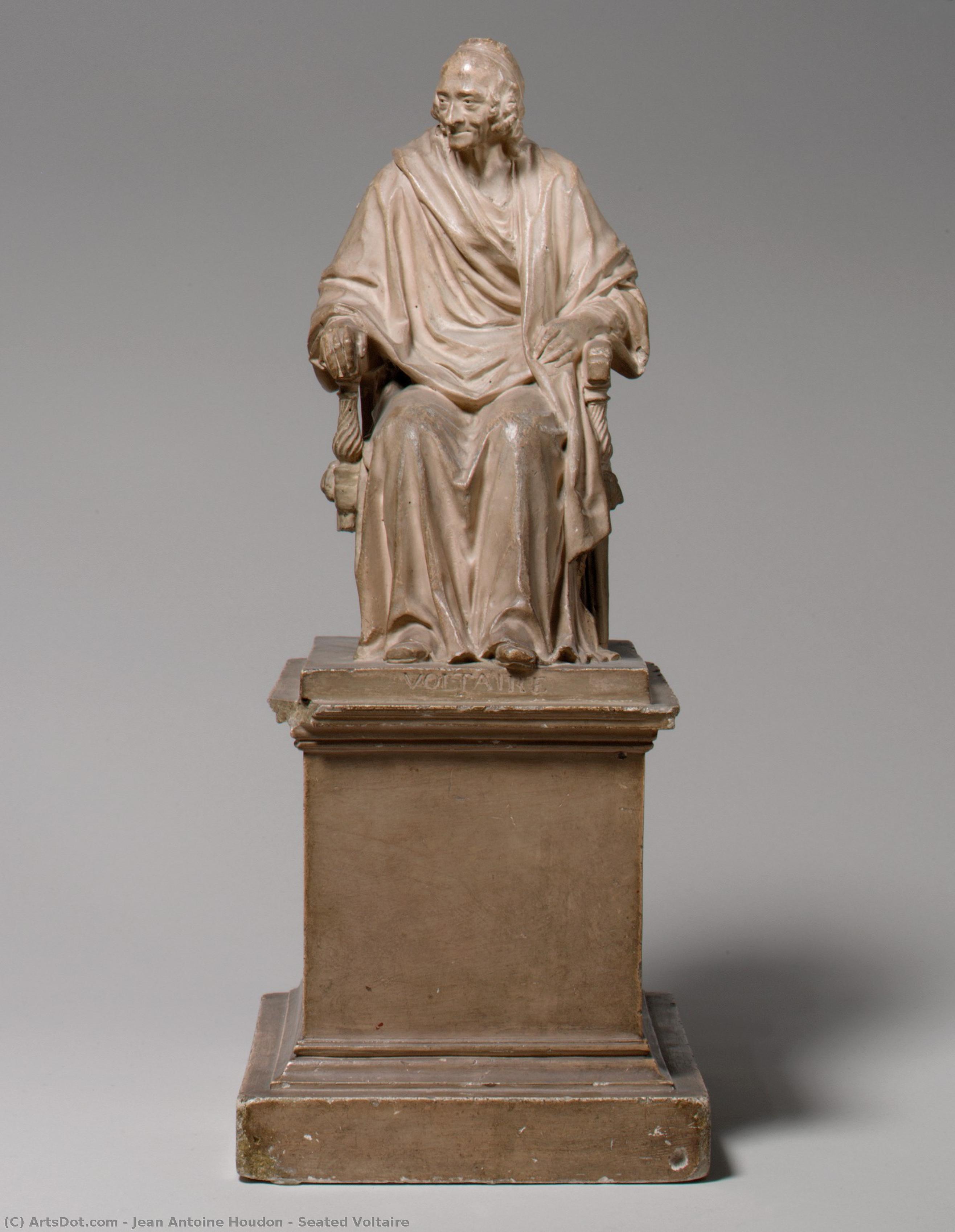
The Soul in Stone: Rediscovering Houdon’s Seated Voltaire
In the quiet, hallowed halls of art history, few works capture the electric tension of an era quite like Jean-Antoine Houdon’s "Seated Voltaire." Completed in 1778, this marble masterpiece is far more than a mere anatomical study; it is a profound distillation of the Enlightenment itself. As the philosopher Voltaire sat for the sculptor, he was not merely posing for a likeness, but participating in the creation of an enduring intellectual icon. Through Houdon’s masterful hands, the cold, unyielding medium of marble is transformed into a living, breathing testament to human reason and the restless spirit of inquiry that defined the eighteenth century.
To gaze upon this sculpture is to encounter a man caught in the very act of thought. The composition centers on the legendary thinker, seated with a dignity that commands the space around him. There is an intimate, almost whispered quality to the work, as if the viewer has stumbled upon a private moment of contemplation. Houdon, a sculptor who famously bridged the gap between the ornate flourishes of the Rococo and the disciplined grandeur of Neoclassicism, utilizes every ounce of his technical prowess to convey this psychological depth. The way the light catches the subtle folds of Voltaire’s robes and the furrowed brow of his forehead creates a silent dialogue between the stone and the spectator, inviting us to share in the philosopher's profound introspection.
A Masterclass in Neoclassical Precision
The technical brilliance of "Seated Voltaire" lies in Houdon’s ability to manipulate texture and line to evoke life. Working within his workshop, Houdon employed traditional sculpting tools to achieve an astonishing level of realism that borders on the miraculous. The marble surface is polished to a luminous finish, allowing for delicate tonal variations that mimic the softness of skin and the heavy drape of fabric. Every line is intentional; the sharp, precise contours of the facial features reflect the clarity of Voltaire’s intellect, while the smoother, flowing lines of the drapery provide a sense of classical elegance and movement.
For the discerning collector or interior designer, this piece offers a sophisticated study in monochromatic harmony. The palette—a serene arrangement of beiges, creams, and soft greys inherent to fine marble—provides a neutral yet visually rich anchor for any high-end space. It possesses a timeless quality that transcends fleeting trends, making it an ideal centerpiece for a library, a formal study, or a curated gallery wall. A high-quality reproduction of this work does not merely decorate a room; it elevates the entire atmosphere, infusing the environment with a sense of historical weight and intellectual prestige.
The Enduring Legacy of Enlightenment Thought
Beyond its aesthetic splendor, the sculpture serves as a powerful symbol of the values that shaped the modern world. In an age of revolution and radical new ideas, Houdon’s portrayal of Voltaire stands as a monument to the power of the human mind. The seated posture, stable and grounded upon its pedestal, suggests the enduring nature of truth and the permanence of philosophical legacy. There is a palpable sense of gravity in the work, a weight that is both physical—due to the density of the marble—and metaphorical, representing the heavy responsibility of wisdom.
Bringing a reproduction of "Seated Voltaire" into one's collection is an act of honoring this intellectual heritage. It serves as a daily reminder of the beauty found in clarity, the strength found in reason, and the artistry required to immortalize the human spirit. Whether viewed as a triumph of Neoclassical technique or as a window into the heart of the Enlightenment, Houdon’s work continues to inspire awe, offering a sophisticated touch of history and soul to the most refined contemporary interiors.