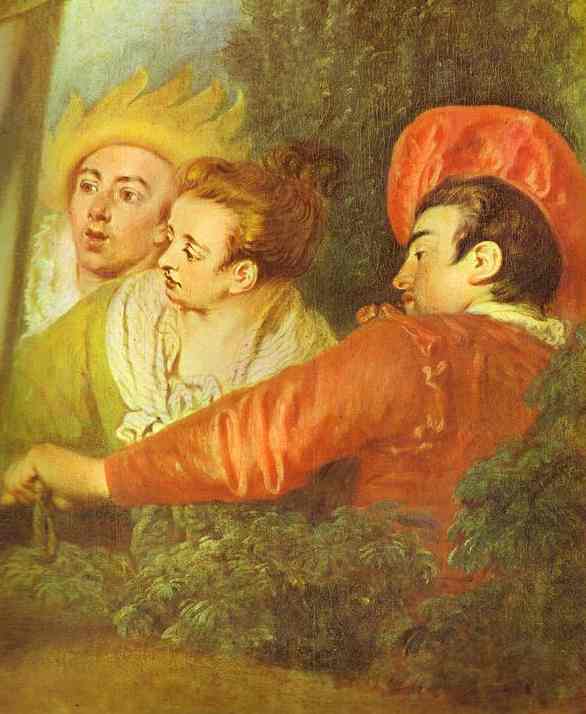
Jean-Antoine Watteau (1684-1721), a French Rococo master, captivated audiences with his ethereal 'fêtes galantes,' portraying aristocratic gatherings amidst lush landscapes and capturing the fleeting beauty of leisure and emotion. Admire iconic works like ‘The Country Dance’ and delve into his enduring impact on 18th-century artistic expression.
Discover Jean-Antoine Watteau (1684-1721), the French Rococo master! Explore his idyllic 'fêtes galantes,' theatrical scenes, & influence on 18th-century art. View masterpieces like 'The Country Dance' & learn about his legacy.
A Delicate Brushstroke: The Life and Art of Jean-Antoine Watteau
Jean-Antoine Watteau, a name synonymous with the blossoming Rococo style, emerged from the northern French city of Valenciennes in 1684. His brief but incandescent career irrevocably altered the course of eighteenth-century painting, shifting its focus from the grandeur and drama of the Baroque to an intimate world of elegance, leisure, and subtle emotion. Unlike many artists who followed a clearly defined path, Watteau’s journey was marked by initial struggles for recognition within the established art institutions of Paris. Born into a family of modest means—his father a master roofer—young Jean-Antoine displayed an early aptitude for drawing, initially sketching the colorful characters and bustling scenes of his hometown streets. This formative experience instilled in him a keen eye for observation and a fascination with everyday life, themes that would permeate his later work. His initial training under local artists honed his skills and nurtured his artistic sensibilities before he eventually ventured into the capital’s competitive art scene.
The Birth of Fêtes Galantes
Watteau's breakthrough came in 1703 with the premiere of ‘La Maison Dorée,’ a theatrical ballet that captivated Parisian audiences and established him as a leading figure in the Rococo movement. This ambitious undertaking signaled a decisive departure from Baroque conventions—the monumental scale, dramatic chiaroscuro, and heroic narratives characteristic of Caravaggio and Rubens—embracing instead a softer palette, diffused light, and an emphasis on decorative splendor. Watteau’s vision was to depict idealized gatherings of aristocrats indulging in carefree pursuits amidst picturesque landscapes, capturing the spirit of aristocratic leisure and social refinement. These ‘fêtes galantes,’ as he termed them, became his signature genre, transforming the ballet into a visual feast for the eyes.
Technique and Style: Illusionism and Pastel
Watteau’s artistic prowess lay primarily in his masterful manipulation of technique, particularly his pioneering use of pastel—a medium previously relegated to decorative applications—to achieve unprecedented levels of luminosity and atmospheric depth. Unlike oil paint, which relies on layering pigments to build up tonal values, pastel employs finely powdered pigment mixed with binder (typically gum arabic) applied directly onto paper or canvas. This method allowed Watteau to create shimmering surfaces that seemed to emanate light itself, capturing fleeting moments of beauty with remarkable precision. Furthermore, he skillfully employed illusionistic techniques—particularly trompe l'oeil—to blur the boundaries between painted and real space, creating an immersive experience for viewers. Consider ‘The Concert,’ where Watteau depicts musicians seated around a table in a richly ornamented salon, blurring the edges of furniture and architectural elements to heighten the sense of realism.
Symbolism: Arcadia Revisited
Watteau’s paintings are replete with symbolic references rooted in classical mythology and pastoral ideals—a deliberate reimagining of Virgil's Arcadia. The landscapes depicted in his ‘fêtes galantes’ are not merely scenic backgrounds but active participants in the narrative, embodying notions of harmony, innocence, and unspoiled nature. Birds, flowers, and musical instruments serve as emblems of virtue and pleasure, conveying messages of refinement and spiritual contemplation. Watteau’s meticulous attention to detail—from the delicate folds of fabric to the expressive gestures of his figures—underscores his belief in the transformative power of art to elevate human experience.
Emotional Impact: Elegance and Melancholy
Despite their outward celebration of aristocratic life, Watteau’s works possess a profound emotional resonance that transcends mere surface ornamentation. Beneath the veneer of gaiety lies an underlying current of melancholy—a poignant awareness of beauty's ephemerality and the inevitability of decay. Watteau’s figures convey subtle expressions of longing and wistfulness, inviting viewers to contemplate the complexities of human emotion. His paintings are not merely aesthetically pleasing; they provoke introspection and inspire contemplation about the enduring themes of love, loss, and mortality—a legacy that continues to captivate audiences centuries after his untimely death in 1721.