A Symphony of Rococo Grace
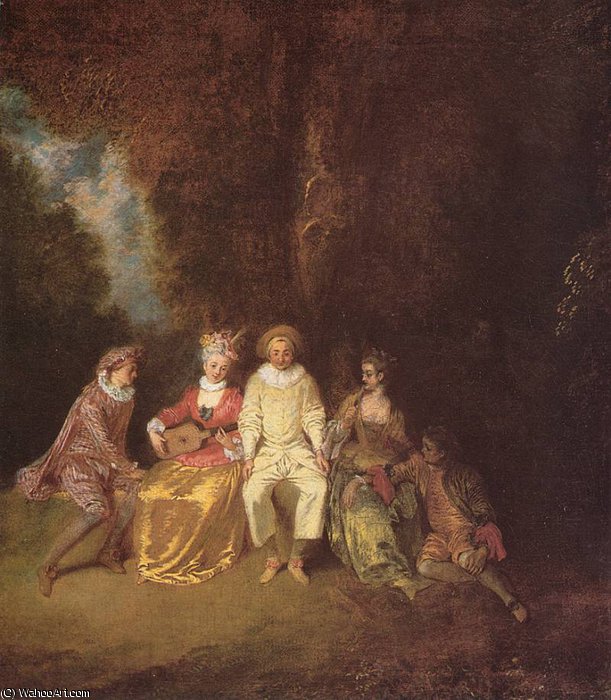
In the delicate dance of light and shadow that defines Jean-Antoine Watteau’s Pierrot Content, we find more than just a painting; we encounter the very heartbeat of the Rococo era. Completed during the early years of the eighteenth century, this masterpiece serves as a window into a world where the heavy, dramatic tensions of the Baroque have dissolved into a luminous celebration of leisure and subtle emotion. The scene unfolds within an idyllic, sun-dappled forest setting, where a group of figures gathers in a moment of quiet, social harmony. As one gazes upon the canvas, there is an immediate sense of joie de vivre—a joyful vitality that invites the viewer to step away from the rigors of reality and into a realm of pastoral elegance.
The composition is masterfully orchestrated to guide the eye through a landscape of soft textures and gentle interactions. A group of five individuals, nestled comfortably against the earth and beneath the sheltering canopy of a tree, engages in the quiet art of conversation. The presence of musical instruments, such as the violin resting near the center, suggests a soundtrack of melodic lightness that complements the visual rhythm of the piece. This is not a scene of grand historical conquest, but rather an intimate fête galante, a genre Watteau himself pioneered, which captures the fleeting beauty of aristocratic pleasure and the poetic charm of the natural world.
Technique and the Art of Atmosphere
Watteau’s technical prowess is evident in his ability to manipulate oil on canvas to achieve a sense of ethereal lightness. His brushwork, often described as delicate and fluid, avoids harsh outlines, allowing forms to emerge softly from the background. This technique creates a dreamlike atmosphere where the boundaries between the figures and their lush environment seem almost permeable. The color palette is quintessential Rococo: a sophisticated arrangement of pastel hues, shimmering silvers, and earthy tones that evoke the soft flickering light of an afternoon in a manicured garden.
For the discerning collector or interior designer, the emotional resonance of Pierrot Content lies in its profound duality. While the surface of the painting radiates tranquility and social ease, there remains an underlying layer of wistful melancholy—a characteristic "sweet sadness" that Watteau mastered so uniquely. This subtle tension provides the work with a psychological depth that prevents it from being merely decorative. It is a piece that commands attention not through volume, but through its ability to whisper stories of romance, contemplation, and the ephemeral nature of time.
An Enduring Legacy for Modern Spaces
Integrating a high-quality reproduction of this masterpiece into a contemporary interior offers an opportunity to introduce a sense of historical prestige and refined elegance. Whether placed in a sunlit drawing room or a sophisticated study, Pierrot Content acts as a focal point of tranquility. Its soft textures and organic composition harmonize beautifully with both classical and modern decor, providing a sophisticated counterpoint to the sharp lines of contemporary furniture.
To possess such a work is to hold a fragment of art history—a tribute to an era that valued wit, intimacy, and the exquisite beauty found in life's most fleeting moments. For those seeking to curate a space filled with inspiration, Watteau’s vision offers a timeless sanctuary of grace and poetic light.