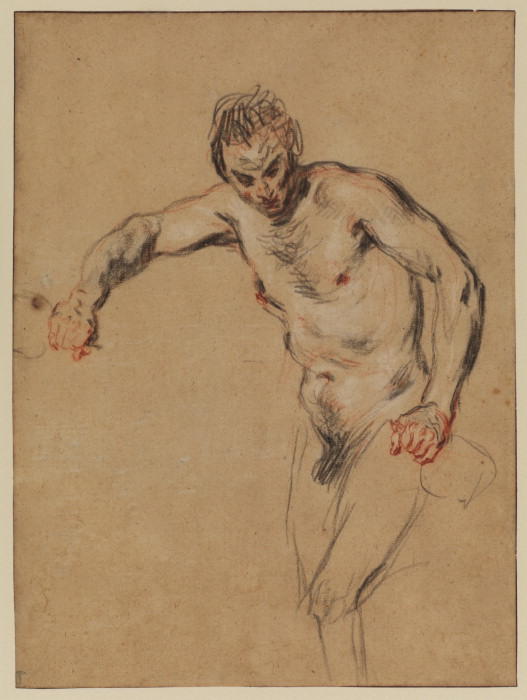
A Delicate Brushstroke: Jean-Antoine Watteau’s Satyr Pouring Wine – An Ode to Illusion
Jean-Antoine Watteau (1684–1721), a figure largely overshadowed by the grandeur of his contemporaries, nevertheless stands as one of the most influential artists of the Rococo era. Born in Valenciennes, France, Watteau’s early life was marked by modest beginnings—his father a craftsman specializing in roofing—yet he possessed an innate talent for drawing that swiftly propelled him beyond provincial obscurity. His formative years spent observing the vibrant tapestry of his hometown streets instilled within him a profound appreciation for everyday life and human interaction, themes which would become central to his artistic vision.
His initial training under local artists honed his observational skills and fostered an understanding of traditional techniques, preparing him for the ambitious challenges presented by Parisian art institutions. Unlike many artists of his time who adhered rigidly to established conventions, Watteau’s path was characterized by perseverance and a willingness to experiment—a quality that ultimately proved pivotal in shaping the distinctive aesthetic he championed.
The Fête Galante: A Revolutionary Vision
Watteau irrevocably transformed the artistic landscape of his era with his pioneering exploration of the “Fête Galante,” or Elegant Feast. Rejecting the weighty seriousness and theatrical grandeur favored by the Baroque, Watteau envisioned a world bathed in pastel hues—a realm where aristocratic leisure reigned supreme, populated by idealized figures engaged in graceful dances and intimate conversations.
- This genre departed from historical narratives and mythological allegories, prioritizing atmosphere and emotion over factual accuracy.
- It deliberately blurred the boundaries between reality and fantasy, creating a dreamlike illusion that captivated audiences and profoundly influenced subsequent artists.
- Considered to be Watteau’s magnum opus, “The Country Dance” exemplifies this revolutionary approach—a meticulously crafted tableau capturing a fleeting moment of aristocratic conviviality.
Technical Mastery & Symbolism's Subtle Language
Watteau’s technique was remarkably innovative for its time. He eschewed the heavy impasto favored by Baroque painters, opting instead for thin glazes and delicate brushstrokes that achieved unparalleled luminosity and subtlety. This meticulous attention to detail—evident in depictions of musculature and facial expressions—served not merely to represent form accurately but also to convey psychological nuance.
- The study of a satyr pouring wine, meticulously rendered by Watteau, exemplifies this artistic philosophy.
- As documented in The Frick Collection’s exhibition on Watteau, the painting's composition—characterized by curving lines and downward gazes—directly reflects the principles of Fête Galante aesthetics.
- Furthermore, the symbolic richness of the artwork speaks to broader themes of beauty, pleasure, and fleeting moments of grace – concepts deeply ingrained in Rococo culture.
An Enduring Legacy
Jean-Antoine Watteau’s influence extended far beyond his immediate contemporaries, shaping the artistic sensibilities of generations to come. His embrace of illusion and emotion paved the way for Impressionism and Surrealism—demonstrating the enduring power of a single artist to redefine artistic conventions and inspire profound aesthetic contemplation.