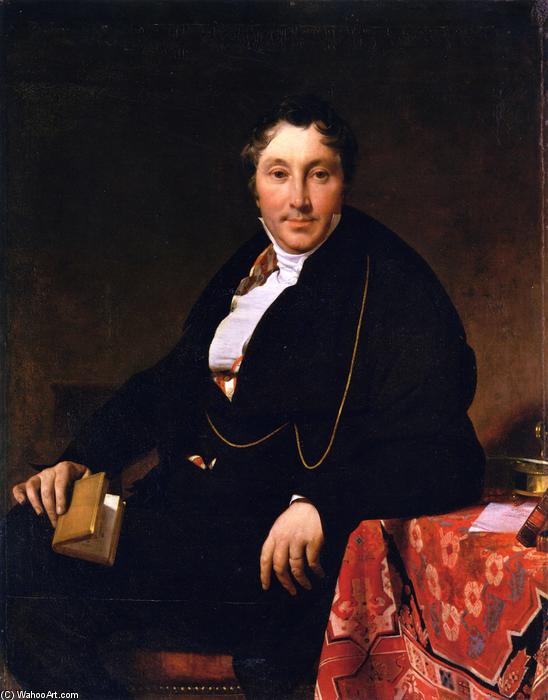
A Portrait of Dignified Reserve: Jean-Auguste-Dominique Ingres’s Jacques-Louis Leblanc
Jean-Auguste-Dominique Ingres's 1774 portrait, “Jacques-Louis Leblanc,” is more than a simple likeness; it’s a meticulously constructed tableau of Neoclassical elegance and restrained power. This painting, rendered in oil on canvas with the artist’s signature precision, offers a glimpse into the world of French society during the late 18th century – a world where formality, intellect, and social standing were inextricably linked. The work immediately commands attention through its balanced composition, dominated by the central figure of Leblanc himself, seated in an upholstered chair that speaks to both comfort and status. The subtle use of color—the deep browns and blacks of his attire contrasted with the creamy whites and beiges of his shirt—creates a visual harmony that reflects Ingres’s dedication to achieving perfect tonal balance.
Neoclassical Precision and Sculptural Form
Ingres, a staunch advocate for classical ideals, channeled the spirit of ancient Greece and Rome into his art. “Jacques-Louis Leblanc” exemplifies this approach through its emphasis on idealized form and precise draftsmanship. The subject’s face is rendered with an almost sculptural quality – every line, every curve, meticulously defined to convey both strength and serenity. Notice how Ingres avoids harsh outlines, opting instead for subtle gradations of tone that give the figure a remarkable sense of volume and depth. This technique, combined with the careful rendering of textures—the rich fabric of the suit, the plushness of the chair, even the delicate weave of the rug beneath him—demonstrates Ingres’s mastery of oil paint and his ability to create illusions of reality. The composition itself adheres strictly to Neoclassical principles: a central figure within a clearly defined space, creating a sense of order and authority.
Symbolism Within the Formal Arrangement
Beyond its technical brilliance, “Jacques-Louis Leblanc” is rich in symbolic meaning. The subject’s direct gaze, unwavering and confident, speaks volumes about his character – projecting an air of self-assuredness and perhaps even a touch of intellectual arrogance. The book he holds, resting on his lap, isn't merely a prop; it represents knowledge, learning, and the pursuit of wisdom—qualities highly valued in 18th-century society. The partially obscured figures in the background hint at a wider social context, suggesting Leblanc’s position within a complex network of relationships and influences. Even the red curtain, a bold splash of color against the muted tones of the room, adds to the painting's dramatic effect, drawing the eye towards the central figure.
A Window into an Era: Ingres’s Legacy
“Jacques-Louis Leblanc” offers a compelling window into the world of 18th-century France and the artistic sensibilities of Jean-Auguste-Dominique Ingres. Born in Montauban in 1780, Ingres dedicated his life to perfecting the principles of Neoclassicism, believing that art should be rooted in classical ideals. His meticulous attention to detail, his mastery of technique, and his unwavering commitment to formal composition have secured his place as one of the most influential artists of the 19th century. This portrait is a testament to Ingres’s enduring legacy – a celebration of beauty, intellect, and the power of art to capture both the outward appearance and the inner essence of its subject. A reproduction of this work would bring a touch of timeless elegance and intellectual gravitas to any interior space.